
Leaf-cutting ant Atta fervens
Atta fervens
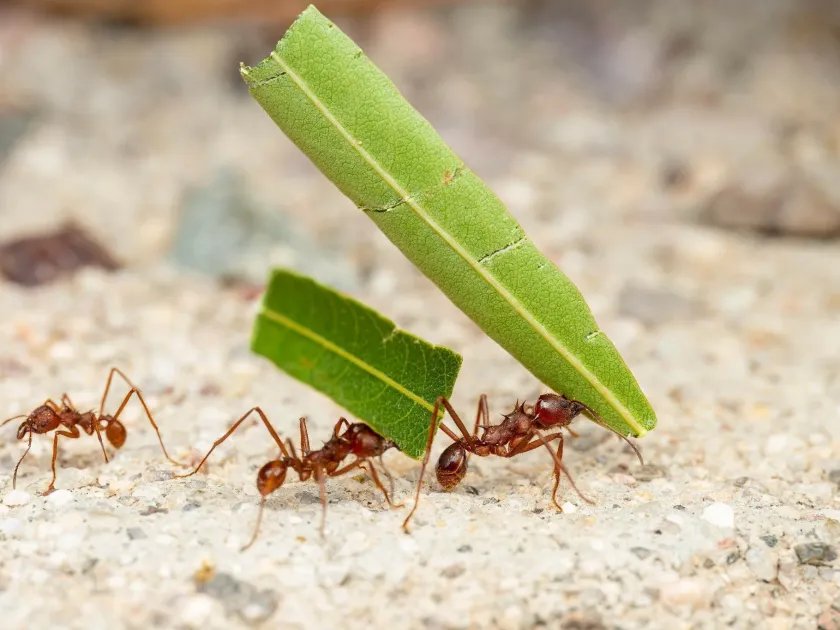
Description
How to identify
The Atta fervens is a species of fungus-growing ant belonging to the family Formicidae. These ants are known for their complex social structure and impressive underground architectural capabilities.
Morphologically, these ants are distinguished by their reddish-brown color and the presence of prominent spines on their thorax. Worker ants vary in size, from small nurses to large majors capable of defense.
The life cycle involves a queen that establishes a new colony and initiates the cultivation of a symbiotic fungus, which serves as the sole food source for the entire brood.
They operate in highly coordinated foraging missions, moving in long columns that can extend for hundreds of meters from the main nest to the foraging site.
Their subterranean nests are extremely extensive, featuring chambers for fungus cultivation, larval rearing, and refuse management, often reaching several meters in depth.
What it damages
Atta fervens is considered a major agricultural pest, capable of defoliating entire trees and shrubs in a single night. They feed on a vast range of crops, including citrus, coffee, and eucalyptus.
By cutting off large portions of leaf tissue, they cause severe photosynthesis inhibition, which weakens the plant and can lead to its eventual death if defoliation is repetitive.
In forest nurseries and orchards, they frequently destroy young saplings by girdling the stems, which prevents the transport of nutrients and causes systemic failure.
The economic impact is profound, as the ants do not only damage the harvest but also hinder the growth of new plantations, making land rehabilitation difficult.
Constant tissue loss forces the plant to divert resources from fruiting and growth, significantly reducing the yield and quality of the final agricultural product.
Signs of infestation
The most reliable sign of an Atta fervens infestation is the presence of cleared trails leading to the nest, where columns of ants can be seen carrying cut leaf segments.
Visual inspection of the plants reveals characteristic semi-circular cuts on the leaf margins, with the primary veins often left intact while the soft tissue is harvested.
Soil mounds or large nest entrances in the vicinity of the crop are clear indicators of the underground structure, which can be massive and interconnected.
Plant material found scattered along trails or rejected by the ants near the nest entrance is a typical sign of the fungus-gardening process occurring underground.
Rapid, overnight damage to foliage is a hallmark behavior, as the foraging force of a mature colony can involve thousands of individuals working simultaneously.
Control measures
Effective management of Atta fervens requires neutralizing the queen within the nest, as surface treatments are largely ineffective against the deeply buried colony.
The primary control method involves the use of toxic granular baits that the ants mistake for food and transport into the nest, where the poison eventually kills the entire colony.
Fumigation of the nest tunnels using specialized insecticidal gases is another reliable technique, especially when the main nest entrance can be identified and treated accurately.
Barrier methods, such as mechanical protectors or sticky substances on the trunks of trees, can provide temporary protection for high-value specimens in urban or orchard environments.
Integrated pest management strategies often emphasize early detection, as smaller, newly established nests are significantly easier to eradicate than mature, multi-year colonies.
Taxonomy
- Latin name
- Atta fervens
- Order
- Hymenoptera
- Family
- Formicidae
- EPPO code
- ATTAFV
Discussion
No discussions yet — be the first.