
Leafcutter ant
Atta cephalotes
Description
How to identify
The leafcutter ant Atta cephalotes is a member of the Formicidae family, renowned for its complex social structure and unique ecological role. These insects operate as a superorganism, with distinct castes specialized for foraging, defense, and garden maintenance.
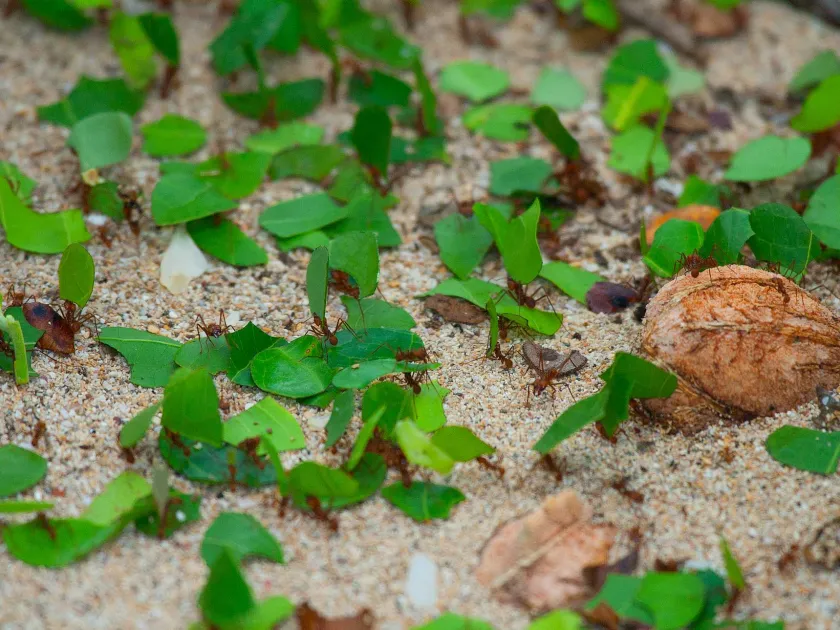
They are characterized by a reddish-brown body with prominent spines on their thorax. Soldiers possess massive mandibles used for protection, while smaller workers are exclusively focused on processing vegetation to feed their fungal symbionts.
The core of their biology is the obligate mutualism with fungi of the genus Leucocoprinus. Unlike other insects, they do not eat plant tissue directly, but use it as a substrate for fungal cultivation inside their underground chambers.
Their nests are massive subterranean structures that can span several meters across, housing millions of individuals. These colonies represent highly sophisticated engineering feats, complete with complex ventilation shafts and waste management areas.
The reproductive cycle begins with the nuptial flight, where queens establish a new colony. They carry a small piece of the original fungal garden in their infrabuccal pocket to ensure the colony's nutritional foundation from the very beginning.
What it damages
Atta cephalotes is considered one of the most destructive agricultural pests in the Neotropics. A single large colony can strip a medium-sized tree of its foliage in less than one night, leading to significant economic losses.
They target a vast range of plant species, including citrus, coffee, cocoa, and various legumes. Young plantations are particularly vulnerable, as the ants often target tender buds and emerging leaves, which can stunt or kill the plants.
The damage extends beyond leaf loss. By tunneling extensively beneath plant root systems, leafcutter ants can cause soil erosion and damage sensitive root structures, making trees susceptible to drought and secondary plant pathogens.
In addition to defoliation, the ants’ activities can disrupt the soil profile in orchards and agricultural lands, making it difficult to maintain irrigation and proper plant spacing on affected sites.
Persistent raiding by these ants can cause long-term productivity issues for farmers, as constant stress on trees weakens their immune systems and reduces fruit yield significantly over time.
Signs of infestation
The most distinctive sign of an infestation is the presence of clear, vegetation-free trails running from the nest toward the foraging target. These paths can extend for hundreds of meters through the forest or fields.
Leaves exhibit characteristic semi-circular or arc-shaped clippings. This pattern is unmistakable and acts as a primary diagnostic feature for identifying leafcutter ant damage in the field.
Visual observation of ants carrying leaf segments back to the nest is common, often earning them the nickname umbrella ants. This behavior is most pronounced during the cooler hours of the night when foraging activity peaks.
Large, loose soil mounds at the entrance of tunnel systems are clear indicators of a subterranean nest. These mounds are often composed of excavated material from the deep fungal chambers.
Sudden defoliation of specific plant rows or trees during a short period, while adjacent plants remain untouched, is a hallmark of localized leafcutter ant colony expansion.
Control measures
Effective control of Atta cephalotes requires targeting the colony as a whole, specifically the queen and the fungus garden. Surface-level sprays are rarely effective because they do not reach the deep chambers where the colony resides.
The most successful agricultural method involves the use of toxic baits. Workers carry the bait into the nest, where the toxicant is incorporated into the fungal garden, effectively eliminating the entire colony from within.
- Application of bait granules containing specialized slow-acting insecticides.
- Biological control through the introduction of specific entomopathogenic fungi.
- Installation of physical barriers on tree trunks to block access for foraging trails.
- Locating and treating the main ventilation shafts of the nest with fumigants.
Integrated Pest Management (IPM) programs emphasize regular field monitoring. Identifying and treating nests at an early stage of development is crucial to prevent the colony from reaching a size that causes irreversible crop damage.
Sustainable agricultural practices also include habitat management, where certain natural enemies of the ants are encouraged to thrive, helping to maintain natural population levels in the long term.
Taxonomy
- Latin name
- Atta cephalotes
- Order
- Hymenoptera
- Family
- Formicidae
- EPPO code
- ATTACE
Discussion
No discussions yet — be the first.