
Atta capiguara leaf-cutter ant
Atta capiguara
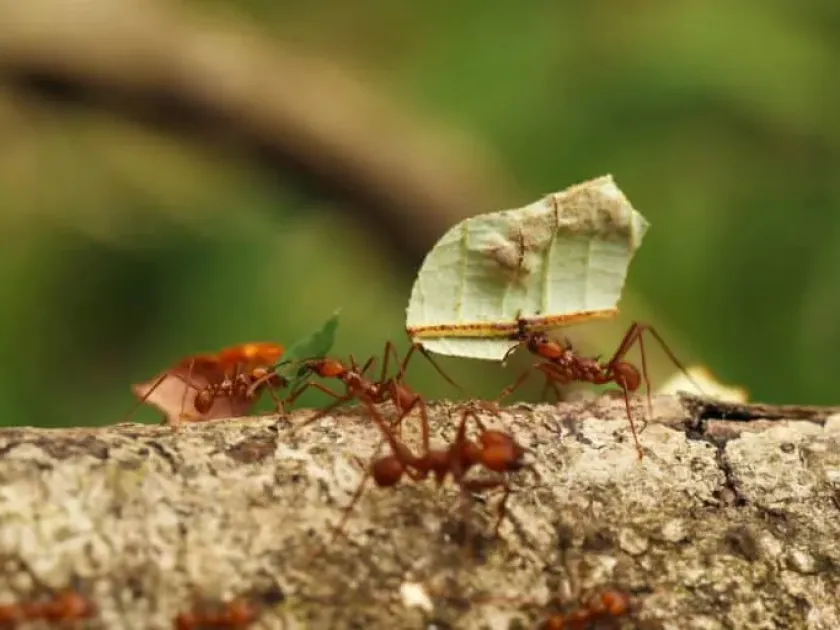
Description
How to identify
The leaf-cutter ant Atta capiguara belongs to the family Formicidae and is recognized as a significant agricultural pest in South America, particularly in grasslands.
This species is highly social and exhibits a complex caste system, including large queens, soldier ants with defensive roles, and foragers that actively collect vegetation.
The workers are identifiable by their spiny thoraxes and powerful mandibles, which are evolved specifically for slicing through tough, fibrous leaves of monocotyledonous plants.
Colonies are architectural marvels, extending deep underground with a vast system of chambers and tunnels designed for waste management and climate regulation.
Their lifecycle is intrinsically linked to the cultivation of a specific fungus, which serves as the sole food source for the ant larvae, necessitating constant forage gathering.
What it damages
The primary hosts for Atta capiguara are grasses, making them devastating pests for cattle ranches, especially on Brachiaria pastures and sugarcane plantations.
The ants relentlessly strip leaves from plants, causing severe loss of photosynthetic area, which leads to reduced yields and eventual death of the vegetation.
Soil structure is often compromised due to the immense volume of earth excavated during the construction and expansion of the colony's underground galleries.
By consuming the vegetation and disturbing the soil, these ants reduce the grazing capacity of pastures, directly impacting livestock productivity and farm economics.
They are particularly attracted to monocultures, and a single large colony can strip significant sections of a field in a very short period of time.
Signs of infestation
The most visible sign of an Atta capiguara infestation is the presence of well-defined, cleared trails leading from the nest to the active foraging area.
Farmers can identify damaged fields by the presence of defoliated patches where only stems remain, characterized by clean-cut edges on any remaining leaf fragments.
The presence of large mounds of soil, known as craters, surrounding the main nest entrances indicates a mature and highly active colony deep underground.
Observation of worker ants traveling in columns, often during dusk or night, is a clear indicator of a nearby nest actively raiding the local vegetation.
The rapid appearance of bare patches in otherwise healthy fields often points to the existence of an established nest nearby that has been feeding undetected.
Control measures
The standard and most effective method for controlling these ants is the use of toxic bait pellets that the workers transport deep into the nest, affecting the queen.
For the treatment to be successful, the bait must be highly attractive and palatable, ensuring that the foragers prioritize it over the natural vegetation.
Mechanical destruction of the nest, while appearing effective, usually fails to eradicate the queen because of the extreme depth at which she is located.
Integrated pest management strategies involve monitoring pasture boundaries and applying targeted treatments before the colonies grow to large, unmanageable sizes.
- Application of granular baits containing slow-acting insecticides.
- Use of entomopathogenic fungi as a biological control alternative.
- Regular field scouting to locate new colonies during the early stages of establishment.
Taxonomy
- Latin name
- Atta capiguara
- Order
- Hymenoptera
- Family
- Formicidae
- EPPO code
- ATTACA
Discussion
No discussions yet — be the first.