
Leaf-cutter ants
Atta
Description
How to identify
Leaf-cutter ants of the genus Atta are members of the Formicidae family (order Hymenoptera). They are highly organized insects that maintain complex social structures within their colonies.
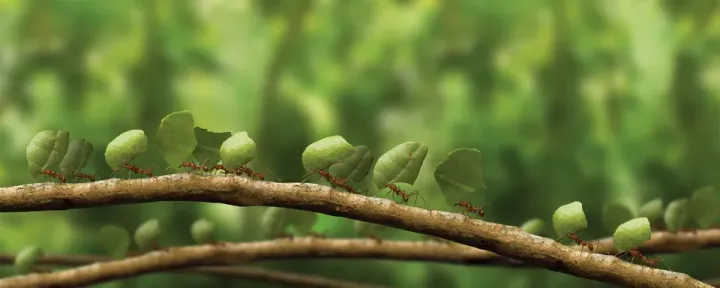
Worker ants possess powerful bodies and sharp mandibles, evolved specifically to cut through plant tissue. They are easily identified by their distinct behavior of carrying leaf fragments high above their heads.
Their colonies can reach massive proportions, extending several meters deep into the soil and housing millions of individuals. They exhibit pronounced polymorphism, with soldiers and workers differing significantly in size.
The biology of Atta is unique because they do not consume vegetation directly. Instead, they use cut leaves as a substrate to cultivate a symbiotic fungus, which serves as the primary food source for the entire colony.
In their native range, these ants are dominant phytophages in tropical and subtropical regions of the Americas, capable of significantly altering local ecosystems.
What it damages
Leaf-cutter ants are aggressive pests capable of destroying significant amounts of foliage in a short period. They prefer fresh, succulent leaves from a wide variety of agricultural crops.
They pose a severe threat to young trees and seedlings, as complete defoliation often leads to the death of the plant. Both fruit-bearing and ornamental species are subject to attack.
Commonly affected crops include citrus, coffee, cocoa, eucalyptus, and various vegetable species. Ants also remove flowers and buds, causing direct harvest losses.
The pest makes no distinction between wild and cultivated plants, often stripping entire plantations of leaves overnight, which leads to massive economic losses for farmers.
Because they harvest parts of leaves, the host plant experiences a drastic reduction in photosynthesis, leading to weakened root systems and increased susceptibility to diseases.
Signs of infestation
The first indicator of an Atta colony is the appearance of «ant trails» — cleared paths leading to the feeding area. Thousands of workers use these routes to transport material back to the nest.
Another telltale sign is the presence of characteristic leaf cuttings, which appear as precise semi-circles on the edges of leaves. Plants eventually lose all foliage, leaving branches bare.
Near the nesting site, one can find mounds of excavated soil. These mounds are often surrounded by layers of processed organic material and plant debris.
Ant activity is highest at night, making it easier to spot columns of ants with a flashlight. Rapid wilting of plants without visible stem damage is another common indicator of infestation.
A distinct smell of fermentation rising from the underground fungus chambers often signals the presence of a large, mature colony in the vicinity of agricultural land.
Control measures
Controlling Atta is challenging because the main colony resides deep underground, protected by the soil. Simple contact sprays are usually ineffective as they do not eliminate the queen.
The most effective strategy involves the use of toxic baits, which foraging workers carry deep into the nest. These toxins eventually destroy the fungal gardens and the entire colony.
Agrotechnical measures include the regular disruption of ant trails and the installation of physical barriers around valuable trees. Sticky bands can effectively prevent ants from accessing the tree canopy.
Contact insecticides are only effective when used against young, developing colonies. It is essential to apply these treatments carefully to avoid harming the surrounding soil ecology.
An integrated pest management (IPM) approach, combining biological agents and targeted chemical applications, yields the best results for long-term crop protection.
Taxonomy
- Latin name
- Atta
- Order
- Hymenoptera
- Family
- Formicidae
- EPPO code
- ATTASP
Discussion
No discussions yet — be the first.