
Rough harvester ant
Aphaenogaster rudis
Description
How to identify
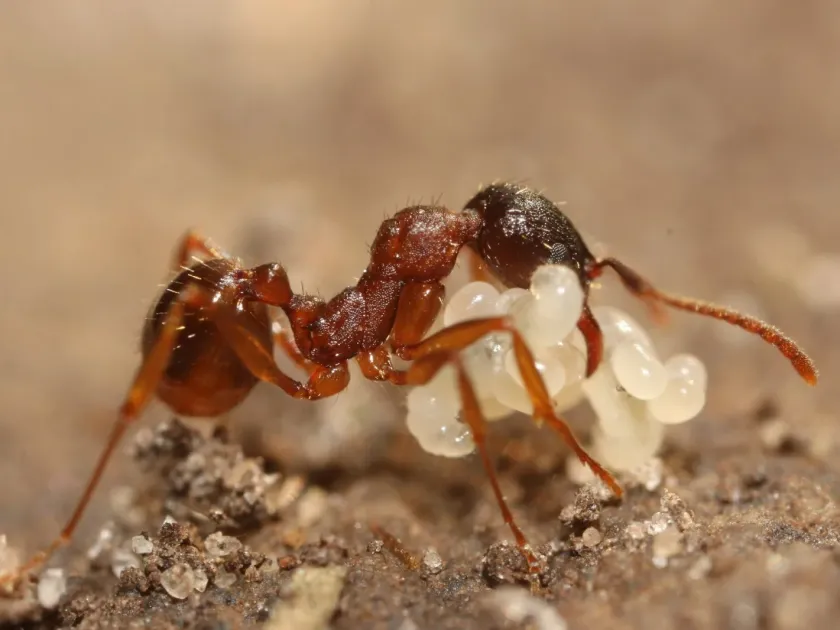
The rough harvester ant (Aphaenogaster rudis) is a member of the Formicidae family, order Hymenoptera. It is recognized by the coarse, sculptured appearance of its body surface.
These ants are typically reddish-brown to dark brown in color. Their heads are elongated, and their mandibles are specialized for gathering small objects, including seeds and organic debris.
Unlike some other harvester ants, this species prefers moist environments such as forest litter, decaying wood, or cool, shaded soil patches, making them common in garden and field edges.
The life cycle follows complete metamorphosis, consisting of egg, larva, pupa, and adult stages. New colonies are typically established by a single queen after a nuptial flight.
Colonies are generally moderate in size, but their foraging behavior can be highly efficient, leading to significant seed loss in localized areas if the population density is high.
What it damages
The primary agricultural damage caused by this species is the collection and removal of seeds shortly after planting, which can lead to poor crop establishment and thin stands.
By hauling seeds back to their nests for storage, these ants directly reduce the plant population. They are particularly attracted to oil-rich or starch-heavy seeds, common in various field crops.
Besides seed removal, the ants often damage germinating seedlings by feeding on the tender root tissue, which can result in wilting or stunted growth of the affected plants.
The soil disturbance caused by their tunneling activities can create air pockets around the seeds, causing them to dry out before germination can successfully occur.
They can also act as vectors for soil-borne pathogens, inadvertently transporting fungal spores into the vicinity of the seeds, increasing the risk of pre-emergence rot.
When it appears
Activity begins in the early spring as soon as soil temperatures reach a threshold that allows for foraging. This timing often perfectly coincides with spring sowing.
Foraging activity peaks during the late spring and early summer when the workers are busy provisioning the nest and feeding the developing brood with high-energy seeds.
During the hottest periods of the summer, foraging may become restricted to early morning or late evening hours to avoid desiccation and excessive heat.
Autumn brings a resurgence of activity as the colony works to store sufficient food reserves to survive the coming winter months in a dormant state.
The ants remain underground throughout the winter, inactive until the warmer temperatures of the next season trigger the restart of the cycle.
Signs of infestation
The most visible sign of their presence is the accumulation of excavated soil particles around the entrances of their nests, located in the middle of cultivated rows.
Empty seed hulls and husk fragments discarded near the nest entrances are clear evidence that the ants have been harvesting the seeds from the planted area.
Inconsistent or patchy germination across the field, often following a line corresponding to the location of subterranean nest tunnels, is a classic indication of an infestation.
Young seedlings in affected areas may show signs of damage to the base of the stem or the primary roots, leading to a loss of vigor compared to unaffected plants.
- Small mounds of loose soil in crop rows.
- Accumulated seed hulls near nesting holes.
- Poor seedling emergence patterns.
Control measures
Using insecticidal seed treatments is the most effective way to prevent ants from harvesting seeds, as the chemicals act as a deterrent during the germination phase.
Baited insecticides that are attractive to the ants can be used to control the colony. The worker ants carry the toxicant back to the nest, eliminating the queen and stopping the colony.
Mechanical cultivation and frequent hoeing disrupt the ants' shallow tunnels and nesting sites, discouraging them from establishing permanent colonies in crop rows.
Biological control agents, such as specialized entomopathogenic fungi, can be applied to the soil to suppress the ant population in a more environmentally friendly manner.
Maintaining a clean field environment by removing weeds reduces the alternative food sources for the ants, potentially limiting their interest in the primary crop.
Taxonomy
- Latin name
- Aphaenogaster rudis
- Order
- Hymenoptera
- Family
- Formicidae
- EPPO code
- APAGRU
Discussion
No discussions yet — be the first.