
Steingroever's ant
Anoplolepis steingroeveri
Description
How to identify
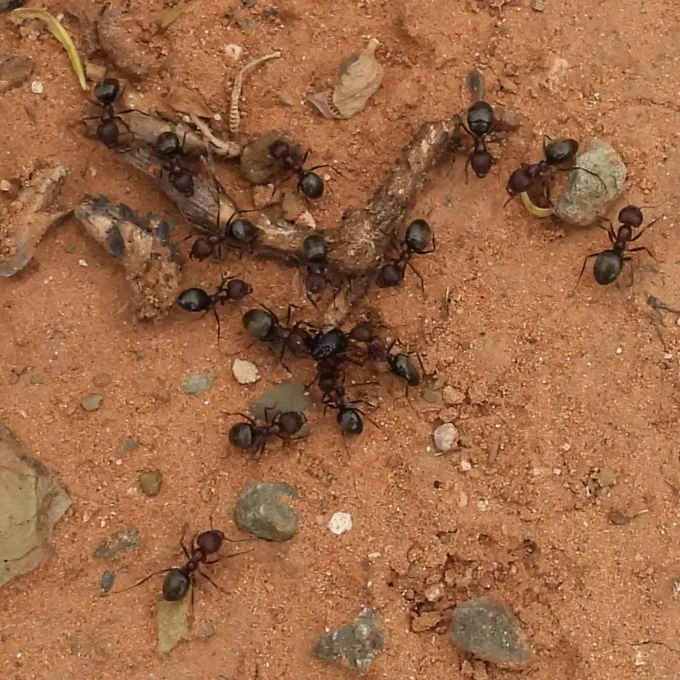
Steingroever's ant (Anoplolepis steingroeveri) belongs to the order Hymenoptera, family Formicidae. These ants are typically yellowish-brown or ochre in color, which serves as camouflage in dry, arid soil environments.
They are characterized by elongated legs and long antennae, enabling them to move rapidly across various surfaces. Their physical structure is well-adapted for foraging and scouting in harsh conditions.
The colonies of this species can be quite extensive, often thriving in semi-arid regions. They exhibit aggressive behavior when defending their nesting sites from intruders or competitors.
Nesting sites are commonly found in soil underneath rocks, dead wood, or at the base of shrubs and trees. They excavate deep tunnels that provide stability for the colony against heat and moisture fluctuations.
The colony structure consists of workers and queens, with specialized roles that allow the population to persist even when resources are scarce. Their social organization makes them highly resilient to environmental changes.
What it damages
The primary economic damage caused by these ants is their mutualistic relationship with honeydew-secreting insects. They actively protect and farm aphids, mealybugs, and scale insects.
By preventing natural predators like ladybugs and lacewings from accessing these pests, the ants facilitate uncontrolled aphid population explosions on fruit trees and decorative shrubs.
The honeydew produced by aphids accumulates on leaves, leading to the growth of sooty mold. This black fungus covers the leaf surface and severely inhibits the plant's ability to perform photosynthesis.
Plant vigor is significantly compromised due to the combination of sap-sucking damage by aphids and the stress caused by the ants' presence. Young shoots often become deformed or stop growing entirely.
Furthermore, their tunneling activities at the base of young plants and seedlings can damage root systems, potentially leading to wilting, nutrient deficiency, and in severe cases, plant mortality.
Signs of infestation
A tell-tale sign of an infestation is the presence of consistent "ant trails" running along tree trunks or stems. These routes usually lead directly to colonies of aphids or other sap-suckers.
Sticky residue on foliage, known as honeydew, is a strong indicator of pest activity. If plants appear shiny and sticky, they are likely being farmed by a colony of Anoplolepis steingroeveri.
The presence of loose soil mounds near the base of plants or trees often reveals the location of ant nests. These mounds are frequently hidden beneath vegetation or decorative landscape stones.
Curled, yellowed, or drooping leaves at the tips of new growth are diagnostic symptoms that pests are present and being protected by the ants.
Excessive ant activity on flowers and budding sections often indicates that they are harvesting secretions, which can physically damage the buds or prevent proper pollination of the crop.
Control measures
Effective management requires targeting the pests the ants protect. By eliminating aphid and scale populations, you remove the primary food source that attracts the ants to the plants.
Installing sticky bands around tree trunks provides a physical barrier that prevents the ants from reaching their protected pests in the canopy, effectively breaking the cycle of protection.
Bait stations containing slow-acting insecticides are highly effective. Workers carry the poisoned bait back to the nest, ensuring the destruction of the queen and the entire colony.
Regular cultivation of the soil around planting beds disrupts the ants' underground galleries and forces them to relocate, reducing their presence in the immediate vicinity of crops.
- Apply mechanical barriers on tree trunks.
- Use systemic insecticides to manage honeydew-secreting pests.
- Maintain garden hygiene to remove nesting opportunities.
Taxonomy
- Latin name
- Anoplolepis steingroeveri
- Order
- Hymenoptera
- Family
- Formicidae
- EPPO code
- ANOPST
Discussion
No discussions yet — be the first.