
Anoplolepis custodiens
Anoplolepis custodiens
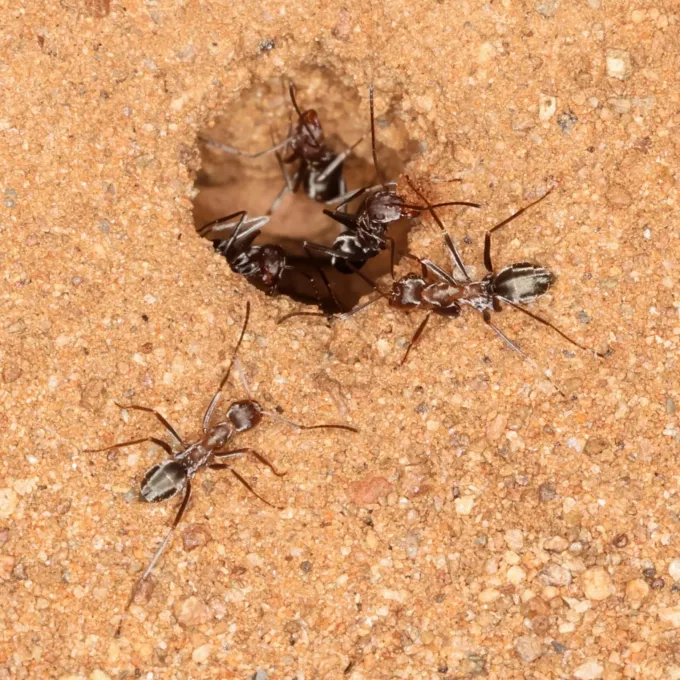
Description
How to identify
Anoplolepis custodiens, commonly known as the pugnacious ant, belongs to the Formicidae family within the order Hymenoptera.
These ants are medium-sized, with workers typically reaching 5 to 6 mm in length, and their coloration ranges from yellowish-brown to dark reddish-brown.
They are characterized by long legs and antennae, which allow them to move with great speed and agility when disturbed or searching for food.
The colonies often exhibit polygyny, meaning they have multiple queens, which facilitates rapid population expansion and the colonization of large areas.
They prefer nesting in warm, dry soils, often constructing galleries near the base of trees, shrubs, or within agricultural field boundaries.
What it damages
Anoplolepis custodiens is classified as a significant agricultural pest, primarily due to its mutualistic relationship with sap-sucking insects like aphids and scale insects.
The ants protect these insects from natural predators and parasitoids in exchange for honeydew, a sugary secretion that is a primary food source for the ants.
This protection allows populations of aphids and mealybugs to reach destructive levels, leading to severe plant stress, wilting, and reduced crop yields.
The accumulation of honeydew also promotes the growth of sooty mold, a fungus that coats leaves and prevents effective photosynthesis, further weakening the plant.
Direct damage can also occur, as these ants may gnaw on young buds, fruits, or soft tissues while foraging, creating entry points for secondary plant diseases.
When it appears
The activity patterns of Anoplolepis custodiens are highly dependent on environmental temperature and moisture conditions throughout the growing season.
Activity peaks during warm spring and summer months when the metabolic rates of both the ants and their symbiotic partners are at their highest.
During drought conditions, the ants are often found congregating near irrigated fields or plant roots to access essential moisture and protect their honeydew sources.
The lifecycle of the colony accelerates with higher temperatures, allowing for multiple generations within a single growing season, complicating pest management.
As temperatures drop in autumn, their activity levels decrease, and they retreat deeper into their soil nests to survive until the following season.
Signs of infestation
The most visible sign of an Anoplolepis custodiens infestation is the presence of distinct foraging trails leading from their nests to affected host plants.
Dense clusters of aphids or scale insects on shoots and leaves that are actively attended by ants are strong indicators of a problematic colony presence.
A sticky, black layer of sooty mold on the foliage is a secondary sign, indicating the presence of large quantities of honeydew being produced by protected pests.
Plants showing signs of stunted growth, leaf yellowing, or structural deformation often suggest that the roots are being disrupted by nest-building activities.
Finding mounds of loose soil or entrance holes at the base of stems confirms the presence of the ant colony within the root zone of the crop.
Control measures
Effective management of Anoplolepis custodiens requires a holistic approach that targets both the ants and the sap-sucking insects they protect.
The use of slow-acting toxic baits containing sugars is often the most effective method, as workers transport the poison back to the queen and the brood.
Physical barriers, such as sticky bands applied to tree trunks, effectively prevent ants from accessing the foliage and reaching their aphid colonies.
Cultivation practices like regular soil disturbance around plant bases help destroy nests and disrupt the communication channels of the colony.
- Application of specialized contact or systemic insecticides.
- Encouraging natural predators such as ladybugs to control aphid populations.
- Managing irrigation to prevent soil moisture that favors ant nest locations.
Taxonomy
- Latin name
- Anoplolepis custodiens
- Order
- Hymenoptera
- Family
- Formicidae
- EPPO code
- ANOPCU
Discussion
No discussions yet — be the first.