
Yellow subterranean ant
Acropyga acutiventris
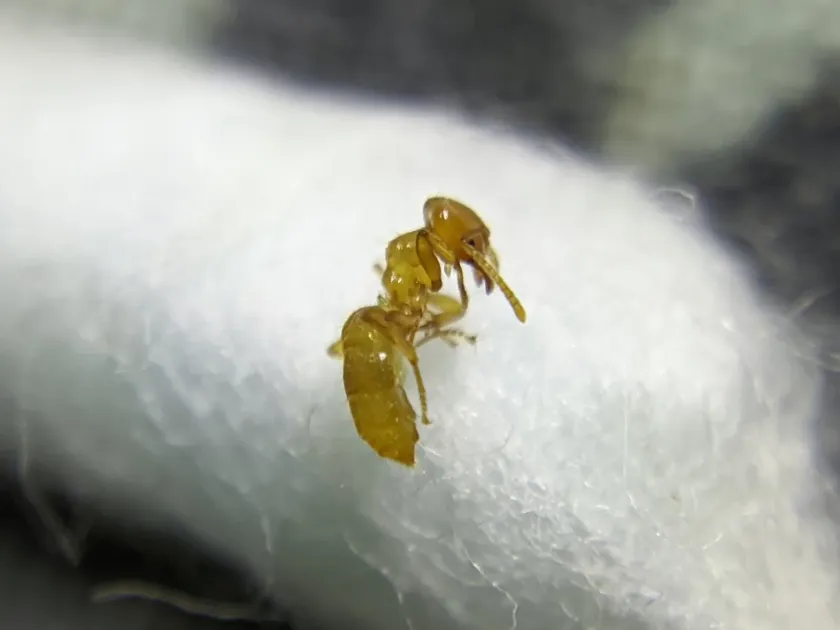
Description
How to identify
Acropyga acutiventris belongs to the order Hymenoptera and the family Formicidae. These are small, subterranean ants that spend almost their entire life cycle below the soil surface.
The species is well-known for its obligate relationship with root-feeding mealybugs, which they protect and move between host plants.
The workers are pale yellow, a common adaptation for a cryptic lifestyle in dark, underground environments.
They are rarely seen outside their nests, making early detection of their presence in fields or gardens particularly challenging.
Taxonomically, they are recognized as highly specialized myrmecophiles, relying heavily on the honeydew produced by their symbiotic mealybugs.
What it damages
The damage caused by these ants is indirect but severe, as they facilitate the survival and spread of root mealybugs that extract sap from plants.
By protecting mealybugs from natural predators and moving them to the healthiest roots, the ants ensure the constant depletion of the host plant's energy.
Plants infested with mealybug colonies supported by ants show signs of nutrient deficiency, including stunted growth and yellowing foliage.
Root wounds created by mealybugs provide entry points for soil-borne pathogens, leading to root rot and other fungal infections.
High infestation levels can result in significant yield losses, particularly in fruit orchards and vegetable crops where roots are the primary focus.
When it appears
Ant activity is closely linked to soil temperature; they become active as the soil warms in the spring, typically above 12 degrees Celsius.
The summer months represent the peak of their activity, characterized by intensive care for the growing mealybug populations in the root zones.
As soil temperatures drop in the autumn, the ants move deeper into the ground to protect their mealybug wards from freezing.
In greenhouse conditions, the life cycle remains active year-round, posing a continuous threat to greenhouse crop production.
Swarming and the emergence of reproductive forms occur when environmental conditions are optimal for the establishment of new colonies.
Signs of infestation
Sudden wilting of plants, despite adequate irrigation, is a common indicator that root systems have been compromised by mealybugs.
Soil excavation or lifting a root ball often reveals the presence of small yellow ants along with white, waxy mealybug residues on the roots.
Distinctive galleries or tunnels in the soil around the base of the plant are signs of an active subterranean ant nest.
Persistent chlorosis in the upper parts of the plant often points to chronic stress induced by the subterranean sap-sucking complex.
Presence of ants near the stem during the evening or morning hours serves as a behavioral indicator of an underground infestation.
Control measures
Effective management requires systemic control agents capable of reaching the deep soil layers where the ants and mealybugs dwell.
Soil drenching with appropriate insecticides is a primary method for reducing populations in the immediate root zone of the plant.
- Application of systemic insecticides that target both the ants and the mealybugs.
- Use of ant baits that can be carried into the nest to eliminate the colony and the queen.
- Mechanical soil disturbance, where feasible, to disrupt the nest structures.
- Strict sanitation protocols in greenhouses to prevent the introduction of infested soil.
- Monitoring of plant roots for early signs of waxy mealybug secretions.
Taxonomy
- Latin name
- Acropyga acutiventris
- Order
- Hymenoptera
- Family
- Formicidae
- EPPO code
- ACRQAC
Discussion
No discussions yet — be the first.