
Leaf-cutting ant
Acromyrmex octospinosus
Description
How to identify
The leaf-cutting ant (Acromyrmex octospinosus) is a fascinating yet destructive species within the Formicidae family. Unlike typical ants, these insects are specialized fungivores, relying entirely on symbiotic fungi for their nutrition.
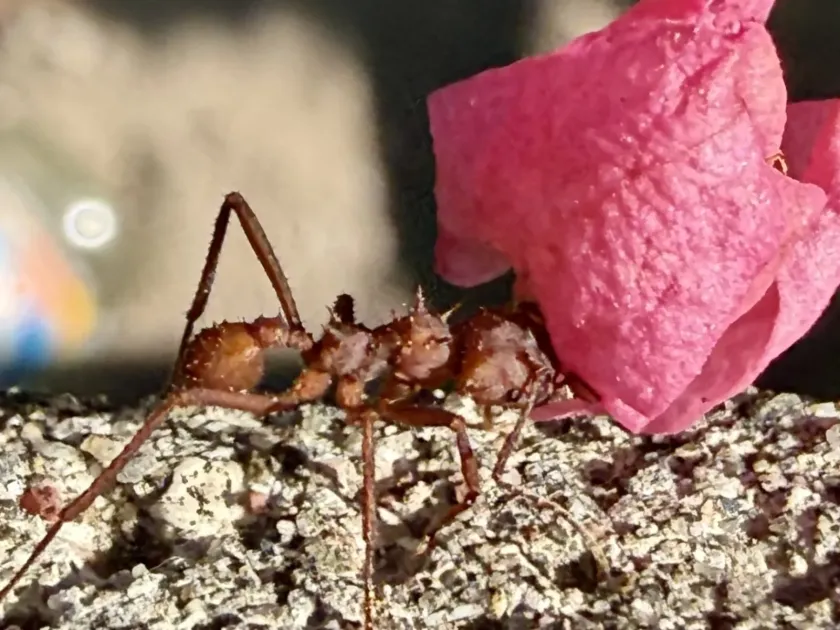
Morphologically, they are characterized by several pairs of spines on the thorax, which distinguish them from other ant species. They exhibit significant polymorphism, with different sizes of workers dedicated to specific tasks like foraging, nursery care, and tunnel construction.
The colony structure is complex, centered around a single queen who initiates the colony by carrying a starter culture of the fungus. All workers originate from her eggs, ensuring the continuity of the symbiotic relationship with their garden fungus.
Their life cycle involves a metamorphosis through egg, larva, and pupal stages. In the stable environment of their underground nests, they can reproduce year-round, which makes managing their population density a persistent challenge for farmers.
These ants are highly sophisticated engineers, creating massive subterranean nests that can span several meters in width and depth, making them difficult to locate and eradicate completely.
What it damages
The primary damage caused by Acromyrmex octospinosus is the large-scale defoliation of agricultural and forest crops. They are not herbivores in the traditional sense, as they consume the fungus, but they harvest massive quantities of leaves as compost.
They target a wide array of plants, including citrus, cocoa, coffee, and many vegetable crops. In severe cases, a single colony can strip an entire tree of its leaves in just one night, severely impacting the plant's ability to photosynthesize.
Root system damage is another consequence of their nesting habits. As they expand their tunnels, they disturb the soil structure, potentially causing wilting and decreased nutrient uptake in young seedlings or sensitive perennial crops.
The economic impact is profound, especially in tropical regions where these ants can significantly reduce the yield of commercial plantations by continuously preventing trees from reaching their full canopy potential.
Long-term damage includes stunted growth, increased susceptibility to secondary pests and diseases, and in many instances, the total mortality of younger plants due to repeated leaf removal.
Signs of infestation
The most evident sign is the appearance of perfectly cut leaf margins on surrounding vegetation. Since the ants selectively harvest fresh leaves, the damage pattern is distinct and unmistakable compared to other insect chewing damage.
Distinctive cleared trails, often called "ant highways," are visible on the ground connecting the nests to the foraging areas. These paths are maintained by the ants and are free of any debris or vegetation.
Excavated soil mounds, which are looser and more extensive than those of other ant species, indicate the presence of nest entrances. These are often found near the base of damaged trees or in open field areas.
Foraging activity is most intense during the evening and night. Observing a column of ants carrying leaf segments over their heads is the definitive confirmation of a leaf-cutting ant infestation.
In mature colonies, one can sometimes observe the steady traffic of workers moving back and forth, with incoming ants carrying green matter and outgoing ants leaving empty-handed.
Control measures
Controlling Acromyrmex octospinosus requires methods that target the entire colony, specifically the queen. Mere extermination of the foragers on the surface is rarely effective as the colony can quickly replace them.
The most effective strategy involves using toxic baits. The foraging ants gather these baits, which contain slow-acting insecticides, and carry them deep into the nest, where they are incorporated into the fungus garden, eventually poisoning the entire population.
Mechanical control measures, such as installing sticky barriers or metal collars around tree trunks, can prevent the ants from reaching the canopy of individual high-value trees, providing a localized level of protection.
Integrated Pest Management (IPM) practices, including the early detection of nests and physical disruption of small, new colonies, are crucial to preventing large-scale infestations across a farm.
- Application of slow-acting toxic baits;
- Regular patrolling to identify nest entrances;
- Installation of mechanical barriers for individual trees;
- Soil fumigation in extreme cases for large, localized nests.
Taxonomy
- Latin name
- Acromyrmex octospinosus
- Order
- Hymenoptera
- Family
- Formicidae
- EPPO code
- ACRXOC
Discussion
No discussions yet — be the first.