
Mesocomys albitarsis
Mesocomys albitarsis
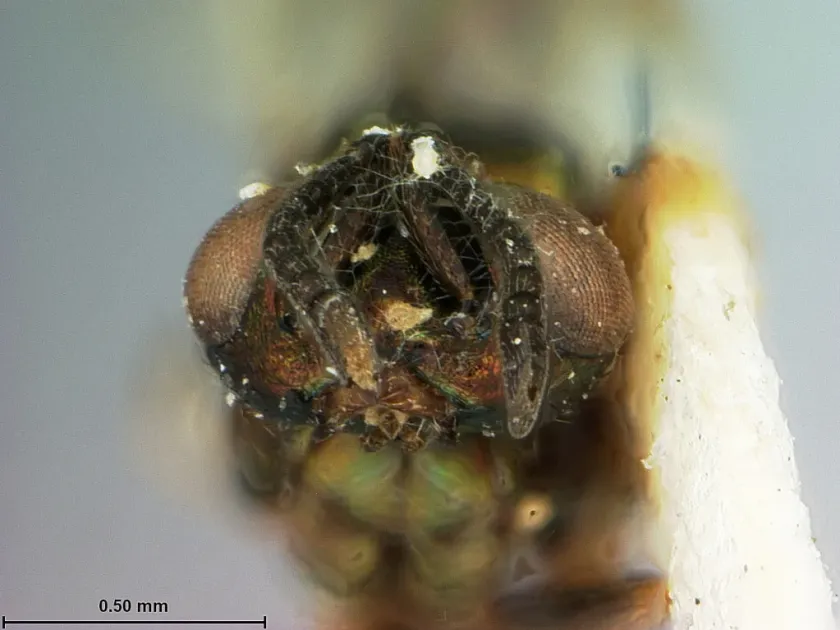
Description
How to identify
Mesocomys albitarsis is a species within the Eupelmidae family, belonging to the order Hymenoptera. These small wasps are widely recognized in entomological studies for their role as egg parasitoids.
Adult insects exhibit the characteristic morphology of the Chalcidoidea superfamily, often featuring a metallic luster on the body. The "albitarsis" part of the name refers to their pale-colored tarsi, which serve as a primary physical identifying mark.
Taxonomically, the genus Mesocomys includes species that display complex ecological relationships, often acting as primary or secondary parasitoids depending on the host species available.
Identification typically requires professional microscopic examination of morphological traits, as distinguishing between related species in the Eupelmidae family can be difficult without expert knowledge.
These insects are generally observed through lab-based rearing of host eggs collected in the field, as their small size makes them elusive in standard forest surveys.
What it damages
The damage caused by Mesocomys albitarsis is primarily ecological, as it impacts populations of host insects by destroying their eggs. While this can suppress primary pests, it may also negatively affect beneficial insects.
By parasitizing eggs of various Lepidoptera species, these wasps reduce the successful emergence rate of caterpillars, thus acting as a natural regulator of forest defoliators.
However, the species can also function as a hyperparasite, meaning it might target the pupae or eggs of other beneficial parasitoids, thereby hindering biological control programs.
The economic impact on forestry is indirect, as the balance of beneficial entomophagous insects is disrupted, potentially leading to fluctuations in primary pest populations.
Understanding the host-parasitoid interaction is crucial for forest management to ensure that native populations of beneficial wasps are maintained and protected from unnecessary chemical exposure.
When it appears
The seasonal cycle of Mesocomys albitarsis is highly synchronized with the phenology of its hosts. Activity peaks during the spring and summer when host egg-laying occurs.
Winter is typically spent in a diapause state as larvae within the host's eggs, which provides necessary protection against extreme environmental conditions.
The emergence of the first generation of adults coincides with warmer temperatures and the availability of fresh egg batches from host species in the forest canopy.
Multiple generations per year are possible if climatic conditions allow, facilitating the wasp's ability to maintain its population density throughout the growing season.
Environmental triggers like daylight length and heat accumulation act as cues for the insect to progress through its life stages, ensuring synchronized development with its primary prey.
Signs of infestation
The most visible sign of parasitism is the appearance of small, circular exit holes in the chorion (shell) of host eggs, indicating where an adult wasp has emerged.
Upon dissecting egg clusters, researchers often find empty shells where the host embryo was consumed during the larval development of the parasitoid.
A measurable decrease in hatching success in an egg batch compared to the expected rate is a strong indicator of parasitoid activity in the area.
Forest entomologists use laboratory breeding methods to verify the presence of Mesocomys albitarsis by collecting egg samples and monitoring them for wasp emergence.
While the egg clusters may remain attached to leaves or branches, their internal structure changes, reflecting the depletion of the host's nutrients by the developing wasp larvae.
Control measures
Direct chemical control measures against Mesocomys albitarsis are generally discouraged, as the species is an integral component of natural forest pest regulation.
Integrated forest management strategies focus on preserving biodiversity and limiting the use of broad-spectrum pesticides that could harm these beneficial parasitoids.
Management efforts should prioritize selective applications and timing treatments to avoid disrupting the peak activity periods of these Hymenopteran insects.
Regular monitoring of natural enemy populations allows forest managers to make informed decisions that prevent the depletion of helpful insects while controlling harmful pest outbreaks.
- Promote forest biodiversity to support natural parasitoid populations.
- Minimize the use of non-selective insecticides in forest habitats.
- Utilize biological monitoring to assess the health of entomophagous insect communities.
Taxonomy
- Latin name
- Mesocomys albitarsis
- Order
- Hymenoptera
- Family
- Eupelmidae
- EPPO code
- ANAUAL
Discussion
No discussions yet — be the first.