
Eupelmus
Eupelmus urozonus
Description
How to identify
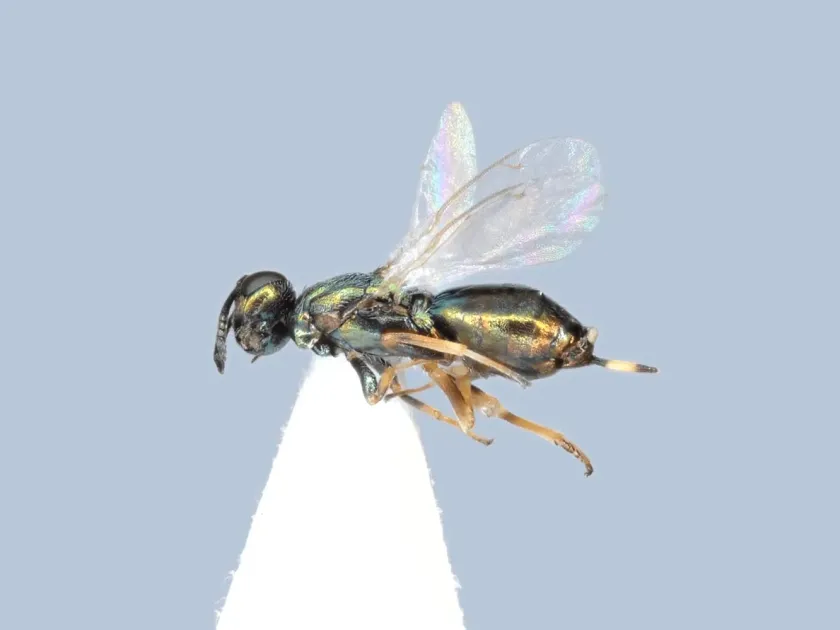
Eupelmus urozonus belongs to the order Hymenoptera, family Eupelmidae. The adult is a small parasitic wasp, typically metallic green or black in color, exhibiting a characteristic sheen.
Females possess a long ovipositor, which allows them to penetrate deep into plant tissues to search for hosts or deposit eggs. The wings are transparent with developed venation, typical for chalcidoid wasps.
The biology of this insect is complex, as it can behave as a primary parasite or an ectoparasite, making its status in agricultural ecosystems quite varied.
Adult specimens rarely exceed 3-5 millimeters in length, making them difficult to spot without specialized insect monitoring equipment.
Larvae are whitish, legless, and lead a hidden lifestyle, developing inside fruits or galls where they feed upon other insect larvae.
What it damages
While often considered a parasitoid, Eupelmus urozonus can damage a wide range of crops, including fruit trees, nut-bearing trees, and certain vegetable varieties.
Primary damage occurs in orchards where the insect parasitizes larvae of gall wasps, weevils, and codling moths, but may damage plant tissues if host availability is limited.
Significant economic losses are observed in hazelnut, walnut, and stone fruit plantations, where larvae develop inside fruits, disrupting their internal structure.
Damage is also reported in various legumes and umbelliferous crops, where the pest colonizes galls, leading to premature shedding of generative plant organs.
The overall impact manifests as a decrease in produce quality, loss of marketability, and reduced yields during periods of mass population outbreaks.
When it appears
Adult activity begins in spring, during the flowering and fruit setting stages of major crops, coinciding with the egg-laying periods of host insects.
Throughout the growing season, Eupelmus urozonus can produce several generations, allowing it to adapt to different stages of fruit maturation.
Population peaks typically occur in mid-summer, when the maximum number of host insect larvae is available within plant tissues.
As autumn approaches, adults enter a state of diapause, remaining in plant debris, fallen fruits, or overwintering in dry plant stems.
Early spring emergence allows the pest to quickly colonize young fruitlets, posing a threat to the upcoming harvest as early as the first half of summer.
Signs of infestation
The first sign of infestation is the presence of pinprick-sized punctures on the fruit surface, left by the female's ovipositor while searching for host larvae.
Premature yellowing and fruit drop occur, and upon inspection, larval galleries or the larvae themselves can be found inside the damaged fruits.
In stone fruits, deformation is noticeable, with fruits becoming stunted, asymmetrical, and unsuitable for storage or sale.
In nut crops, the internal part of the nut turns black and the cavity fills with larval excrement, leading to the complete destruction of the kernel.
The presence of exit holes, approximately 0.5-1 mm in diameter, on the fruit skin indicates that the adult has already completed its development and emerged.
Control measures
The primary control method involves cultural practices, such as the diligent collection and destruction of fallen fruit, which acts as a primary overwintering site.
Deep cultivation of the soil under tree canopies in autumn or early spring is recommended to disrupt the pupation sites of the insects in the soil and debris.
The use of biological insecticides based on entomopathogenic fungi or bacteria is effective in limiting pest populations without harming beneficial insect fauna.
Chemical control must be strictly regulated and timed during periods of peak adult activity to ensure that beneficial parasitic wasps are not inadvertently destroyed.
- Utilizing pheromone traps for continuous population monitoring.
- Removing weeds in orchard alleys and along field borders.
- Timely sanitary pruning and disposal of infested fruit.
Taxonomy
- Latin name
- Eupelmus urozonus
- Order
- Hymenoptera
- Family
- Eupelmidae
- EPPO code
- EUPEUR
Discussion
No discussions yet — be the first.