
Eupelmus allynii
Eupelmus allynii
Description
How to identify
Eupelmus allynii is a member of the Eupelmidae family within the order Hymenoptera. These are small, parasitic wasps often found in cereal agroecosystems.
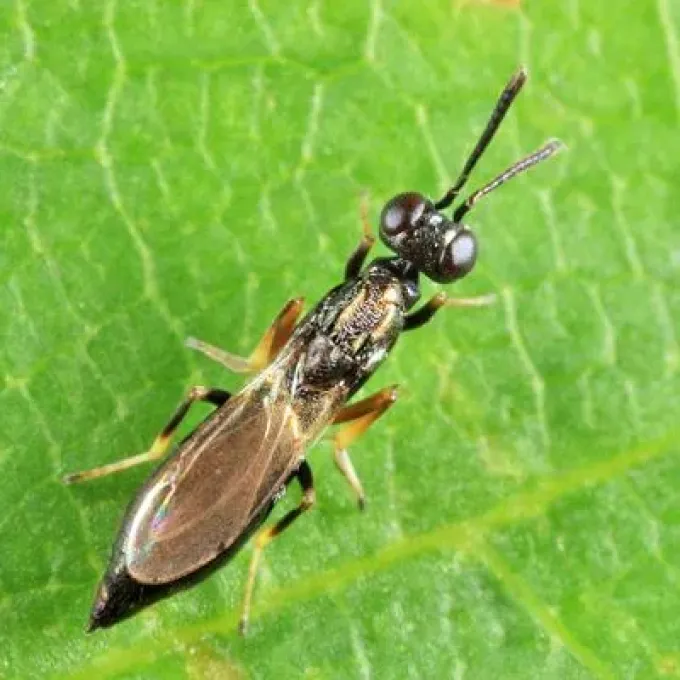
Adults exhibit a slender body structure with a characteristic metallic luster, typically ranging from bronze to greenish-black, allowing them to blend into the foliage.
The wings are clear with specific venation patterns common to the superfamily Chalcidoidea, which are essential for long-distance flight in search of hosts.
Females are easily identifiable by a prominent ovipositor, used to pierce plant tissue or the larvae of other insects to deposit their eggs.
Microscopic analysis is often required for precise identification, as their external appearance shares similarities with other chalcidoids present in the field.
What it damages
This species is primarily associated with cereal crops, including wheat, barley, and rye, which serve as the main habitat for its larval development.
The larvae feed within the plant stalks or near the grain heads, which disrupts nutrient flow and compromises the physical integrity of the stem.
Damage results in reduced grain filling, lower overall yield, and significantly decreased crop quality, which can lead to economic losses for producers.
Plants affected by the pest often show signs of stunted growth and, in severe cases, may lodge, making mechanical harvesting difficult and inefficient.
The feeding activity also creates entry points for secondary pathogens, potentially leading to fungal infections that further degrade the harvested material.
When it appears
Adult emergence typically begins in late spring, triggered by rising temperatures and the phenological development of the host cereal plants.
Activity peaks during the summer months when the crops are in the heading and grain-filling stages, providing optimal conditions for reproduction.
The life cycle involves multiple generations per season, allowing the population density to increase rapidly if environmental conditions remain favorable.
As autumn approaches and temperatures decline, the insects enter a state of dormancy, overwintering as prepupae or pupae in crop residues.
The synchronization between the insect's life cycle and the growth stages of the cereal crop is a critical factor in determining the severity of annual infestations.
Signs of infestation
The most common sign of infestation is the premature yellowing or whitening of the grain heads, often referred to as "whiteheads" in agricultural literature.
Careful inspection of the stems reveals small, circular exit or entry holes, often accompanied by necrotic spots where the female has penetrated the tissue.
When stalks are split open, one may observe larvae or pupae within the vascular tissue, which confirms the presence of the pest in the field.
Fields with high pest populations exhibit reduced grain weight and lower bushel weight, which is detectable during pre-harvest quality sampling.
Increased activity of parasitic wasps near the field margins can serve as a biological indicator of the pest's presence in the nearby cereal crops.
Control measures
Integrated pest management strategies are crucial, starting with the immediate destruction of crop residues after harvest to eliminate overwintering sites.
Deep tillage effectively buries the pupae, preventing adult emergence in the following spring and reducing the pressure on new crops.
Crop rotation is highly effective, as it denies the pest its primary host, forcing the population to move or perish due to the lack of suitable conditions.
Chemical control should be applied strictly according to economic thresholds to avoid unnecessary costs and the destruction of beneficial natural enemies.
- Utilize resistant or tolerant cereal crop varieties.
- Maintain clean field borders to remove alternative host plants.
- Monitor pest populations with sticky traps in early spring.
- Practice timely harvesting to prevent extended exposure to pests.
Taxonomy
- Latin name
- Eupelmus allynii
- Order
- Hymenoptera
- Family
- Eupelmidae
- EPPO code
- EUPEAL
Discussion
No discussions yet — be the first.