
Anastatus mirabilis
Anastatus mirabilis
Description
How to identify
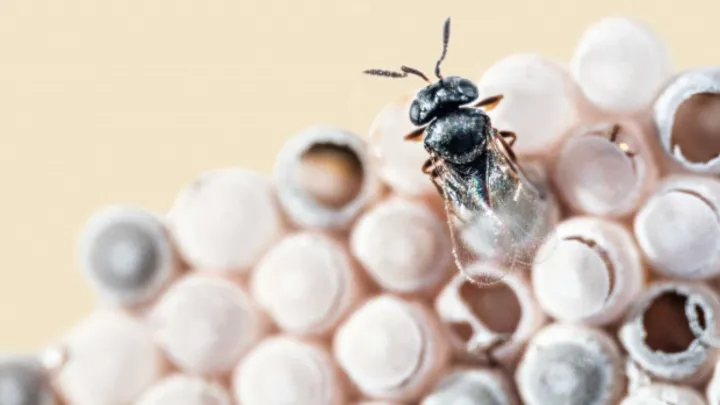
Anastatus mirabilis is a tiny insect belonging to the order Hymenoptera and the family Eupelmidae. It acts as a specialized parasitoid, playing a complex role within the agricultural ecosystem's trophic web.
Adults exhibit slender bodies with a characteristic metallic sheen. Females are often characterized by reduced wings (brachyptery), which restricts their mobility, whereas males are fully winged and capable of flight.
The life cycle involves internal parasitism of host eggs, such as those of the sunn pest (Eurygaster integriceps). This developmental strategy links their population dynamics directly to the availability of host insects.
Identification in the field requires specialized entomological skills or laboratory analysis due to their minute size and resemblance to other related species of Eupelmidae.
In agronomic practice, recognizing this species is crucial for evaluating the composition of the local parasitoid complex, which influences the effectiveness of biological control programs.
What it damages
Anastatus mirabilis does not feed on plant tissues, meaning it causes no direct damage to crops like wheat or other cereals. Its status as a "pest" is derived from its role as an hyperparasitoid or a competitor to beneficial egg-parasitoids.
By attacking the eggs of other beneficial insects that control primary crop pests, it potentially weakens the natural suppression of populations like the sunn pest, indirectly leading to higher pest pressure.
The damage is primarily economic in nature, occurring when the balance of biological control in a field is shifted, forcing farmers to consider additional chemical interventions.
Areas with high population density of Anastatus mirabilis may experience a decrease in the effectiveness of natural egg-parasitoids, which are vital for maintaining the health of cereal crops.
Agronomists monitor this species as part of an integrated approach to understand how different parasitoid species interact within the grain field environment during the growing season.
When it appears
The activity of Anastatus mirabilis begins in the spring, coinciding with the warming of the soil and the emergence of adults from their overwintering sites in plant debris.
The peak period of activity corresponds to the reproductive cycles of their host insects, specifically when the target pests lay their eggs in the field.
Multiple generations can occur throughout the growing season, with the population density fluctuating based on the availability of suitable hosts in the local environment.
As temperatures drop in the autumn, the insects enter diapause, seeking shelter in the soil or crop stubble to survive the winter months until the next season.
Field monitoring during the spring and early summer is essential to determine the population levels and potential impact on other beneficial parasitoids in the field.
Control measures
Direct chemical control specifically against Anastatus mirabilis is generally discouraged as it can disrupt the entire complex of beneficial insects required for natural pest management.
The most effective strategy is the implementation of Integrated Pest Management (IPM), which prioritizes the health of the beneficial insect population by reducing reliance on broad-spectrum insecticides.
Selective pesticides should be used whenever possible to target primary pests without adversely affecting the parasitoid complex that regulates insect populations.
Maintaining a diverse agroecosystem, including non-crop vegetation, supports a balanced parasitoid population, ensuring that natural regulation remains efficient throughout the crop cycle.
- Implement precision spraying to reduce insecticide exposure.
- Conserve natural habitats near agricultural fields.
- Use pheromone traps for monitoring, not just for pests, but for parasitoid activity.
Taxonomy
- Latin name
- Anastatus mirabilis
- Order
- Hymenoptera
- Family
- Eupelmidae
- EPPO code
- ANAUMI
Discussion
No discussions yet — be the first.