
Anastatus japonicus
Anastatus japonicus
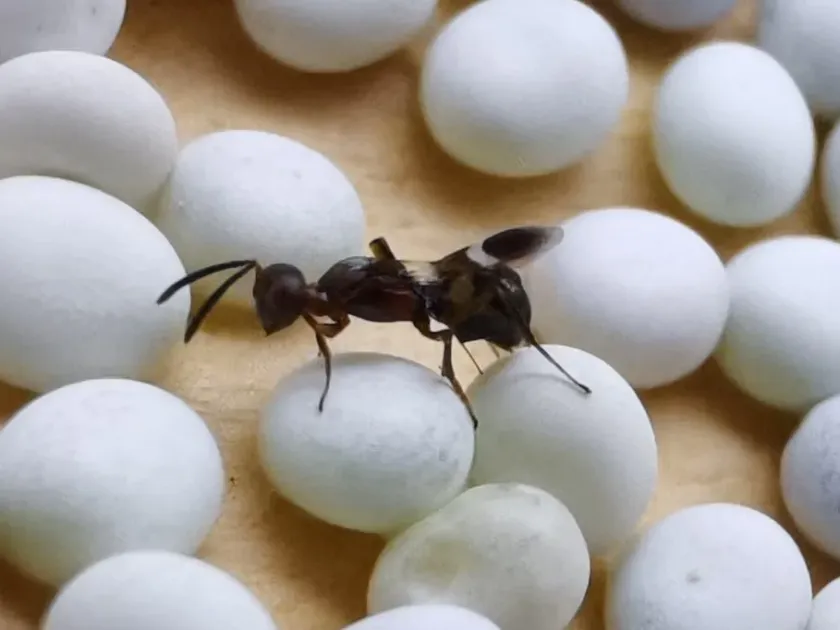
Description
How to identify
Anastatus japonicus is a member of the Hymenoptera order and the Eupelmidae family. It is a small wasp known primarily for its role as an egg parasitoid of various insect species.
The adult morphology is characteristic of eupelmid wasps, featuring a slender body with a metallic sheen. They are highly mobile and use their wings to seek out suitable hosts for oviposition.
Females are equipped with an ovipositor, which allows them to penetrate the tough chorion of host eggs. Once the egg is pierced, the wasp deposits its own egg inside to ensure its offspring's development.
The larvae develop entirely within the host egg, feeding on its contents. This internal development makes it a highly specialized insect capable of surviving in diverse environments.
From a taxonomic perspective, this species is essential to monitor as it interacts complexly with other beneficial insects within the agricultural food web.
What it damages
The damage caused by Anastatus japonicus is often indirect, occurring through the parasitization of beneficial egg-parasitoids that are naturally present in the field.
Crops such as soybeans, cereals, and vegetables can be affected when the wasp population interferes with the biological control of major crop pests by destroying the eggs of natural enemies.
In cases where it targets the eggs of primary pests (such as stink bugs), its activity may be considered beneficial; however, excessive parasitism can disrupt established integrated pest management (IPM) programs.
Economic impact is measured by the reduced efficiency of biological control agents, leading to an increased need for synthetic pesticide applications to manage primary pest populations.
The cumulative effect of parasitism can destabilize the predator-prey balance, making fields more susceptible to sudden outbreaks of other agricultural pests.
When it appears
The seasonal activity of Anastatus japonicus begins in late spring, typically aligned with the onset of favorable temperatures and the arrival of host insect eggs in the field.
The species is multivoltine, meaning it produces multiple generations per season, allowing it to rapidly adjust its population density based on the availability of hosts.
Peak emergence and activity levels are observed during the mid-summer months when host populations are most abundant and environmental conditions are optimal for wasp reproduction.
As temperatures begin to decline in the autumn, the wasps enter a diapause phase. They overwinter as larvae or pupae inside the host eggs, emerging only when conditions permit in the following spring.
Humidity levels and temperature fluctuations are the primary environmental drivers that determine the success of each generation and the overall overwintering survival rate.
Signs of infestation
The most reliable sign of Anastatus japonicus presence is the appearance of small, circular exit holes on the surface of insect egg clusters after the adult wasp has emerged.
Microscopic examination of egg clutches often reveals darkened or discolored shells, which serve as an early indicator of parasitism rather than a normal developmental process.
Yellow sticky traps or pheromone-baited monitors can be used to track the movement and population density of adults throughout the growing season.
Failure of expected beneficial insects to emerge from a parasitized cluster is a critical field observation that suggests the involvement of hyperparasitoids like Anastatus japonicus.
Internal examination of infested eggs will show the larval stages or pupal cocoons of the wasp, along with shed skins from the developmental stages.
Control measures
Management strategies for this species focus on maintaining ecological balance within the agroecosystem to prevent the parasite from overwhelming beneficial insect populations.
Selective insecticide use is recommended when chemical control is necessary, choosing products that do not have long-lasting negative effects on non-target species.
Integrated Pest Management (IPM) practices, including the preservation of hedgerows and wildflower borders, help support natural diversity and mitigate risks associated with dominant species.
- Regular monitoring of egg clusters for signs of parasitism.
- Adjustment of planting schedules to avoid synchrony with peak wasp activity.
- Promotion of natural predatory insect diversity to create competition.
Cultural practices such as weed management and soil cultivation contribute to reducing the habitat and shelter available for host species, effectively controlling their numbers.
Taxonomy
- Latin name
- Anastatus japonicus
- Order
- Hymenoptera
- Family
- Eupelmidae
- EPPO code
- ANAUJA
Discussion
No discussions yet — be the first.