
Anastatus colemani
Anastatus colemani
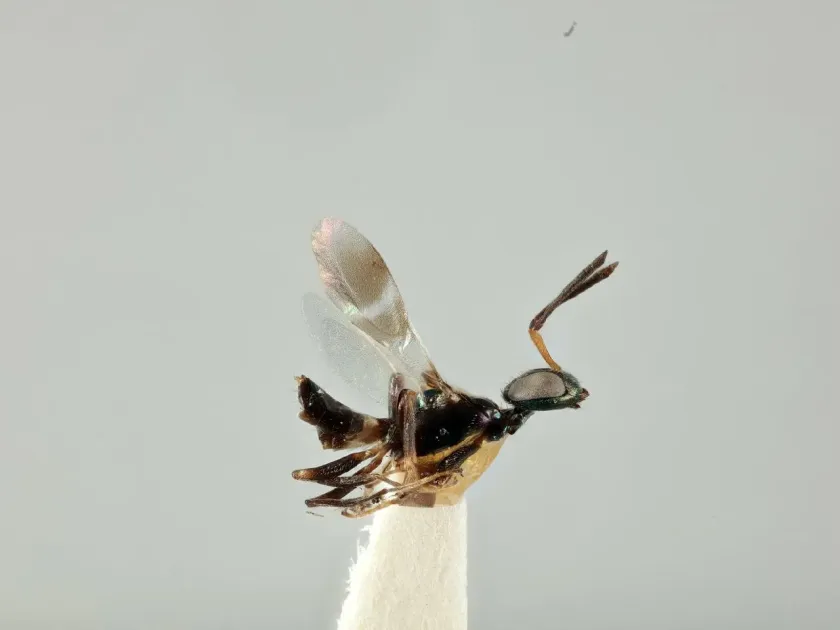
Description
How to identify
Anastatus colemani is a member of the order Hymenoptera, belonging to the family Eupelmidae.
Physically, this insect is small and often mistaken for a pest, although it is naturally an egg parasitoid.
The adult body possesses a characteristic metallic luster, with a length of only a few millimeters.
The wings are transparent with a specific venation pattern typical of this family of wasps.
Identification in the field is difficult and requires laboratory examination under a microscope to study morphological traits.
What it damages
It is important to understand that Anastatus colemani does not directly damage plants as it does not feed on leaves or stems.
This species is a specialized entomophage that attacks the eggs of various bug species, including shield bugs.
In agronomic practice, its activity is considered beneficial, contributing to the natural reduction of phytophage populations.
However, in certain situations, excessive activity of entomophages can disrupt the balance in biocontrol programs.
The main target of parasitization is the egg clusters of insect pests located on crops.
When it appears
The insect's life cycle is closely synchronized with the activity periods of its hosts, which are herbivorous bugs.
Mass emergence of adults occurs during the spring and summer when bugs begin laying eggs on crops.
The efficiency of egg parasitization depends on climatic conditions, temperature, and humidity within the agroecosystem.
Several generations can develop per season, depending on the availability of suitable eggs for larval development.
Peak activity occurs during vegetation phases when the population density of bugs in the fields is high.
Signs of infestation
The main indicator of Anastatus colemani presence is a change in the color of the host bug eggs.
Parasitized eggs darken and acquire a metallic or grayish-black hue, distinguishing them from healthy eggs.
Upon careful inspection of the clusters, one can observe tiny exit holes gnawed by adults upon emergence.
The absence of bug larvae hatching from the cluster is also an indirect sign of parasitoid activity.
To confirm the species, it is necessary to collect samples and incubate the eggs under laboratory conditions.
Control measures
Since this species is a beneficial entomophage, specific control measures against it are generally not practiced in agroecosystems.
It is necessary to avoid the unjustified use of broad-spectrum insecticides that kill beneficial entomofauna.
When integrating plant protection systems, choose pesticides with minimal impact on egg parasitoids.
Preserving natural habitats around fields helps maintain the Anastatus colemani population at a stable level.
The core strategy is rational landscape management to maintain the balance between pests and their natural parasites.
Taxonomy
- Latin name
- Anastatus colemani
- Order
- Hymenoptera
- Family
- Eupelmidae
- EPPO code
- ANAUCO
Discussion
No discussions yet — be the first.