
Anastatus antestiae
Anastatus antestiae
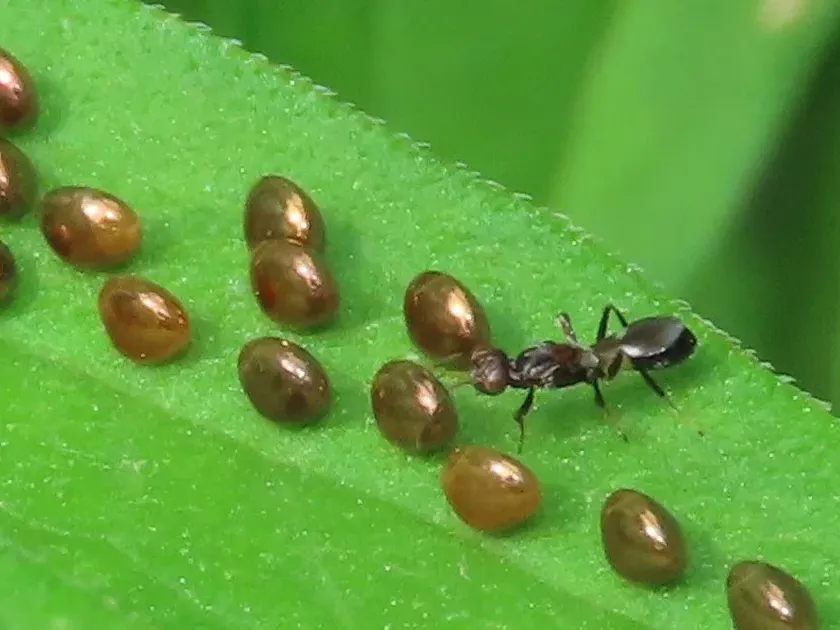
Description
How to identify
Anastatus antestiae is a species of hymenopteran insect belonging to the family Eupelmidae, within the superfamily Chalcidoidea.
This small wasp is a specialized egg parasitoid, evolved to identify and exploit the eggs of various bug species, particularly those affecting coffee crops.
The adult wasps are characterized by a metallic body sheen and specialized ovipositors designed for piercing the tough chorion of their host's eggs.
Being highly specialized, they possess advanced olfactory receptors that allow them to detect pheromones and kairomones released by host bugs.
The taxonomic classification places them as essential agents in integrated pest management programs in tropical regions.
What it damages
It is crucial to clarify that Anastatus antestiae is not a pest, but rather a beneficial biological control agent that suppresses harmful coffee bugs.
The wasp targets the eggs of bugs belonging to the genus Antestiopsis, which are known to cause significant damage to coffee berries and shoots.
By laying an egg inside the host's egg, the wasp larva consumes the developing bug embryo, effectively preventing the pest from reaching maturity.
This natural process significantly reduces the population of harmful insects, protecting the integrity of the coffee plant's reproductive organs.
Without the presence of this parasitoid, coffee producers would face much higher pest pressure and increased losses during the fruiting season.
When it appears
The activity patterns of Anastatus antestiae are highly synchronized with the reproductive cycles of their target hosts.
In tropical coffee-growing regions, this generally corresponds to the rainy season, when host bugs are most active in egg-laying.
The wasps are diurnal and require warm temperatures and high humidity to effectively locate and parasitize host egg masses.
Population density fluctuates throughout the year, peaking when the host bug populations provide an abundance of suitable eggs for parasitism.
During dry spells or periods of low host density, the population of Anastatus antestiae often remains at low, stable levels in refugia.
Signs of infestation
The primary sign of infestation is the discovery of discolored or darkened host egg masses on the underside of coffee leaves.
After the adult wasp emerges, it leaves a very small, clean, circular hole in the chorion of the host egg, a diagnostic feature of parasitization.
Regular monitoring of leaves for these exit holes is an effective way to assess the level of biological control occurring on the plantation.
A low number of surviving nymphs in discovered egg masses suggests that the Anastatus antestiae population is successfully controlling the pest.
The presence of adult wasps patrolling leaves in a search-like behavior during daylight hours is a positive indicator of natural pest management.
Control measures
To preserve this beneficial insect, agricultural practices must prioritize the minimization of broad-spectrum insecticide applications.
Integrated Pest Management (IPM) strategies are recommended, focusing on the use of selective pesticides only when strictly necessary.
Maintaining diverse vegetation and buffer strips around coffee plantations provides essential nectar sources for adult wasps.
Field research suggests that natural habitats serve as reservoirs, allowing Anastatus antestiae to recolonize coffee fields after management interventions.
Data-driven decision making, based on actual pest and parasitoid counts, is the best approach to ensure the continued efficacy of this natural control agent.
Taxonomy
- Latin name
- Anastatus antestiae
- Order
- Hymenoptera
- Family
- Eupelmidae
- EPPO code
- ANAUAN
Discussion
No discussions yet — be the first.