
Tetrastichus planipennisi
Tetrastichus planipennisi
Description
How to identify
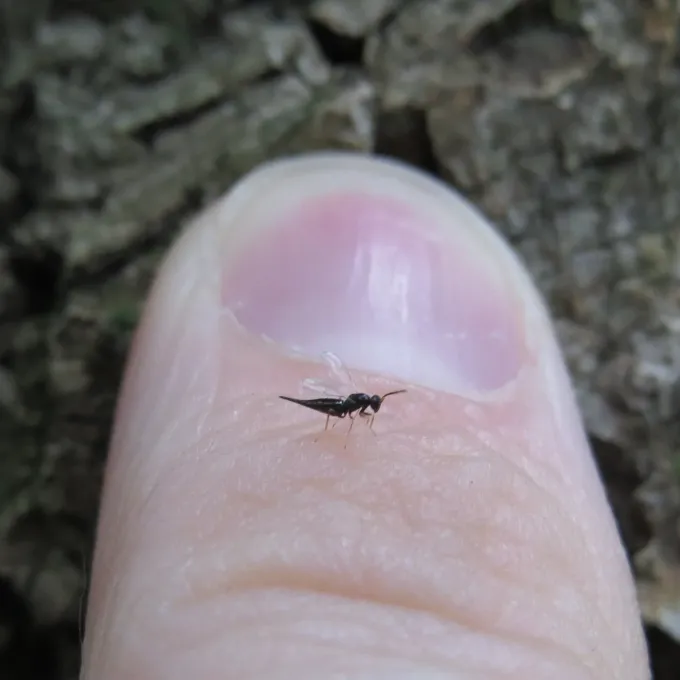
Tetrastichus planipennisi is a small gregarious parasitoid wasp belonging to the family Eulophidae. Measuring approximately 3 millimeters in length, these wasps are barely visible to the naked eye under field conditions.
The adults are characterized by a metallic green or dark body color. Females possess a specialized ovipositor designed to penetrate tree bark, allowing them to deposit their eggs directly into the larvae of their host.
This species is highly evolved to locate hosts hidden deep beneath the bark of ash trees. Their sensory abilities allow them to pinpoint larvae, making them exceptionally efficient agents in dense forest environments.
The life cycle of the wasp is closely linked to the phenology of the Emerald Ash Borer. Proper timing of its activity is crucial for effective parasitism, as the wasp must locate larvae at the susceptible stage of development.
Scientific research highlights its role as a key natural enemy in programs designed to suppress invasive pest populations through classical biological control methods.
What it damages
It is critical to distinguish that Tetrastichus planipennisi is not a plant pest. Instead, it is a beneficial insect used as a biological control agent to manage the invasive Emerald Ash Borer (Agrilus planipennis).
The host of this parasitoid is the larva of the Emerald Ash Borer. The wasp injects eggs into the host larva; the developing larvae of the wasp then consume the host from the inside, preventing the borer from maturing and damaging the tree.
Because of its host-specificity, this wasp does not harm healthy plants or other wildlife. It serves as a natural regulator of borer populations, preventing the complete destruction of ash species in infested areas.
Without the presence of T. planipennisi, the Emerald Ash Borer causes severe xylem damage, which leads to canopy dieback and the eventual death of mature ash trees. The wasp helps mitigate these devastating losses.
The interactions between this parasitoid and its host demonstrate a balanced ecological approach to pest management, effectively reducing the need for toxic chemical interventions in forested landscapes.
Control measures
The primary control method involving T. planipennisi is the strategic release of laboratory-reared wasps into areas infested with the Emerald Ash Borer. This is a standard procedure in integrated pest management.
To ensure the success of these releases, it is essential to minimize the application of broad-spectrum insecticides, which would otherwise eliminate the beneficial wasp population along with the targeted pest.
Monitoring efforts focus on evaluating the parasitism rate within local borer populations. Researchers look for emergence holes on the bark of ash trees, which indicate that the next generation of wasps has successfully developed.
Successful management strategies combine the introduction of T. planipennisi with other practices, such as sanitation harvesting and long-term tree health monitoring, to maintain sustainable forest health.
Continuous investment in the study of this parasitoid ensures that forest managers can optimize release strategies and improve the chances of long-term control against the invasive borer threat.
Taxonomy
- Latin name
- Tetrastichus planipennisi
- Order
- Hymenoptera
- Family
- Eulophidae
- EPPO code
- TETSPL
Discussion
No discussions yet — be the first.