
Tetrastichus julis
Tetrastichus julis
Description
How to identify
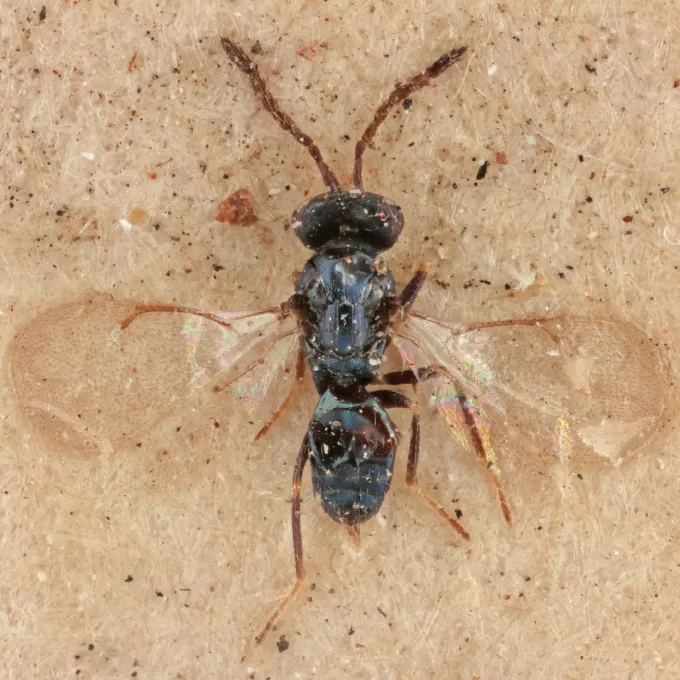
Tetrastichus julis is a species of eulophid wasp that serves as a highly specialized parasitoid of the cereal leaf beetle (Oulema melanopus). It is classified under the order Hymenoptera and the family Eulophidae.
Adult wasps are very small, typically measuring between 2 to 3 mm in length. Their metallic black-green appearance allows them to blend effectively into the foliage of cereal crops where they hunt for their prey.
The lifecycle of this wasp is strictly synchronized with the life stages of the cereal leaf beetle. The female wasp locates the beetle larvae on the leaves of host plants and deposits her eggs inside them using her ovipositor.
The larvae of the parasitoid develop inside the body of the host, feeding on its internal tissues until they reach the pupation stage, which inevitably causes the death of the beetle larva.
Because these wasps can have multiple generations in a single season, they are capable of rapidly suppressing pest populations, making them vital allies in sustainable agriculture.
What it damages
Tetrastichus julis is strictly beneficial. It does not cause damage to plants; rather, it protects wheat, barley, oats, and rye by reducing the population of cereal leaf beetle larvae that feed on crop leaves.
In fields where these wasps are abundant, the damage to crops caused by leaf beetles is significantly minimized. This natural control mechanism prevents the need for massive chemical insecticide applications.
By preventing the maturation of the beetle larvae, the wasp ensures that the vegetative growth of the grain crops remains undisturbed, which is crucial for achieving stable yields.
The parasitism rates in some regions can reach up to 90%, highlighting the extraordinary efficiency of this tiny wasp in maintaining ecological stability within agroecosystems.
Farmers who utilize Integrated Pest Management (IPM) strategies recognize this wasp as a cornerstone for maintaining the health of cereal production without unnecessary environmental degradation.
When it appears
The activity of Tetrastichus julis typically begins in late spring, aligning with the emergence of cereal leaf beetle larvae in cereal grain fields.
As the temperature increases, the wasps become more active, searching for host larvae during the tillering and stem elongation stages of cereal development.
The parasitoid exhibits several generations per season, allowing its population to rise and fall in synchrony with the density of the host beetle population.
Optimal environmental conditions involve mild temperatures and moderate humidity, which support the high metabolic activity and reproduction of the parasitoid.
As the season progresses toward harvest, the wasps enter a diapause phase, overwintering in soil or protective vegetation until the cycle begins again the following year.
Control measures
The most effective strategy for managing Tetrastichus julis is to foster a field environment that maximizes its survival and reproductive success, particularly by avoiding broad-spectrum insecticides.
When pest pressure exceeds economic thresholds, it is essential to use selective insecticides that specifically target the pest while preserving the populations of beneficial parasitoids.
Maintaining field margins and semi-natural habitats provides essential refuge areas for overwintering and early-season colonization of the wasp.
Consistent monitoring and scouting of cereal crops are necessary to determine if natural control by the wasp is sufficient or if intervention is required.
- Avoid non-selective insecticide spraying during the parasitoid's activity window.
- Implement Integrated Pest Management (IPM) practices.
- Preserve non-crop vegetation near fields to support biodiversity.
- Monitor parasitism levels before applying chemical treatments.
Taxonomy
- Latin name
- Tetrastichus julis
- Order
- Hymenoptera
- Family
- Eulophidae
- EPPO code
- TETSJU
Discussion
No discussions yet — be the first.