
Tetrastichus euplectri
Tetrastichus euplectri
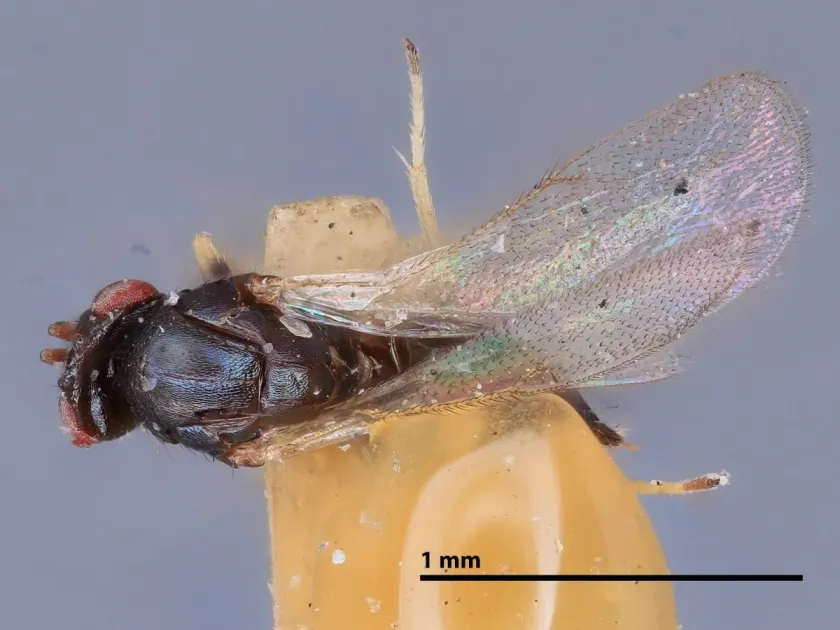
Description
How to identify
Tetrastichus euplectri belongs to the order Hymenoptera, family Eulophidae. It is a tiny parasitoid wasp involved in complex ecological interactions.
Adults exhibit a dark, often metallic appearance with clear, membranous wings, typical of many eulophid wasps in agricultural landscapes.
Accurate identification is difficult without specialist microscopic examination, as many related species look nearly identical in the field.
The larval stages are endoparasitic, developing internally within the bodies of host insects, such as larvae of various Lepidoptera.
Its life history is strictly dependent on the availability of its hosts, which makes it a significant factor in ecological population dynamics.
What it damages
This species functions as a hyperparasite, meaning it attacks primary parasitoids that would otherwise control major crop pests.
The damage caused is primarily indirect, as it suppresses the natural regulatory effect of beneficial insects on plant-eating pests.
Many cultivated plants are affected when biological control programs, which rely on introduced beneficials, are disrupted by this organism.
By killing the larvae of primary parasitoids, it allows pest populations to rebound, leading to potential yield losses for farmers.
In high-intensity agricultural systems, the loss of natural enemies due to hyperparasitism can lead to unexpected pest outbreaks.
When it appears
The insect's seasonal activity is closely correlated with temperature and the phenology of its host population in the agroecosystem.
Mass emergence typically occurs during the summer months when host activity is at its highest, providing ample opportunities for reproduction.
Overwintering usually occurs within the remains of host cocoons or in crop debris, allowing the population to survive harsh conditions.
Multiple generations can be produced in a single growing season, depending on local climate conditions and available hosts.
Activity tapers off during late autumn and early spring, with the population surviving in a quiescent state until warmer weather returns.
Signs of infestation
The most reliable sign of infection is the presence of tiny, pin-prick emergence holes on the shells of beneficial host cocoons.
Infected larvae often display abnormal coloration or stunted growth, eventually leading to their death before reaching adulthood.
A noticeable decrease in the efficacy of naturally occurring or introduced beneficial insects is a strong indicator of hyperparasitism.
Visual inspection of the field may not reveal the pest directly due to its small size, requiring more advanced diagnostic methods.
Sampling and rearing host larvae in controlled environments can confirm the presence and infection rates of this parasitic species.
Control measures
Effective management focuses on disrupting the lifecycle of the hyperparasite while preserving primary beneficial insects in the field.
Selective chemical controls can be used to manage the population, provided that the timing is carefully chosen to protect primary parasitoids.
Sanitation practices, such as removing or incorporating crop debris, help reduce the number of suitable overwintering sites.
Integrated Pest Management strategies involve coordinating the release of beneficials to minimize competition with native hyperparasites.
- Regular monitoring using yellow sticky traps and sweep nets.
- Destruction of overwintering sites in crop residues.
- Strategic timing of biological control releases.
- Application of selective biopesticides where necessary.
Taxonomy
- Latin name
- Tetrastichus euplectri
- Order
- Hymenoptera
- Family
- Eulophidae
- EPPO code
- TETSEU
Discussion
No discussions yet — be the first.