
Tamarixia radiata
Tamarixia radiata
Description
How to identify
It is critical to define Tamarixia radiata correctly: it is not a plant pest. It is a highly specialized parasitoid wasp of the family Eulophidae, widely recognized as a primary biological control agent against the Asian citrus psyllid (Diaphorina citri).
The adult wasp is extremely small, measuring approximately 1–2 mm in length. Its body is primarily black, with delicate, transparent wings typical of the Chalcidoidea superfamily.
The female wasp is an expert hunter, capable of locating psyllid infestations from significant distances by detecting chemical cues and honeydew deposits left by the pest.
The biological cycle involves the wasp laying eggs under or near the psyllid nymphs. Upon hatching, the wasp larva feeds externally on the psyllid, effectively terminating the pest's development.
In global agricultural practices, this wasp is considered a frontline defense against the spread of citrus greening disease (HLB), as it keeps the psyllid vector populations below economic injury levels.
What it damages
This object does not damage crops. It is strictly a beneficial organism that does not feed on plant foliage, stems, or fruit juices.
The agronomic value of Tamarixia radiata lies in its predatory efficiency against one of the world's most destructive citrus pests. It exerts natural pressure on pest populations without any negative impact on the tree's physiology.
Integrating this wasp into citrus orchard management allows farmers to significantly reduce their reliance on broad-spectrum chemical insecticides, promoting healthier ecosystems.
Labeling this species as a "pest" is fundamentally incorrect; rather, it is a key ally in sustainable integrated pest management (IPM) programs.
For modern horticulture, utilizing such biological agents is an essential strategy for long-term protection and cost-effective disease management.
When it appears
The activity of the wasp is highly dependent on environmental temperature and the availability of psyllid nymphs, which serve as the essential host for its offspring.
In tropical and subtropical regions, Tamarixia radiata remains active throughout the year, provided there is a constant supply of citrus growth flushes where psyllids aggregate.
The development time from egg to adult is short, roughly 14 days under warm conditions (25–28°C), allowing for rapid population growth in response to psyllid surges.
Adult wasps exhibit strong survival instincts and can overwinter in orchard vegetation, ready to resume activity during the spring warming period.
Peak population cycles of the wasp generally mirror the population cycles of the citrus psyllid, ensuring that natural control is most intense during the period of highest pest pressure.
Signs of infestation
Identifying the presence of Tamarixia radiata in an orchard involves observing signs of parasitism on the psyllid nymphs:
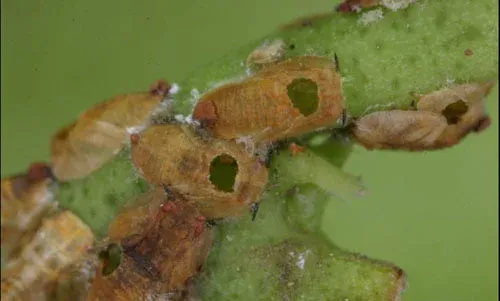
- Presence of mummified or collapsed psyllid nymphs on the underside of leaves;
- Evidence of small, circular exit holes on the exoskeletons of dead psyllid nymphs;
- Significant decline in the population of live, sap-sucking nymphs on new citrus shoots;
- A reduction in the prevalence of honeydew and associated sooty mold on the foliage;
- Clearance of psyllid colonies in areas where the wasp has been successfully introduced.
Control measures
The management strategy regarding Tamarixia radiata focuses on conservation. The goal is to provide a habitat where the wasp can thrive by avoiding the use of toxic pesticides.
If chemical control of other pests is necessary, growers should select selective pesticides that are known to have low toxicity to parasitoid wasps.
Planting flowering cover crops or field borders can provide supplemental nectar sources for adult wasps, which can improve their longevity and fecundity.
Regular monitoring of citrus groves is essential to determine the impact of natural parasitism and to decide if augmentation (releasing laboratory-reared wasps) is required.
Effective management combines these biological controls with sound pruning practices that limit excessive flush growth, thereby reducing the habitat available to the citrus psyllid.
Taxonomy
- Latin name
- Tamarixia radiata
- Order
- Hymenoptera
- Family
- Eulophidae
- EPPO code
- TAMRRA
Discussion
No discussions yet — be the first.