
Tamarixia dryi
Tamarixia dryi
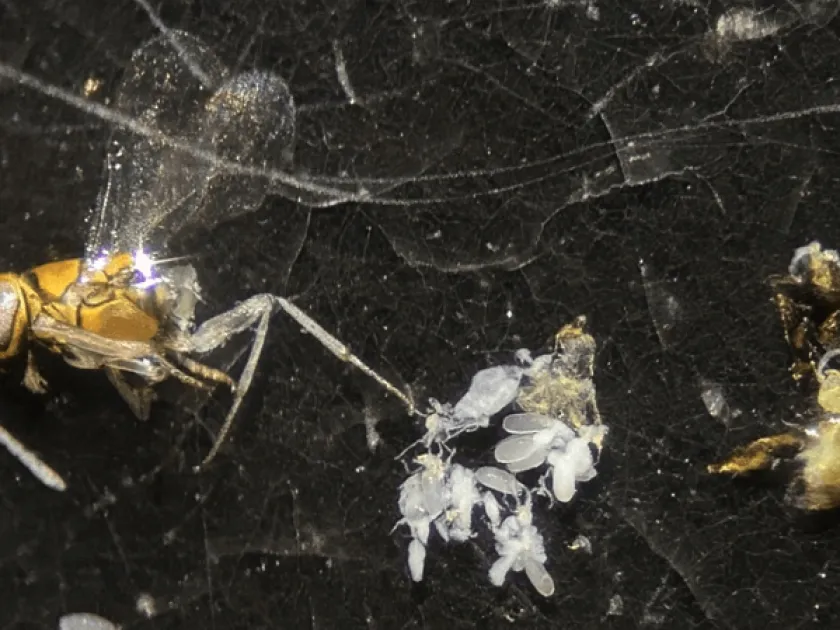
Description
How to identify
Tamarixia dryi is a highly specialized parasitoid wasp belonging to the family Eulophidae within the order Hymenoptera. This tiny insect plays a vital role in natural ecosystems and agricultural pest management programs.
The adult wasp is extremely small, typically measuring between 1 and 2 millimeters in length. Its body is generally dark with a subtle metallic sheen, which is a common characteristic among many species in the superfamily Chalcidoidea.
Identification in the field requires specialized equipment like sweep nets or yellow sticky traps followed by laboratory microscopic examination. The wing venation and specific morphological traits of the antennae are key features used by taxonomists.
As a biological control agent, it has evolved to locate its host with high precision. Females use sensory organs to detect the presence of nymphs, allowing them to navigate complex canopy environments effectively.
The life cycle involves an egg, larval, and pupal stage. These stages occur primarily under or within the body of the host, protecting the developing parasitoid from environmental stressors and generalist predators.
What it damages
It is critical to note that Tamarixia dryi is not a plant pest. Instead, it is an essential beneficial insect that serves as a predator for the Asian citrus psyllid, Diaphorina citri, which is a devastating agricultural threat.
The citrus psyllid is notorious for transmitting Candidatus Liberibacter asiaticus, the bacterium responsible for Huanglongbing (HLB), also known as citrus greening disease. This disease has caused billions of dollars in losses for the global citrus industry.
The wasp attacks the nymph stage of the psyllid by laying eggs under or inside the host's body. The developing wasp larva consumes the psyllid nymph, effectively killing it before it can reach adulthood or transmit disease pathogens.
By suppressing psyllid populations, Tamarixia dryi acts as a natural biological buffer. This significantly reduces the reliance on chemical insecticides, promoting a more sustainable approach to citrus orchard management.
Therefore, this species is entirely beneficial to agricultural crops. Its presence is considered a key indicator of integrated pest management success in citrus-growing regions prone to psyllid infestations.
Control measures
Control measures concerning Tamarixia dryi are focused on conservation and augmentation. Since it is a natural ally, the primary goal for agronomists is to ensure the environment remains hospitable for the wasp's survival.
The most effective strategy involves eliminating or significantly reducing the use of broad-spectrum pesticides. These chemicals often have lethal effects on beneficial insects, which can lead to a surge in pest populations once the natural predators are removed.
Providing nectar sources via companion planting or wildflower strips around orchards is recommended. Adult wasps require carbohydrates for energy, and nectar sources significantly increase their lifespan and reproductive output.
In areas where psyllid populations exceed economic thresholds, laboratory-reared populations of Tamarixia dryi are released. This augmentation strategy helps re-establish the balance between the pest and its natural enemy.
- Regular monitoring of wasp activity using non-invasive techniques.
- Prioritizing selective, eco-friendly pesticides that preserve beneficial populations.
- Maintaining field borders that harbor non-crop vegetation for ecological stability.
Taxonomy
- Latin name
- Tamarixia dryi
- Order
- Hymenoptera
- Family
- Eulophidae
- EPPO code
- TAMRDR
Discussion
No discussions yet — be the first.