
Tamarixia
Tamarixia
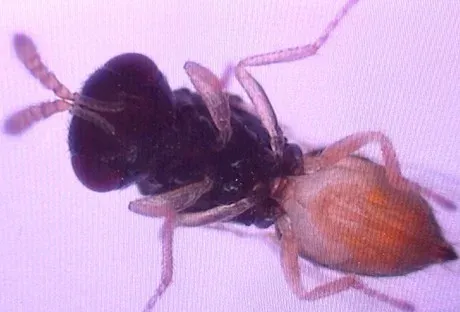
Description
How to identify
Tamarixia (scientific name: Tamarixia radiata) is a tiny parasitic wasp from the Eulophidae family within the order Hymenoptera. These beneficial insects are essential agents in biological control programs, especially for citrus crops.
Adult wasps are extremely small, typically measuring between 1 to 1.5 millimeters in length. They are characterized by their dark coloration and agile movement patterns, allowing them to scan foliage efficiently for their host, the psyllid.
The life cycle of the wasp is specialized. Female wasps search for the late-instar nymphs of their target pest. Once a host is identified, the female deposits an egg underneath the body of the psyllid nymph.
Upon hatching, the larva of the wasp feeds on the internal tissues of the psyllid, ultimately killing the host. The wasp then undergoes pupation within the remnants of the host's body, emerging shortly after as an adult.
Their life cycle is relatively rapid, often completed within two weeks under warm climatic conditions, which allows populations to build up quickly in response to pest outbreaks.
What it damages
Tamarixia itself does not cause any damage to plants or crops. Its entire evolutionary strategy is focused on identifying and parasitizing specific types of hemipteran pests, most notably the Asian citrus psyllid (Diaphorina citri).
The Asian citrus psyllid is a devastating pest in citrus orchards worldwide because it acts as the primary vector for Candidatus Liberibacter species, which cause Citrus Greening disease (HLB).
By parasitizing the nymphs of the psyllid, Tamarixia directly reduces the population density of the pest. This action is crucial in preventing the rapid spread of the disease and the subsequent degradation of tree health.
The parasitism rates achieved by this wasp can be high, making it a sustainable alternative to repetitive chemical applications. It effectively exerts pressure on the pest population, keeping it below economic damage thresholds.
In modern agricultural practice, Tamarixia is viewed as an indispensable tool for sustainable grove management, contributing to the longevity and productivity of citrus trees.
Control measures
Effective management regarding Tamarixia involves creating an environment where these parasitoids can thrive. The priority is to avoid the indiscriminate use of broad-spectrum chemical insecticides that can decimate beneficial populations.
If chemical interventions are absolutely necessary due to extreme pest pressure, growers should use selective or biological insecticides that are compatible with the presence of parasitoid wasps.
Maintaining floral diversity within or around the orchard is an excellent strategy to support adult wasps. Nectar sources provide the essential energy required for the wasps to live longer and search for hosts more effectively.
- Monitor psyllid populations closely to determine the best timing for potential biocontrol releases.
- Avoid spraying during the peak flight activity of adult Tamarixia.
- Establish hedgerows or cover crops to provide refugia for natural enemies.
In high-infestation scenarios, augmenting the natural population with mass-reared Tamarixia from specialized insectaries can significantly increase the success of suppression efforts.
Taxonomy
- Latin name
- Tamarixia
- Order
- Hymenoptera
- Family
- Eulophidae
- EPPO code
- TAMRSP
Discussion
No discussions yet — be the first.