
Sympiesis dolichogaster
Sympiesis dolichogaster
Description
How to identify
Sympiesis dolichogaster is a minute parasitic wasp belonging to the order Hymenoptera and the family Eulophidae. These wasps are widely recognized for their role as parasitoids of various leaf-mining insects.
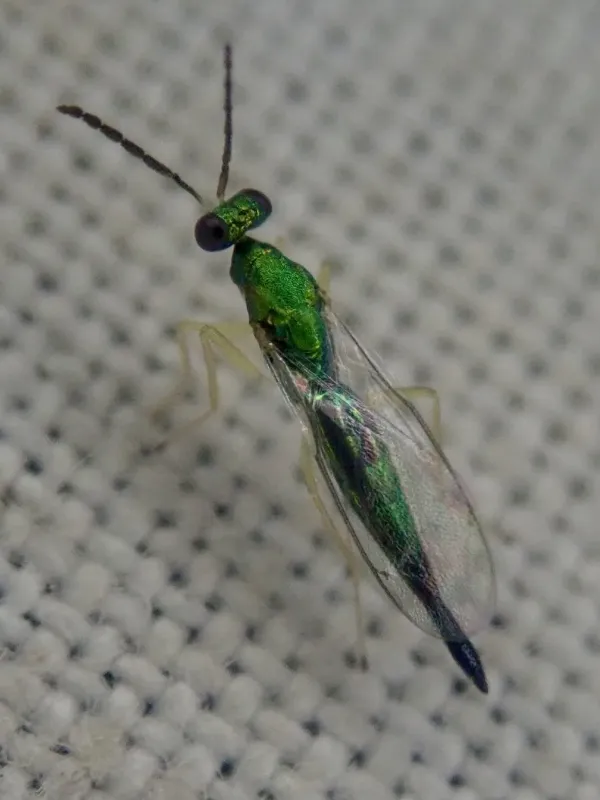
The adult wasps are typically 2-3 mm long, featuring a metallic green or bronze body color. Their wings are transparent and possess a distinctive venation pattern characteristic of the Eulophidae family.
Larvae of this species are external parasitoids. They develop within the mines created by host insects, where they feed on the host's body tissues until reaching the pupal stage.
The females utilize a specialized ovipositor to penetrate plant tissues or existing mines to deposit eggs near or directly onto the host larvae.
Identification in the field often requires microscopic examination or rearing specimens from collected mines to distinguish them from other similar parasitoid species.
What it damages
The primary target of Sympiesis dolichogaster is leaf-mining larvae, including various species of moths and flies that infest fruit trees and ornamental shrubs.
Damage to plants is primarily indirect. By parasitizing beneficial insects, these wasps can disrupt the natural biological control mechanisms, potentially leading to outbreaks of primary pests.
In high concentrations, their activity inside the leaf tissue can accelerate the necrosis of the leaf blade, negatively affecting the plant's overall photosynthetic efficiency.
Fruit crops like apples and pears are particularly susceptible when the balance between primary miners and parasitoids is shifted by improper pesticide use.
Although they are not direct herbivores, their impact on the complex insect community within a canopy makes them an important factor in horticultural management.
When it appears
The activity of Sympiesis dolichogaster typically begins in late spring, coinciding with rising temperatures and the emergence of the first generations of host insects.
The species undergoes multiple generations throughout the growing season, with the number of cycles being highly dependent on the host density and prevailing weather conditions.
Peak abundance is often observed in mid-to-late summer, when the population density of leaf-mining larvae is at its highest level in the orchard or garden.
As autumn approaches, the wasps enter a state of diapause, overwintering in sheltered locations such as leaf litter, bark crevices, or the upper soil layer.
Temperature and humidity fluctuations play a critical role in the timing of their emergence and the overall success of each generation during the vegetative season.
Signs of infestation
The most prominent sign of infestation is the appearance of empty or perforated mines on the leaves, where the host larvae were previously active.
Closer observation of the leaves reveals small exit holes, indicating where the adult wasps have emerged from the mines after completing their development cycle.
Inside the mines, one may find the remains of host larvae or the distinctive pupae of the parasitoid, often darker in color than the host's original inhabitants.
A sudden cessation of the mine's growth is a strong indicator that the mining larvae have been parasitized or killed by the wasp.
- Presence of exit holes on the leaf surface.
- Death of host larvae within the leaf tissue.
- Disrupted and browned patches of leaf mines.
Control measures
Effective management of Sympiesis dolichogaster requires a balanced integrated pest management (IPM) approach to avoid eliminating beneficial natural enemies.
The use of broad-spectrum insecticides should be minimized, as these chemicals often harm parasitoids more significantly than the targeted pests.
Good horticultural practices, such as the removal and destruction of fallen leaves in autumn, help reduce the number of overwintering individuals.
Regular monitoring using sticky traps can provide essential data regarding population levels, allowing for more precise and timely interventions only when necessary.
Promoting habitat diversity in and around the orchard supports a healthy population of predators and parasitoids, which naturally keeps the pest population in check.
Taxonomy
- Latin name
- Sympiesis dolichogaster
- Order
- Hymenoptera
- Family
- Eulophidae
- EPPO code
- SYMIDO
Discussion
No discussions yet — be the first.