
Erythrina gall wasp
Quadrastichus erythrinae
Description
How to identify
The Erythrina gall wasp (Quadrastichus erythrinae) is a small hymenopteran insect belonging to the Eulophidae family. Despite the common name "wasp," it acts as a highly specialized gall-forming pest.
Adults are very tiny, measuring approximately 1.5 mm in length. They have a dark body and are capable of flight, which allows for the rapid spread of the species across urban and rural landscapes.
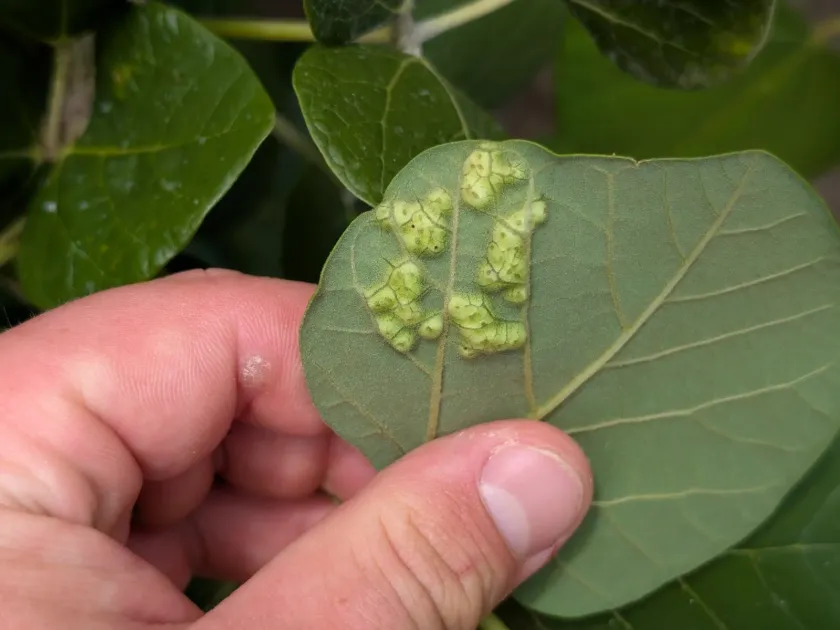
The life cycle involves larval development inside the plant tissue. The insect forces the host plant to create tumor-like structures called galls, which provide food and shelter for the larvae.
Positive identification typically requires an expert examination of the galls. However, the presence of these specific deformities on Erythrina trees is a strong indicator of an infestation.
This pest is recognized as an invasive species in many parts of the world, capable of causing severe ecological and economic damage to ornamental plantings.
What it damages
The primary host for this pest is the genus Erythrina, commonly known as coral trees. These are widely used in landscaping due to their vibrant flowers and rapid growth.
The wasp targets new vegetative growth, including young leaves, petioles, and flower buds. Infestation occurs when the adult female lays eggs into the soft tissue of the host plant.
As larvae develop, they release chemical substances that cause abnormal cellular division in the plant. This leads to the formation of hard, woody galls that stunt the plant's growth.
Leaves affected by the gall wasp become twisted, crumpled, and unable to photosynthesize efficiently. This reduces the energy production of the tree and weakens its overall defense mechanisms.
Severe infestations can lead to total defoliation and the death of young saplings, making it a critical threat to nursery production and urban forestry.
Signs of infestation
The most prominent sign is the appearance of small, green, or yellow nodules on the leaves. These quickly swell and turn into hardened, distorted gall structures.
Stems and petioles show characteristic thickening and severe twisting. In many cases, the terminal buds die off, resulting in stunted branch development and a "witches' broom" growth pattern.
Plants may show signs of chlorosis or necrosis on the leaf margins as the tree struggles to maintain growth in the presence of the parasitic larvae within the tissues.
Premature leaf drop is a hallmark of high-level infestation. If the galls are dissected, one can often find small larvae or pupae tucked inside the interior chambers.
Stunted growth, particularly in younger trees, is often noticed long before the specific gall structures become visible, making early detection difficult but necessary.
Control measures
Sanitation is the first line of defense. All infested plant parts must be pruned and disposed of carefully, preferably by burning, to prevent the escape of emerging adults.
Systemic insecticides are the most effective chemical intervention. Since the larvae are protected inside the galls, contact sprays often fail, while systemic products translocated through the sap are more reliable.
Integrated Pest Management (IPM) strategies, including monitoring and biological control using specific parasitoids, are being researched and implemented in affected regions.
Nursery owners must maintain strict quarantine protocols to avoid importing infested plant materials, which is the primary driver of the wasp's long-distance movement.
- Regular monitoring of canopy health
- Prompt pruning and disposal of galls
- Use of systemic insecticides like imidacloprid
- Strict quarantine on Erythrina imports
- Preventative sprays during the flushing season
Taxonomy
- Latin name
- Quadrastichus erythrinae
- Order
- Hymenoptera
- Family
- Eulophidae
- EPPO code
- QUSTER
Discussion
No discussions yet — be the first.