
Pediobius bruchicida
Pediobius bruchicida
Description
How to identify
Pediobius bruchicida is a species of parasitic wasp belonging to the order Hymenoptera and the family Eulophidae. It acts as an important entomophage, specializing in parasitizing the larvae of insects that develop within the seeds of various legumes.
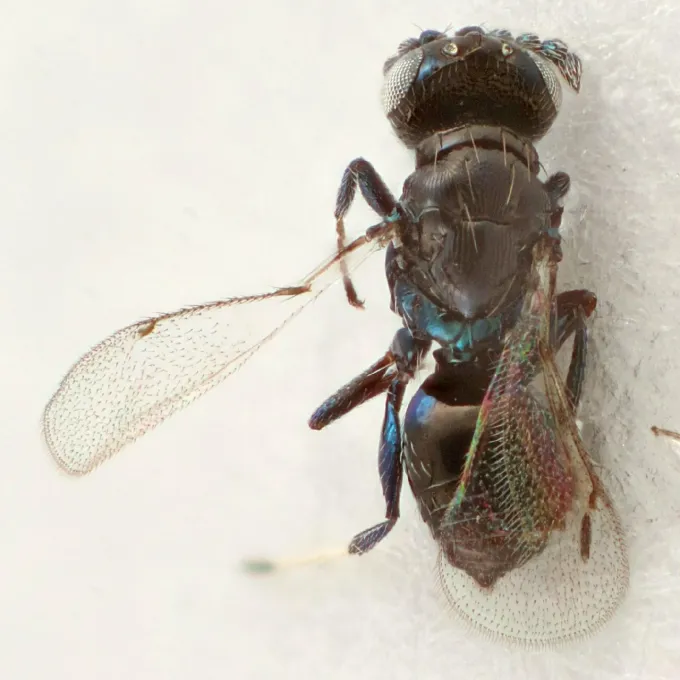
The adult wasp is minute, typically measuring only a few millimeters in length. Its body coloration is often dark with a metallic sheen, which is characteristic of many eulophid wasps. Due to their small size, these insects are rarely seen by the naked eye in field conditions.
The biological cycle of this species is perfectly adapted to its hosts, primarily members of the family Bruchidae. The female wasp possesses highly developed sensory organs to detect larvae hidden deep within the seeds of peas, beans, and other legumes.
The life cycle includes a complete metamorphosis, comprising the stages of egg, larva, pupa, and adult. The developmental timing is synchronized with the host's life cycle to ensure that the parasite larvae have sufficient resources for their growth.
Entomologists consider this species a vital component of the natural ecosystem in pulse crop fields. Their presence is a sign of a functioning biological control mechanism that helps maintain the balance of the insect community.
What it damages
Pediobius bruchicida is not a direct pest of agricultural crops. It does not consume plant tissues, stems, leaves, or roots, and therefore causes no physical damage to the growth or development of cultivated legumes.
Its "damage" is exclusively related to the insect world. As a parasitoid, it kills the larvae of primary pests like the pea weevil or bean weevil. This activity is considered beneficial to agriculture, as it reduces the number of weevils that destroy seeds.
While it is a parasitoid, it primarily targets the destructive larvae of Bruchidae. By reducing the larval population, it significantly lowers the level of seed infestation, thereby protecting the harvest quality for farmers.
In some cases, if parasitoids are overly abundant, they might affect other beneficial insects, but this is a natural ecological trade-off rather than an agricultural loss. There is no economic damage associated with the activity of this species.
Farmers should understand that Pediobius bruchicida is a natural ally. Their presence in the field is a indicator that the agro-ecosystem is capable of suppressing pest populations without the immediate need for chemical intervention.
Control measures
No control measures are directed against Pediobius bruchicida because it is a beneficial insect. The objective for any agronomic program should be to preserve and protect this species to maximize its efficiency as a biological control agent.
The use of broad-spectrum insecticides is discouraged, as these chemicals often eliminate parasitoids faster than they eliminate the target pests. A selective approach to pest management is recommended to sustain the population of these wasps.
Integrated Pest Management (IPM) practices should be employed to monitor population dynamics. Only when the primary pest density exceeds the economic threshold should targeted chemical treatments be considered, and even then, choosing products with lower toxicity to beneficials is key.
Good agricultural practices, such as post-harvest field sanitation and proper seed storage, contribute to the management of primary pests without harming the parasitoid population. These methods help maintain the natural balance effectively.
Creating refugia or maintaining edge habitats around fields can provide the necessary conditions for these wasps to thrive. Encouraging biodiversity around legume fields is a strategic way to boost natural pest control services.
Taxonomy
- Latin name
- Pediobius bruchicida
- Order
- Hymenoptera
- Family
- Eulophidae
- EPPO code
- PEDBBR
Discussion
No discussions yet — be the first.