
Euplectrus puttleri
Euplectrus puttleri
Description
How to identify
Euplectrus puttleri is a small parasitic wasp belonging to the family Eulophidae within the order Hymenoptera. It is well-recognized in entomology as an ectoparasitoid of various lepidopteran larvae.
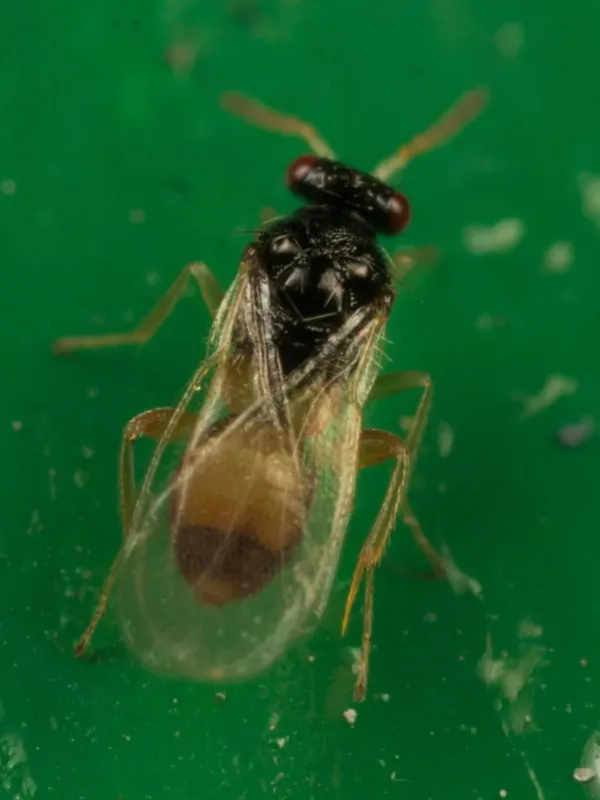
The adult form is typically dark-colored with a metallic sheen, featuring slender antennae and specialized wings designed for agile flight during the search for hosts.
A distinctive biological trait of this species is the external development of its larvae, which feed on the host's body surface rather than burrowing inside, differentiating them from endoparasitoids.
They possess an ovipositor used to deposit eggs directly onto the host's cuticle, ensuring the emerging larvae have immediate access to nutrients.
Due to their minute size, professional entomologists utilize magnifying equipment for accurate species identification, as they can easily be confused with other eulophid wasps.
What it damages
In an agricultural context, Euplectrus puttleri is generally considered a beneficial organism because it regulates populations of caterpillar pests that damage crops.
Primary hosts include larvae of noctuid moths (Noctuidae), which are known to cause significant economic losses in corn, soybean, and vegetable cultivation.
Direct damage to the plant is nonexistent; however, an imbalance in the predator-prey relationship can occur if pesticide use disrupts the wasp's presence, leading to unchecked pest outbreaks.
The intensity of the impact on crop health depends on the wasp's ability to locate hosts within the field, which is often influenced by field architecture and biodiversity.
By effectively suppressing caterpillar populations, Euplectrus puttleri acts as a natural guardian of crop yield, minimizing the need for artificial intervention.
When it appears
The activity cycle of Euplectrus puttleri is strictly synchronized with the life cycle of its hosts and the phenology of the agricultural crops they infest.
Adult wasps typically emerge during the summer months, coinciding with the period of peak abundance for lepidopteran larvae in commercial fields.
They can complete multiple generations per season if environmental conditions, particularly temperature and humidity, remain within the optimal range of 20 to 28 degrees Celsius.
Winter survival is achieved through pupation, with the insects entering a dormant stage within silk cocoons securely attached to plant debris or soil crevices.
As temperatures rise in the spring, the emerging adults commence their search for fresh larvae to lay eggs, effectively starting the new control cycle.
Signs of infestation
The most reliable sign of Euplectrus puttleri presence is the observation of clusters of tiny, creamy-colored larvae anchored firmly to the thorax or abdomen of a host caterpillar.
Parasitized hosts exhibit visible lethargy, cessation of feeding behavior, and a gradual decline in physical condition leading to eventual mortality.
After the larvae finish feeding on the host's hemolymph, they spin small, whitish cocoons in the immediate vicinity of the host carcass.
Careful field scouting reveals empty host exoskeletons scattered among the foliage, often accompanied by the silken remains of the wasp's pupal stage.
High infestation levels in a field can often be seen as a sudden, natural drop in the population density of caterpillars, signaling successful parasitoid activity.
Control measures
To maximize the benefits provided by Euplectrus puttleri, growers should prioritize Integrated Pest Management (IPM) strategies that avoid broad-spectrum insecticides.
When chemical application is absolutely necessary, selecting systemic or narrow-spectrum products with low toxicity to Hymenoptera is highly recommended to protect the wasp population.
Maintaining floral borders and hedgerows around crop fields provides essential nectar sources for adult wasps, thereby increasing their longevity and reproductive success.
Reducing mechanical disturbance of the soil surface in the fall and early spring can help preserve pupae, ensuring a stronger emergence of adults in the following season.
Consistent monitoring of pest populations allows for targeted intervention only when thresholds are exceeded, thus keeping the biological control agents safe and active.
Taxonomy
- Latin name
- Euplectrus puttleri
- Order
- Hymenoptera
- Family
- Eulophidae
- EPPO code
- EUPLPU
Discussion
No discussions yet — be the first.