
Euplectrus ceylonensis
Euplectrus ceylonensis
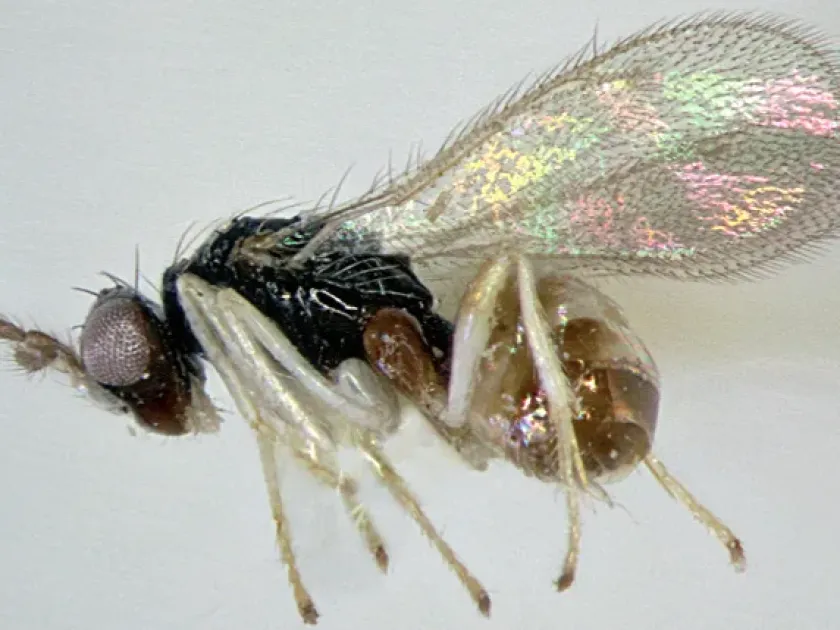
Description
How to identify
Euplectrus ceylonensis is a species of parasitic wasp belonging to the family Eulophidae (order Hymenoptera). It is recognized as a vital natural enemy of various lepidopteran larvae that pose threats to agricultural productivity.
The adult insect is a minute wasp, typically exhibiting a metallic dark green or black coloration. It possesses highly specialized sensory organs that allow it to locate host larvae with remarkable precision within dense crop canopies.
The life cycle encompasses four stages: egg, larva, pupa, and adult. Unlike endoparasitoids, E. ceylonensis larvae develop ectoparasitically, attaching themselves to the external surface of the host caterpillar.
This species is highly specialized, targeting specific families of moths. Its efficiency makes it a significant candidate for integrated pest management (IPM) programs in tropical and subtropical agriculture.
The reproductive rate is rapid, enabling the population to recover quickly and effectively suppress pest outbreaks during the critical phases of crop growth.
What it damages
Euplectrus ceylonensis does not cause damage to crops; rather, it is a beneficial organism that provides biological pest control. Its activity directly reduces populations of lepidopteran larvae, such as armyworms and bollworms.
In agroecosystems where this wasp is absent, uncontrolled outbreaks of defoliating insects frequently occur, leading to significant yield losses in cotton, tomato, soybean, and other vegetable crops.
The pest suppression provided by this wasp is natural and sustainable, preventing the need for excessive synthetic chemical inputs that are often harmful to the environment.
Damage to the plant is indirect: when the parasitic wasp population is high, the number of leaf-consuming larvae is kept below the economic injury level.
Consequently, the presence of E. ceylonensis is an asset to farmers, functioning as a silent guard that protects the foliage and fruit from destructive larval feeding.
Signs of infestation
The primary sign of E. ceylonensis activity is the presence of small, whitish or yellowish larvae attached to the external body of the host caterpillar.
Affected caterpillars exhibit reduced activity, stop feeding immediately, and eventually die. This cessation of feeding is the most visible benefit for the grower, as it preserves plant biomass.
Near the remains of the dead host, one can often find the pupal cocoons of the wasp, which are small and typically found on the underside of leaves or along stems.
A decrease in fresh frass (larval excrement) on the leaves beneath the crop canopy serves as a clear indicator of successful parasitism and controlled pest populations.
Scouting protocols using yellow sticky cards or visual inspection of leaf clusters are standard methods for detecting the presence of the adult wasps in the field.
Control measures
The most effective strategy for managing E. ceylonensis is the preservation of its habitat and the avoidance of broad-spectrum insecticide sprays that are lethal to beneficial wasps.
Integrating nectar-producing flower strips into field borders provides essential nutrition for adult wasps, increasing their lifespan and searching efficiency.
When chemical control is unavoidable, growers should opt for selective, biorational insecticides that specifically target the pest while minimizing toxic effects on beneficial entomophages.
IPM programs rely on monitoring the ratio of pests to natural enemies to ensure that chemical applications are only deployed when absolutely necessary.
- Minimize the use of non-selective broad-spectrum pesticides.
- Establish refuge areas to support local beneficial insect populations.
- Implement regular field scouting to monitor pest and parasitoid dynamics.
Taxonomy
- Latin name
- Euplectrus ceylonensis
- Order
- Hymenoptera
- Family
- Eulophidae
- EPPO code
- EUPLCE
Discussion
No discussions yet — be the first.