
Dahlbominus fuscipennis
Dahlbominus fuscipennis
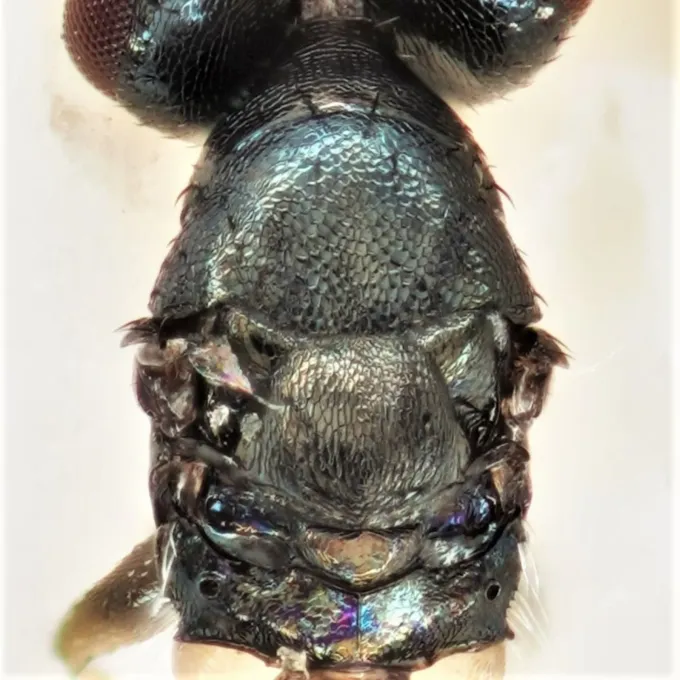
Description
How to identify
Dahlbominus fuscipennis is a small parasitic wasp belonging to the family Eulophidae within the order Hymenoptera.
Unlike traditional agricultural pests, this species is highly valued in forestry as a primary biological control agent for various sawfly species.
The adults are characterized by a dark appearance and a specific brownish wing hue, which is the primary trait used for its identification.
Due to its tiny size, the insect is rarely noticed in the wild, requiring professional expertise for accurate monitoring and field surveys.
The species is a specialist parasite, meaning its entire biological strategy is tied to the successful localization of host cocoons.
What it damages
The larvae of Dahlbominus fuscipennis develop as endoparasites, consuming the pupae of sawflies within their protective cocoons.
The primary hosts are species such as the European pine sawfly, which are notorious for defoliating coniferous trees in massive outbreaks.
As a parasite of pests, this insect does not inflict direct damage to trees, making it a beneficial organism for forest health.
By preventing the maturation of sawflies, the wasp effectively reduces the population pressure on pine forests in a sustainable manner.
Economic damage is typically associated with the sawfly host, while the presence of the wasp is a sign of natural regulation.
When it appears
The activity period for adult wasps typically spans from late spring through the summer months, depending on the climatic zone.
Multiple generations can occur within a single year if the environmental temperatures are sufficiently high for rapid development.
The lifecycle is strictly synchronized with the availability of host pupae, which are usually found in the soil or forest litter.
As temperatures begin to drop in autumn, the insects enter a state of diapause inside the host cocoons to survive the winter.
Spring emergence is triggered by warming soil temperatures, allowing the new generation to begin the search for hosts immediately.
Signs of infestation
The main indicator of this species' presence is the discovery of empty sawfly cocoons with small emergence holes made by the wasp.
Field analysis of forest litter often reveals a significant number of these parasitized cocoons during peak sawfly population years.
A sudden decline in sawfly damage on young pines is often a reliable sign that a population of Dahlbominus fuscipennis is active.
Laboratory examination of cocoons is necessary to distinguish between natural mortality and parasitism by this specific wasp species.
The lack of emerging adult sawflies from gathered cocoons provides empirical evidence of the biological control occurring in the area.
Control measures
Conservation of this species in forestry is best achieved by avoiding indiscriminate insecticide applications during peak activity periods.
Preservation of leaf litter and natural soil cover provides the necessary microhabitat for the wasps to overwinter successfully.
Integrated Pest Management strategies should prioritize biological controls over chemical ones to protect populations of beneficial insects.
If chemical intervention is unavoidable, targeted applications are required to minimize the impact on non-target parasitic species.
Continuous monitoring of population dynamics ensures that the natural control provided by the wasp remains the cornerstone of management.
Taxonomy
- Latin name
- Dahlbominus fuscipennis
- Order
- Hymenoptera
- Family
- Eulophidae
- EPPO code
- DAHLFU
Discussion
No discussions yet — be the first.