
Colpoclypeus florus
Colpoclypeus florus
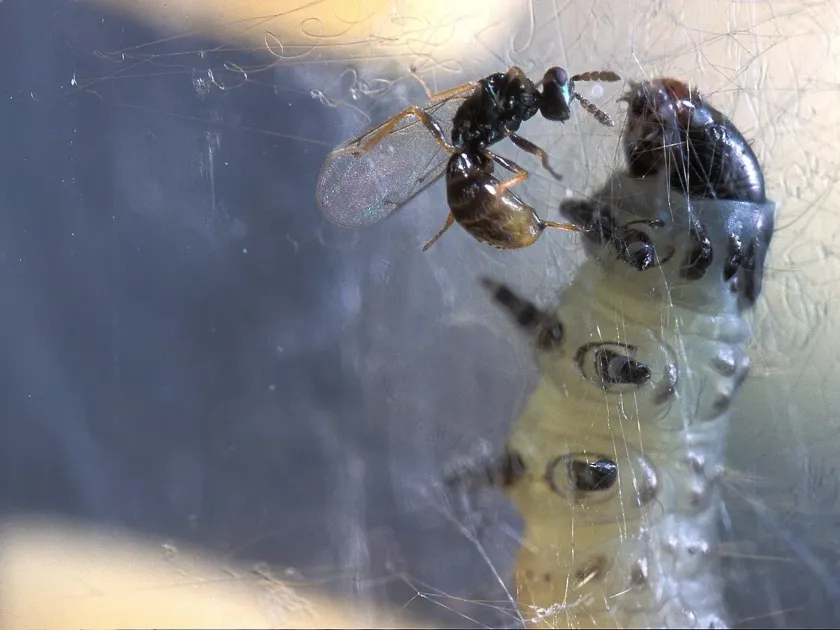
Description
How to identify
Colpoclypeus florus is a species of parasitic wasp belonging to the order Hymenoptera and the family Eulophidae. These tiny insects are critical natural enemies of various leaf-tying moths.
The adults are characterized by their small size and specialized morphology, which allows them to thrive in the complex microhabitats of orchard canopies.
They are classified as idiobiont parasitoids, meaning they paralyze their host upon oviposition and prevent any further growth or movement of the caterpillar.
The biology of Colpoclypeus florus is inextricably linked to its hosts, primarily various species of leafrollers (Tortricidae) that are significant orchard pests.
Scientific research highlights this species as a major contributor to the natural suppression of pest populations in sustainable and organic farming systems.
What it damages
This species is not a plant pest itself; it is a beneficial organism that preys on leafrollers, which are the ones causing damage to fruit trees such as apple, pear, and plum.
Leafrollers feed on leaves, buds, and young fruit, leading to significant yield loss and fruit deformity, which this wasp helps to prevent.
By parasitizing the caterpillars of leafrollers, Colpoclypeus florus significantly reduces the damage caused by these moths to agricultural crops.
In orchards where this wasp is active, the rate of leaf-tying and fruit scarring is noticeably lower, enhancing the overall quality of the harvest.
The economic impact of this wasp is positive, as it serves as a free, natural biological tool for managing pest outbreaks without chemical inputs.
When it appears
Adult activity typically begins in late spring, coinciding with the emergence of the first generation of leafroller larvae in orchards.
Population peaks usually occur during mid-summer, when the overlap of host generations provides an abundance of suitable larvae for egg-laying.
The species survives the winter by overwintering inside the pupae or final larval instars of its host, protected by the leaf structures spun by the caterpillars.
As temperatures rise in the spring, the adult wasps emerge to begin their search for hosts, responding to chemical cues released by damaged plants.
Seasonal patterns are influenced heavily by regional climatic conditions, which determine the synchronization between the parasite and the host life cycles.
Signs of infestation
A key indicator of their presence is the discovery of immobilized or darkened host caterpillars within rolled leaves, which no longer show signs of feeding.
Examining the host larvae under magnification often reveals the small, translucent larvae of Colpoclypeus florus feeding on the host's body.
A reduction in the number of active, webbed leaf clusters in the orchard canopy is a strong indicator of successful parasitism.
The absence of fresh feeding holes in fruit and leaves in late summer often correlates with a high presence of these beneficial wasps earlier in the season.
Adult wasps can sometimes be spotted resting on the underside of leaves or flying in the vicinity of host-infested branches on warm, sunny days.
Control measures
Management practices should focus on conservation biological control to protect this valuable species from chemical interference.
- Avoid using broad-spectrum insecticides that are harmful to beneficial wasps.
- Implement an Integrated Pest Management (IPM) approach to minimize chemical use.
- Provide floral resources around the orchard to support adult wasp longevity.
- Utilize pheromone monitoring to apply treatments only when strictly necessary.
- Preserve refuge areas within or near the orchard to maintain a stable population of natural enemies.
Taxonomy
- Latin name
- Colpoclypeus florus
- Order
- Hymenoptera
- Family
- Eulophidae
- EPPO code
- COOCFL
Discussion
No discussions yet — be the first.