
Colpoclypeus
Colpoclypeus
Description
How to identify
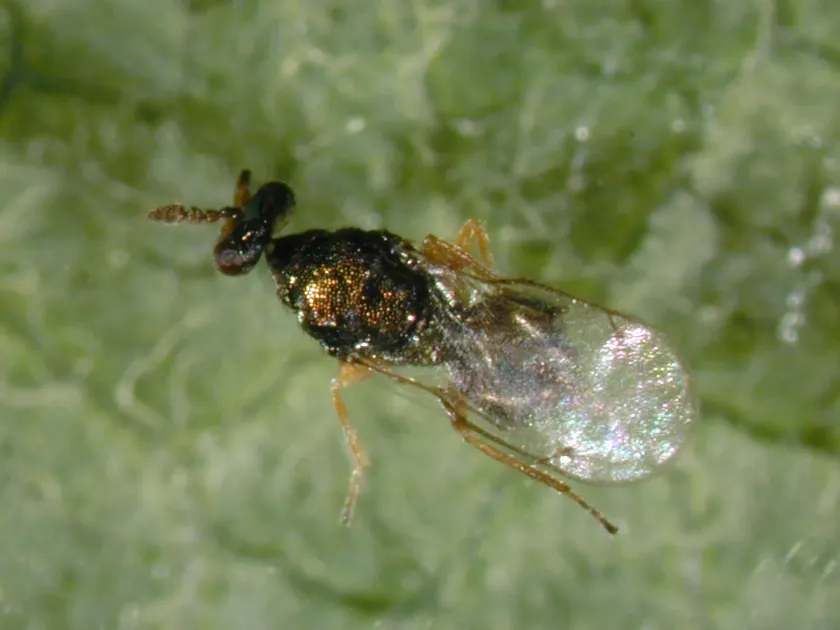
Colpoclypeus (Colpoclypeus florus) is a small, highly effective parasitic wasp belonging to the Eulophidae family within the Hymenoptera order.
This species is well-known in agricultural entomology as an ectoparasitoid, meaning its larvae develop externally on the body of the host.
The adult wasp is minute, typically measuring only a few millimeters, allowing it to navigate easily within leaf rolls created by its hosts.
As a specialist in biological regulation, it actively seeks out leafroller larvae, which are common and destructive pests in many horticultural systems.
Its role as a biological control agent is crucial for maintaining the ecological balance within orchards and vineyard ecosystems.
What it damages
It is essential to clarify that Colpoclypeus florus does not feed on plants; therefore, it is classified as a beneficial insect rather than a crop pest.
The "damage" caused by this insect is entirely directed toward the populations of tortricid moths, commonly known as leafrollers.
The larvae of these wasps feed on the hemolymph of the pest, effectively killing the caterpillar before it can reach the adult stage or cause significant crop destruction.
Crops that benefit from this insect include apples, pears, peaches, and grapes, where leafroller pressure is typically high.
By keeping pest populations below economic injury levels, this wasp saves farmers significant costs associated with chemical interventions.
When it appears
The activity of Colpoclypeus florus is strictly synchronized with the seasonal development of its primary hosts, the leafrollers.
Adult wasps emerge in early spring, precisely when overwintering larvae of pests become active and start feeding on budding foliage.
Multiple generations of this wasp occur throughout the growing season, tracking the pest's life cycle to provide continuous biological pressure.
The species survives the winter in a quiescent stage, often seeking shelter in bark crevices or plant debris to withstand freezing temperatures.
Successful population dynamics depend heavily on ambient temperature and the availability of early-season host larvae for the first brood of the year.
Signs of infestation
Detection of the wasp's presence requires careful inspection, as their eggs and young larvae are tiny and hidden inside leaf rolls.
The most reliable sign of their activity is the discovery of lethargic or dead leafroller larvae with white or yellow ectoparasitic larvae attached to their exterior.
Heavily parasitized caterpillars will exhibit a lack of movement, cessation of feeding, and eventually a characteristic shriveled or darkened appearance.
One might also find the pupae of the wasp within the leaf nest, which are morphologically distinct from the pupae of the moths themselves.
Low levels of leaf damage despite a high historical presence of leafrollers are the strongest field indicator of effective control by Colpoclypeus.
Control measures
Conservation biological control is the most effective strategy for managing the population of this beneficial wasp in commercial environments.
Farmers are encouraged to avoid broad-spectrum insecticides that are known to have high toxicity levels for beneficial Hymenoptera.
Adopting an Integrated Pest Management (IPM) approach ensures that chemical use is only a last resort, preserving the wasp population.
- Implement selective insecticides that target specific pests without harming predators.
- Provide floral resources around the orchard to support adult wasps with nectar.
- Maintain orchard margins as refugia for overwintering beneficial species.
By carefully timing applications and using biopesticides, growers can harness the full potential of these parasitic wasps to maintain crop health.
Taxonomy
- Latin name
- Colpoclypeus
- Order
- Hymenoptera
- Family
- Eulophidae
- EPPO code
- COOCSP
Discussion
No discussions yet — be the first.