
Closterocerus ruforum
Closterocerus ruforum
Description
How to identify
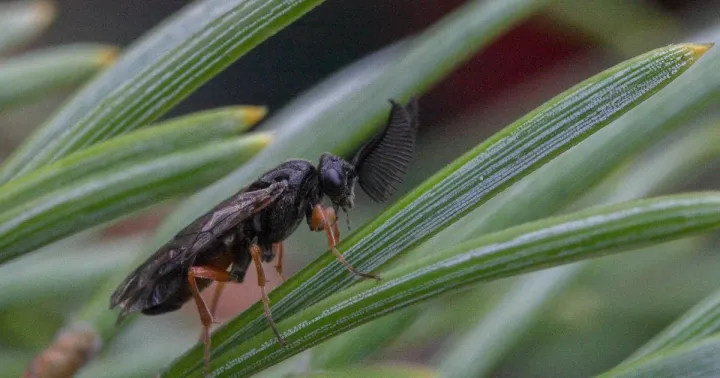
Closterocerus ruforum is a specialized parasitic wasp belonging to the family Eulophidae within the order Hymenoptera. This tiny insect acts as a crucial natural enemy to various species of sawflies, most notably the European pine sawfly.
Adult specimens are extremely small, often measuring only a few millimeters in length. Their dark, sometimes metallic-looking bodies make them difficult to spot in dense pine foliage, requiring specialized entomological sampling techniques for identification.
The life cycle of this species is intricately linked to its host. Females search for sawfly larvae to deposit their eggs. The larval stage of the parasitoid develops internally, eventually killing the host before the sawfly can complete its own life cycle.
Entomologists often identify the presence of this species by rearing collected sawfly cocoons in laboratory conditions. Observing the emergence of wasps instead of adult sawflies confirms the presence of Closterocerus ruforum in the ecosystem.
This biological interaction is vital for maintaining forest health. By keeping sawfly populations in check, these wasps prevent extensive defoliation that would otherwise cause significant stress to pine trees.
What it damages
Closterocerus ruforum is strictly a beneficial organism in forestry and does not cause any damage to plants. It is an entomophage that focuses solely on preying upon the larval stages of sawflies that feed on pine needles.
The damage caused by the parasitoid is exclusively restricted to the pest population it controls. By effectively parasitizing sawfly larvae, it serves as a natural regulator that limits the growth of pest outbreaks in pine stands.
From an economic standpoint, this wasp represents a form of biological asset. Protecting it saves forests from the negative impacts of sawfly infestation, such as reduced tree growth, wood loss, and in severe cases, the mortality of entire stands.
Because it acts as a silent guardian of the forest, any agricultural practice that indiscriminately eliminates insects will inadvertently harm this beneficial species, leading to long-term ecological consequences.
Therefore, Closterocerus ruforum should be regarded as a key component of integrated pest management (IPM) strategies for pine forests rather than an organism that needs control.
When it appears
The activity of Closterocerus ruforum is synchronized with the seasonal development of its host, the pine sawfly. Adult wasps are typically active during the spring and summer months when sawfly larvae are abundant on the trees.
Overwintering usually occurs in the prepupal stage, hidden securely within the host's cocoon. These cocoons are often located in the forest leaf litter, where they are protected from extreme weather conditions throughout the winter.
As temperatures rise in the spring, the wasps emerge from their dormant state to begin the search for hosts. This timing is critical, as the population density of the wasp is often directly dependent on the availability of sawfly larvae.
Under favorable climatic conditions, multiple generations of the parasitoid may develop within a single growing season. This high reproductive plasticity allows the wasp to track fluctuations in pest numbers effectively.
Monitoring the emergence periods of these wasps is essential for forest researchers to assess the level of natural biological suppression occurring within a specific forest compartment.
Signs of infestation
There are no visible signs of damage caused by Closterocerus ruforum on the plants themselves, as it is a parasitoid and not a plant consumer. Signs of its presence are almost exclusively limited to the biological state of the sawfly larvae.
A primary indicator is the mortality of sawfly larvae that cannot be attributed to fungal or viral pathogens. Such larvae may appear sluggish and fail to develop into healthy pupae.
In a controlled environment, the emergence of tiny wasps from collected sawfly cocoons is the most definitive sign of activity. This process proves that the parasitoids are successfully colonizing the pest population in the area.
A reduction in the total number of sawflies in areas where they were previously highly prevalent often suggests that natural control by parasitoids like Closterocerus ruforum is occurring effectively.
Entomologists also use sticky traps or specific attractant traps to monitor adult wasp populations, which provides data on the biodiversity and health of the forest ecosystem.
Control measures
Control measures are not required for this species; instead, the focus must be on conservation. Protecting this wasp is a vital part of maintaining ecological balance in forest ecosystems.
The most effective strategy is to avoid broad-spectrum insecticides, which can devastate beneficial insect populations. Whenever possible, forestry managers should prioritize biological control agents and localized treatments.
Preserving the forest floor is another critical practice. Since many sawfly cocoons (and thus the overwintering parasitoids) reside in the litter layer, minimizing heavy machinery usage and soil disturbance is essential for their survival.
Integrating floral biodiversity near pine plantations can provide adult wasps with supplemental food sources, such as nectar, which may increase their overall lifespan and reproductive success.
- Avoid the use of non-selective broad-spectrum chemical pesticides.
- Prioritize biological control methods if pest management is necessary.
- Maintain forest floor integrity to protect overwintering sites.
- Encourage local plant biodiversity to support natural enemies.
Taxonomy
- Latin name
- Closterocerus ruforum
- Order
- Hymenoptera
- Family
- Eulophidae
- EPPO code
- ACHCRU
Discussion
No discussions yet — be the first.