
Cirrospilus
Cirrospilus
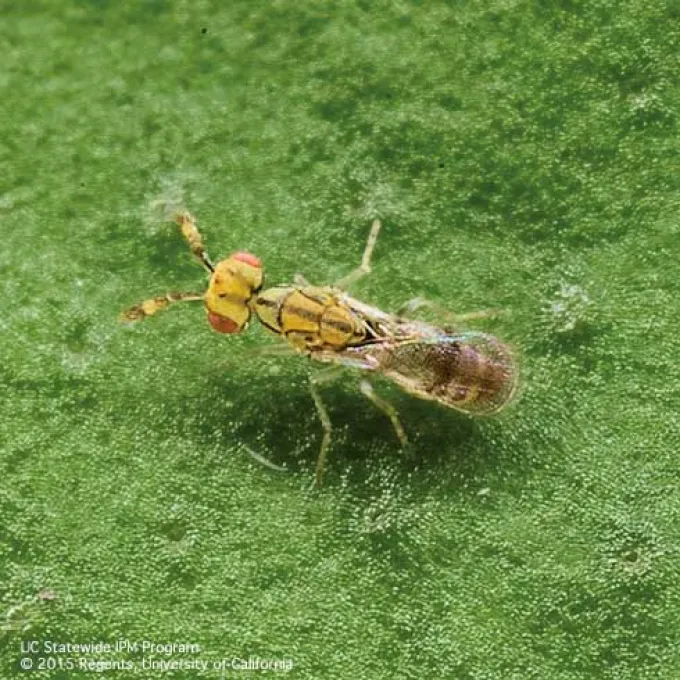
Description
How to identify
Cirrospilus is a genus of parasitic wasps belonging to the family Eulophidae within the order Hymenoptera. These tiny insects act as natural regulators of pest populations in agricultural ecosystems.
Adult wasps are characterized by a metallic, often dark, iridescent body. They are extremely small and typically require microscopic inspection to determine the exact species classification.
In most contexts, Cirrospilus serves as a beneficial biological control agent, preying upon larvae of leaf-mining insects that cause damage to various vegetable and ornamental plants.
The life cycle involves the female wasp laying eggs on or near the host larva. Upon hatching, the wasp larva consumes the host, effectively stopping the damage to the host plant.
Their presence is a key indicator of a balanced ecosystem where natural predators are actively keeping populations of harmful leafminers under control.
What it damages
While the wasps themselves do not feed on plant tissues, they are inextricably linked to leaf-mining insects (such as Agromyzidae or leaf-mining moths) that do cause significant damage to foliage.
The damage caused by the host larvae manifests as winding, translucent tunnels (mines) across the leaf surface. This destroys the photosynthetic tissue, reducing the plant's yield potential.
Crops frequently targeted by the pests that Cirrospilus parasitizes include tomatoes, cucumbers, potatoes, and diverse garden flowers.
If the population of leafminers goes uncontrolled, the plant's health degrades significantly, leading to yellowing of leaves and reduced overall vigor of the host plant.
The ecological impact is two-fold: the pest causes the initial damage, while the wasp works to alleviate this pressure by significantly reducing the pest density.
When it appears
The activity of these parasitic wasps is highly dependent on temperature and the presence of their hosts. They typically emerge in late spring when temperatures are conducive to host activity.
Throughout the growing season, these wasps can complete several generations, allowing them to rapidly increase their numbers in response to leafminer outbreaks.
As winter approaches, the wasps enter a dormant stage (diapause), often remaining as pupae inside the remains of their host or within dead plant tissues.
In controlled environments such as greenhouses, the lack of seasonal fluctuations may allow them to remain active year-round if the host population is present.
Environmental conditions play a critical role; warm and humid weather usually favors higher activity rates for both the wasps and their host insects.
Signs of infestation
The most visible sign of an infestation is the presence of pale, serpentine mines on the leaves, which indicate the activity of the host insect.
Upon closer examination, one might find small exit holes on the mines. These holes are clear indicators that a parasitic wasp has successfully developed and emerged from the host larva.
Severely infested plants will show signs of stress, including chlorosis (yellowing) and premature leaf drop, as the leafminer damage compromises the foliage.
Using a hand lens, one can sometimes observe adult wasps hovering near infested leaves, searching for hosts to parasitize.
The presence of parasitized larvae often looks like a collapsed, inactive tunnel, whereas healthy pest larvae usually leave active, expanding damage marks.
Control measures
Effective management focuses on Integrated Pest Management (IPM) strategies that prioritize the preservation of existing natural enemies over chemical interventions.
Avoid broad-spectrum insecticides that can wipe out beneficial parasitic wasps like Cirrospilus, potentially leading to subsequent secondary pest outbreaks.
Cultural practices, such as removing crop residues, help to interrupt the overwintering cycle of both the pests and their beneficial wasp parasites.
Biological control can be enhanced by planting nectar-rich flowering plants around crops, which provide food sources for adult wasps, thereby increasing their longevity.
- Limit chemical pesticide applications.
- Use selective biopesticides when necessary.
- Monitor leaf damage regularly.
- Maintain garden hygiene after harvest.
Taxonomy
- Latin name
- Cirrospilus
- Order
- Hymenoptera
- Family
- Eulophidae
- EPPO code
- CIRRSP
Discussion
No discussions yet — be the first.