
Chrysocharis nitetis
Chrysocharis nitetis
Description
How to identify
Chrysocharis nitetis is a minute parasitic wasp belonging to the family Eulophidae, within the order Hymenoptera. These insects are essential players in natural ecosystems and managed agricultural environments.
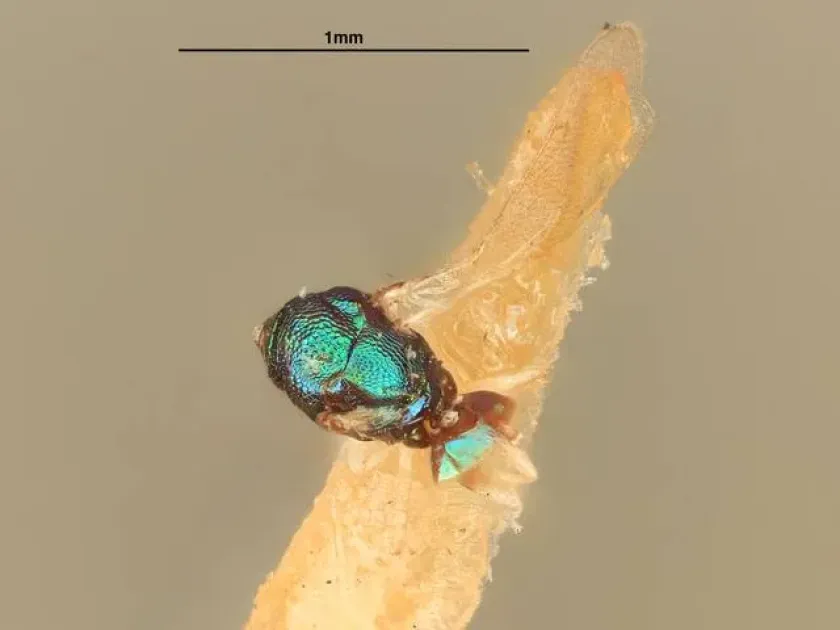
Adults are extremely small, often appearing as tiny, shimmering specks with a metallic green or bluish hue. Their wings possess very little venation, which is a key identification feature for entomologists.
Proper identification usually requires taxonomic expertise and the use of stereomicroscopes to examine specific anatomical features like antennae and body segment patterns.
They undergo complete metamorphosis (holometabolism), passing through egg, larval, pupal, and adult stages, with each stage specifically adapted for its ecological role.
Understanding their role as specialized parasitoids is crucial for modern agronomists who focus on integrated pest management (IPM) strategies.
What it damages
Chrysocharis nitetis is primarily known as a parasitoid of leaf-mining insects, particularly those from the Agromyzidae family. It does not damage plants directly.
Target crops usually include greenhouse-grown vegetables such as tomatoes, cucumbers, and lettuce, where leaf miners frequently cause significant aesthetic and physiological damage.
The female wasp lays eggs inside the host larva. The emerging wasp larva consumes the host from the inside, effectively terminating the leaf miner's life cycle.
Because they actively hunt down and neutralize leaf miners, they are considered beneficial insects rather than primary pests, despite being grouped under biocontrol research.
Their efficacy in reducing pest populations makes them a highly valued biological agent for growers looking to reduce synthetic pesticide reliance.
When it appears
The seasonal activity of Chrysocharis nitetis is highly dependent on ambient temperatures and the presence of available hosts in the vicinity.
In greenhouse settings, these wasps can maintain continuous populations throughout the year, provided that host availability and climatic conditions are stable.
Adult emergence cycles are often synchronized with the life cycles of the leaf-mining species, ensuring that a steady supply of hosts is available for reproduction.
During colder periods or in the field, they may overwinter as pupae within leaf litter, soil, or even inside the remains of their previous hosts.
Development rates are strongly correlated with temperature; higher temperatures typically speed up the life cycle, leading to more frequent generations per season.
Signs of infestation
One of the primary indicators of their presence is the cessation of leaf miner activity, characterized by the stopping of tunnel expansion on the leaves.
Careful inspection of leaves might reveal empty, dried-up cadavers of leaf miner larvae, often with tiny exit holes left by the emerging adult wasp.
A reduction in the overall damage rate, where new leaf tunnels do not appear, is a strong sign that the parasitoid population is successfully managing the miners.
Microscopic examination of infested leaves might show evidence of internal larval predation, confirming the successful parasitization process.
Integrated monitoring using sticky traps can also help detect the presence of adult wasps, providing data for more accurate biological control decisions.
Control measures
Management of Chrysocharis nitetis focuses primarily on its conservation. Avoid broad-spectrum insecticides that can wipe out beneficial parasitoid populations.
Integrated Pest Management (IPM) programs should prioritize selective chemistry that targets the pests while leaving the parasitoids unharmed.
- Limit the frequency of pesticide applications.
- Implement habitat management to support adult wasps.
- Use yellow sticky traps to monitor population shifts.
- Introduce laboratory-reared wasps if natural control is insufficient.
Agricultural practices, including sanitation and leaf pruning, should be performed with caution to avoid unintentionally removing beneficial wasps from the crop environment.
Taxonomy
- Latin name
- Chrysocharis nitetis
- Order
- Hymenoptera
- Family
- Eulophidae
- EPPO code
- CHRCNI
Discussion
No discussions yet — be the first.