
Chrysocharis nephereus
Chrysocharis nephereus
Description
How to identify
Chrysocharis nephereus is a species of parasitic wasp belonging to the family Eulophidae (order Hymenoptera). It is not a plant pest but rather a highly effective natural enemy of various leaf-mining insects that cause damage to agricultural crops.
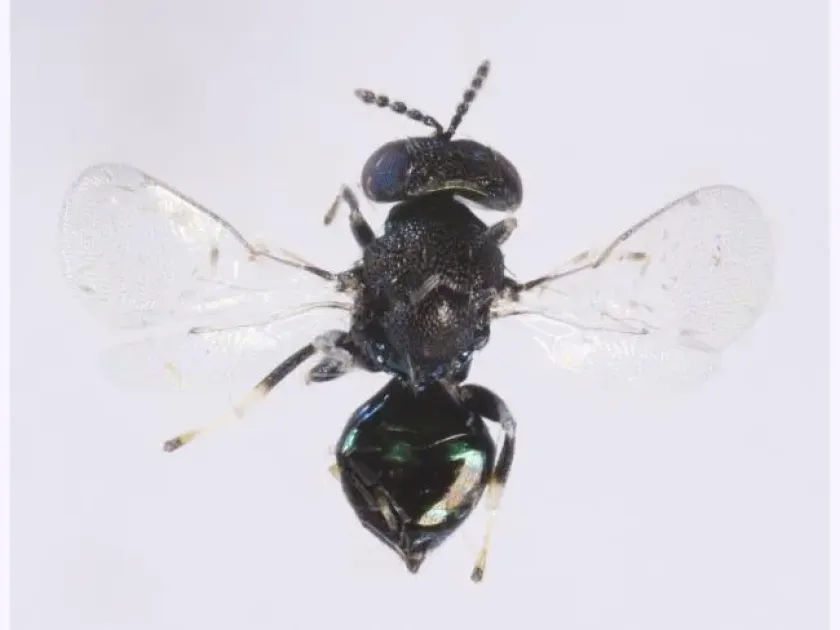
Adult wasps are extremely small, usually measuring 2-3 millimeters in length. They typically exhibit a metallic green or bronze sheen, which helps them blend into the foliage environment. Their small size makes them inconspicuous, often leading to them being overlooked by farmers.
The biology of this species is centered around its role as an endoparasitoid. Females possess specialized sensory organs on their antennae that allow them to locate the larvae of host insects, such as agromyzid flies, hidden deep within leaf tissues.
Once a host is located, the female inserts her eggs into or onto the host larva. The development stages—egg, larva, pupa, and adult—all take place within the host or the leaf mine created by the host, effectively ending the pest's life cycle.
This species is essential for maintaining ecological balance. By serving as a biological regulator, it naturally keeps the population levels of various leaf-miners below the threshold of economic damage.
What it damages
It is vital to clarify that Chrysocharis nephereus does not cause any damage to plants. It does not feed on leaves, stems, or fruits, and it possesses no mouthparts capable of damaging agricultural tissues.
Conversely, the presence of this wasp provides significant economic benefits to farmers. It specifically targets leaf-mining larvae, which are responsible for creating visible channels in leaves that reduce photosynthetic capacity and overall crop vitality.
By parasitizing these pests, the wasp reduces the need for synthetic pesticide applications. This results in healthier crops, lower production costs, and reduced environmental impact on the farm.
Trying to eradicate this wasp is detrimental to the ecosystem. Without the natural pressure of Chrysocharis nephereus, populations of leaf-mining pests can explode, causing severe crop loss that would be much harder and more expensive to manage.
In the context of integrated pest management (IPM), this species is categorized as a beneficial organism, and its conservation is a key goal for sustainable agricultural practices.
When it appears
The activity of Chrysocharis nephereus is strictly correlated with the presence and lifecycle of its host insects. They begin to emerge in the spring, as temperatures rise and the first generations of leaf-miners start their activity on crops.
Their peak activity typically occurs during mid-summer, when the warm weather facilitates rapid development cycles for both the host and the parasitoid. Multiple generations can occur within a single growing season.
Climate factors play a crucial role in their activity levels. While they remain efficient in various environments, extreme heat or heavy rain can temporarily reduce their searching efficiency in the field.
As the season comes to an end, the wasps enter a dormant stage (diapause) to survive the winter. They usually pupate within the leaf mines or in the soil surface layer, emerging again when conditions become favorable the following spring.
Agronomists often observe that Chrysocharis nephereus populations follow a "boom and bust" cycle that trails slightly behind the population peaks of the leaf-mining pests they control.
Signs of infestation
Signs of Chrysocharis nephereus at work include a visible stagnation in the spread of leaf mines. If the serpentine tunnels on the leaves stop increasing in size, it is a strong indicator that the larvae inside have been parasitized.
If you inspect damaged leaves under magnification, you may find the empty pupal or larval remains of the host pest, often with clear signs of exit holes where the adult wasp has emerged after completing its development.
The absence of live larvae within fresh-looking mines is another diagnostic sign. Farmers might also use yellow sticky traps for monitoring, where these small wasps can be identified during routine counts.
Field-level indicators often involve seeing a decrease in the overall pest pressure throughout the season, even when no chemical intervention has occurred, signifying successful natural control.
These signs are essential for the decision-making process in IPM. If a significant proportion of pest larvae are found to be parasitized, a planned insecticide application can often be cancelled, saving time and money.
Control measures
The "control" of Chrysocharis nephereus is actually a strategy for its conservation. Since it is a beneficial species, the primary goal is to provide a habitat where it can thrive without interference from chemical sprays.
It is essential to shift away from broad-spectrum insecticides. These chemicals kill beneficial insects just as effectively as the target pests, often leading to secondary outbreaks of other pests due to the loss of natural enemies.
Farmers should implement selective pest management, using biological agents or biopesticides that have minimal negative effects on Chrysocharis nephereus. Always check for compatibility with natural enemies when choosing products.
Enhancing biodiversity around the field helps sustain the wasp population. Planting wildflower margins provides a source of nectar, which is necessary for adult wasps to maintain their energy, longevity, and reproductive success.
- Avoid spraying during peak flowering times to protect pollinators and natural enemies.
- Prioritize spot-treatment instead of blanket field spraying.
- Establish non-crop refugia areas for overwintering sites.
- Train staff to recognize beneficial insects and assess parasitism rates before spraying.
Taxonomy
- Latin name
- Chrysocharis nephereus
- Order
- Hymenoptera
- Family
- Eulophidae
- EPPO code
- CHRCNE
Discussion
No discussions yet — be the first.