
Chrysocharis gemma
Chrysocharis gemma
Description
How to identify
Chrysocharis gemma is a species of minute parasitic wasp within the Eulophidae family of the order Hymenoptera. In agricultural settings, it is recognized as a vital natural enemy of various leaf-mining insects that threaten vegetable and ornamental crops.
The adult wasp is extremely small, typically measuring between 2 to 3 millimeters in length. It displays a metallic color, often reflecting shades of green or blue, which is a characteristic feature of many species within the Chalcidoidea superfamily.
The biology of this species is defined by its role as an ectoparasitoid. Its larvae develop on the exterior of the host larva, gradually consuming the internal tissues and fluids, which ultimately leads to the death of the leaf miner pest.
The systematic placement of this species highlights its high level of specialization. It demonstrates significant efficiency in targeting specific host species, making it a valuable tool in greenhouse and field biological control programs.
For agronomists, identifying this beneficial wasp in the field can be difficult due to its size. However, its presence serves as an essential indicator of a balanced ecosystem capable of self-regulation.
What it damages
Technically, Chrysocharis gemma is not a pest, as it does not cause damage to plant tissues. It is, in fact, an important biological control agent that suppresses populations of leaf miners, which are the real threat to crops.
The leaf miner larvae, which serve as hosts for the wasp, damage plants by creating serpentine tunnels (mines) in leaves. This damage reduces the plant's photosynthetic capacity, leading to premature leaf senescence and stunted growth.
By parasitizing these larvae, Chrysocharis gemma mitigates the damage inflicted on vegetable, fruit, and decorative plants. Consequently, the presence of these wasps leads to healthier crops and increased yields.
The economic impact of this species is purely positive. It provides a natural service that helps farmers reduce their reliance on chemical insecticides, which can be both expensive and harmful to the environment.
Therefore, Chrysocharis gemma should be viewed as an ally in the agricultural process rather than an organism that needs to be controlled or eliminated.
When it appears
The activity period of this species is closely linked to the lifecycle of its host, the leaf miner. Adults typically emerge in the spring, coinciding with the start of the plant growing season and the first appearance of leaf miner larvae.
Multiple generations of the wasp can occur during the growing season. Populations often peak in the second half of summer, responding to the increased prevalence of leaf miners in field conditions.
In controlled greenhouse environments, Chrysocharis gemma can maintain continuous activity year-round, provided that a stable population of host larvae is available for their development.
As temperatures drop in autumn, the wasps enter a dormant stage (diapause). They spend the winter in protected environments, such as leaf debris or within the pupal cases of their hosts in the topsoil.
Monitoring the seasonal emergence of this parasitoid allows farmers to time their pest management interventions effectively, avoiding periods when beneficial insects are at their peak activity.
Signs of infestation
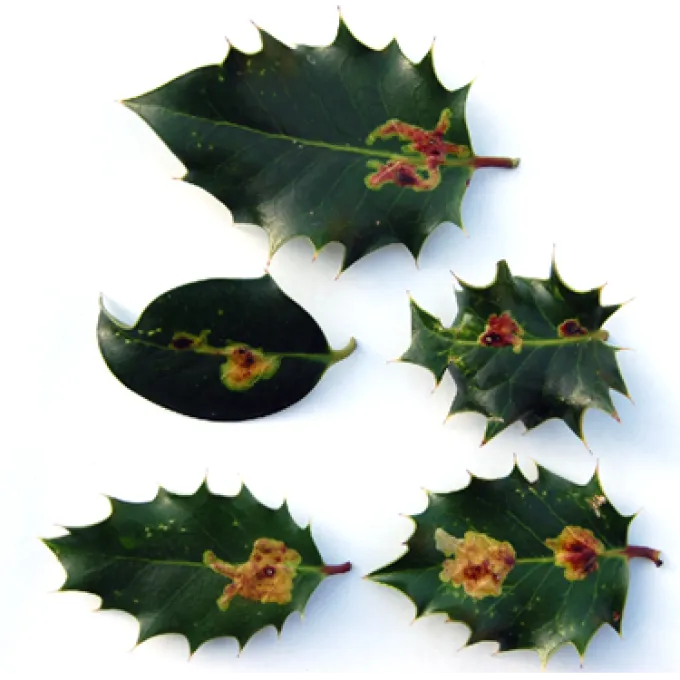
Evidence of this parasitoid's presence can be observed in the condition of leaf mines. A "dead-end" or abandoned mine that contains the remains of a withered host larva is often an indicator of successful parasitism.
Adult wasps may occasionally be found on yellow sticky traps used for monitoring agricultural pests. However, accurate identification usually requires the use of magnification tools by a trained professional.
A notable sign of biological control is a stabilization or decline in the rate of new mine formation on leaves, despite the observed presence of adult leaf miners in the vicinity.
Laboratory analysis of infested leaves frequently reveals the wasp's pupal stage inside the leaf mine. This provides definitive proof of its role in suppressing the pest population.
Farmers should look for signs of a healthy ecosystem, such as stable levels of minor pests rather than rapid, exponential increases, which often indicate effective biological control is at work.
Control measures
The most important measure to support Chrysocharis gemma is to minimize the use of broad-spectrum insecticides, particularly pyrethroids and organophosphates, which are highly toxic to parasitic wasps.
Adopting an Integrated Pest Management (IPM) approach is essential. This includes using selective bio-rational pesticides that target specific pests without harming beneficial Hymenoptera populations.
Creating floral margins around fields or greenhouses provides essential nectar sources, which significantly increases the lifespan and reproductive success of these beneficial wasps.
When chemical intervention is unavoidable, it should be conducted in the evening hours when wasps are less active, and only using products with minimal residual toxicity to natural enemies.
In large-scale greenhouse operations, augmenting the natural population through regular releases of lab-reared Chrysocharis gemma is a highly recommended strategy for sustainable pest management.
Taxonomy
- Latin name
- Chrysocharis gemma
- Order
- Hymenoptera
- Family
- Eulophidae
- EPPO code
- CHRCGE
Discussion
No discussions yet — be the first.