
Chrysocharis
Chrysocharis boops
Description
How to identify
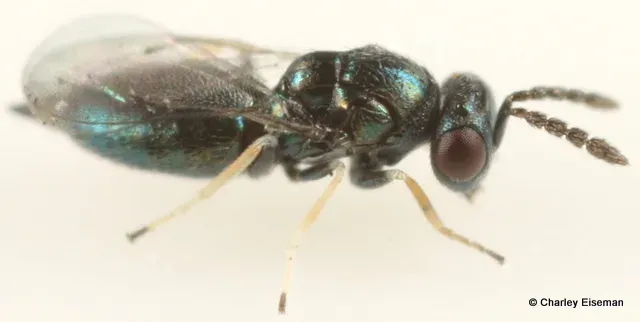
Chrysocharis boops belongs to the order Hymenoptera and the family Eulophidae. These are tiny parasitic wasps, often displaying a characteristic metallic sheen, usually ranging from green to bronze colors.
The adults of this species are extremely small, typically only a few millimeters in length. They possess well-developed wings with reduced venation, a common diagnostic trait for this group of chalcidoid wasps.
Accurate identification in field conditions requires the use of magnification tools, as morphological differences between closely related species in the Chrysocharis genus are often subtle.
These insects are entomophagous, acting as parasitoids. Their presence in agroecosystems serves as an indicator of the pest pressure from leafminers and other plant-feeding insects.
The biology of this species is primarily studied in the context of their role as natural regulators of populations of various leafmining flies and other phytophagous pests.
What it damages
Chrysocharis is not a pest that consumes plant tissue directly; instead, it parasitizes the larvae of leafmining insects, which are the ones causing significant damage to crops.
They most commonly target larvae of leafminer flies (Agromyzidae) that affect vegetable crops such as tomatoes, cucumbers, beans, and various ornamental plants.
The presence of these wasps in greenhouses or fields indicates a population of leafmining pests, whose larvae create tunnels (mines) inside the leaf tissues.
The primary damage to plants is caused by the host larvae—the leafminers—which reduce the photosynthetic capacity of leaves, leading to premature drying and wilting.
By laying eggs inside the leafminer larvae, the wasp suppresses the pest's development, effectively performing a natural biological control function.
When it appears
The activity of Chrysocharis boops adults directly correlates with temperature conditions and the growing season of their leafminer hosts.
In greenhouse conditions, the wasp can develop almost year-round, provided there is a sufficient density of leafminer fly populations to sustain the cycle.
In open field conditions, population peaks occur during summer months, coinciding with the mass emergence and activity of leafmining pests.
The life cycle includes egg, larval, pupal, and adult stages, with the parasitoid developing either within the host's body or inside the host's mine.
Optimal conditions for reproduction include warm weather with moderate humidity, matching the phases of active growth for most vegetable crops.
Signs of infestation
The primary signs of pest activity targeted by Chrysocharis are winding, pale tunnels (mines) on the leaf surface.
When parasites are present inside the mines, the leafminer larvae stop feeding, their growth slows, and they eventually perish, halting the expansion of the damaged area.
Detailed inspection of infested leaves under a microscope may reveal the remains of host larvae or the empty pupal casings of the wasp within the tunnel.
A decrease in new tunnel formation, despite the presence of old mines, can indirectly indicate the effective work of natural entomophages in the agroecosystem.
Adults of Chrysocharis are often found on the undersides of leaves or near damaged areas where they actively search for hosts to lay their eggs.
Control measures
The use of broad-spectrum chemical insecticides is highly discouraged, as it leads to the destruction of beneficial entomophages, including Chrysocharis wasps.
It is recommended to prioritize biological pest control methods, such as releasing predatory insects or utilizing selective biopesticides.
Agronomic practices include the removal and disposal of heavily infested leaves showing signs of mining to limit the reproduction of the pests.
Maintaining crop rotation and managing weed populations is essential, as weeds often serve as intermediate reservoirs for leafmining flies and their associated parasites.
- Restrict the use of broad-spectrum pesticides.
- Monitor leafminer pest population density.
- Timely removal and destruction of crop residues.
Taxonomy
- Latin name
- Chrysocharis boops
- Order
- Hymenoptera
- Family
- Eulophidae
- EPPO code
- CHRCBO
Discussion
No discussions yet — be the first.