
Baryscapus tineivorus
Baryscapus tineivorus
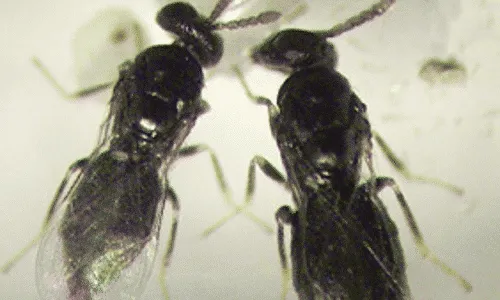
Description
How to identify
Baryscapus tineivorus is a member of the Eulophidae family, an order of Hymenoptera, known for being parasitic on various insects.
These tiny insects are highly specialized parasitoids that function as natural regulatory agents for moth populations in grain stores and warehouses.
The adult form is characterized by a small body size and often displays a metallic luster, typical of many eulophid wasps.
Identifying this species requires microscopic analysis of morphological features, such as wing venation and antennal structure, due to its minute size.
Taxonomically, it remains an important object for entomological research, as it provides valuable insights into host-parasitoid relationships in agricultural ecosystems.
What it damages
Although often discussed in the context of pests, this insect does not inflict direct damage on agricultural crops such as grains or vegetables.
Instead, it acts as a beneficial natural enemy, targeting the larvae of moths that are responsible for contaminating stored food products and textiles.
Therefore, its presence is usually considered advantageous for farmers and storehouse managers looking to control moth infestations through biological means.
Direct economic impact is actually positive, as the parasitoid reduces the need for heavy chemical treatments that might otherwise be required to save the stored inventory.
There is no risk of direct destruction of plant tissues by this species, as its entire developmental cycle is dependent on the presence of specific moth larvae.
When it appears
The life cycle of this parasitoid is strictly linked to the developmental stages of its host, mainly focusing on moth larvae and pupae found in storage environments.
In temperature-controlled storage facilities, reproduction can occur continuously throughout the year, allowing for a consistent presence of the parasitoid.
In outdoor or naturally ventilated areas, activity follows the seasonal rhythms of the host species, peaking during warm periods when moth activity is highest.
Temperature fluctuations directly influence the rate of development; warmer temperatures shorten the generation time, leading to rapid population growth.
Overwintering typically takes place within the host's cocoon, where the parasitoid remains in a larval or pre-pupal state until favorable conditions return.
Signs of infestation
A primary indicator of the parasitoid's presence is the discovery of empty moth cocoons featuring small, clean-cut exit holes made by the emerging adult wasp.
A sudden decline in the moth population within a specific storage site is a clear sign that the parasitoid is successfully exercising biological control.
Microscopic examination of the debris around infested grain batches may reveal the remnants of the parasitoid's development, such as larval skins.
The absence of fresh damage to grain despite the presence of moth remnants often indicates that the parasitoid is working to keep the pest under control.
Field inspections using magnifying tools can confirm the presence of this beneficial insect, which is crucial for making informed storage management decisions.
Control measures
There is no need for measures to control or eradicate Baryscapus tineivorus, as it is a beneficial organism that supports sustainable agriculture.
Instead, focus should be placed on maintaining an environment where natural parasitoids can thrive by minimizing the use of broad-spectrum pesticides.
- Maintain optimal humidity and temperature in storage.
- Use pheromone traps to monitor moth activity levels.
- Prioritize biological control methods over synthetic chemical applications.
By protecting these natural enemies, managers can effectively manage pest populations while adhering to environmental safety and food quality standards.
Integrated Pest Management (IPM) practices should highlight the importance of preserving beneficial species like Baryscapus tineivorus to achieve long-term grain safety.
Taxonomy
- Latin name
- Baryscapus tineivorus
- Order
- Hymenoptera
- Family
- Eulophidae
- EPPO code
- BARSTI
Discussion
No discussions yet — be the first.