
Baryscapus
Baryscapus
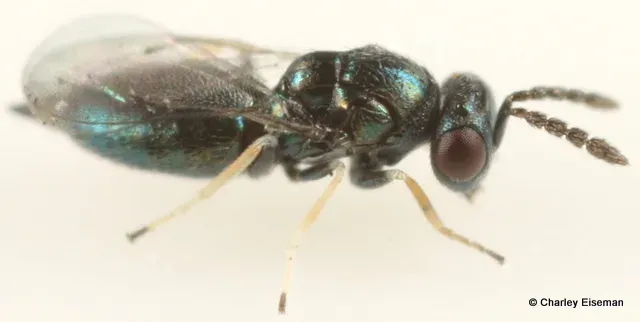
Description
How to identify
The genus Baryscapus belongs to the Eulophidae family within the order Hymenoptera. These are minute wasps that play complex roles in ecosystems.
Adults are typically very small, ranging from 1 to 2 mm in length, and often display dark, metallic coloration common among members of the subfamily Entedoninae.
Morphological identification is highly technical, as it relies on specific wing venation patterns and genital structures visible only under high magnification.
Many species within this group are parasitoids that develop inside other insects, making their status as a pest dependent on their host specificity.
While some species are beneficial as biological control agents, others are considered pests because they induce galls or infest seeds of commercial crops.
What it damages
Certain Baryscapus species cause significant damage by inducing gall formation on various plant parts, including leaves, stems, and flower buds.
Feeding by larvae inside plant tissues leads to physiological stress, resulting in stunted growth, leaf deformation, and reduced fruit yield.
In ornamental plants and nurseries, the presence of galls diminishes the aesthetic and commercial value of the affected vegetation.
Infestations can lead to premature flower bud drop or seed destruction, which directly impacts the reproductive success of the plant.
Because they often infest internal plant tissues, the damage is frequently hidden until structural abnormalities become visually apparent.
When it appears
The activity of Baryscapus adults is closely linked to the phenology of their host plants and the seasonal presence of their prey.
Typically, adults emerge during the spring and early summer when plant tissues are soft and susceptible to oviposition by the females.
The development cycle can be rapid, with several generations occurring throughout the growing season if environmental conditions are favorable.
Overwintering usually occurs as larvae or pupae protected within plant galls, where they remain dormant until the following growing season.
Field monitoring is most effective during the peak growth phases of the crop, looking for signs of gall development on new shoots.
Signs of infestation
The primary symptom of an infestation is the formation of galls—abnormal growths on plant surfaces—which serve as shelters for developing larvae.
Small, pin-sized exit holes on the surface of galls indicate that the adult wasps have successfully completed their development and emerged.
Visible curling of foliage, twisted stems, and irregular development of seed pods are common indicators of larval presence inside the tissues.
Poor plant vigor, yellowing of leaves in localized areas, and unexpected drop of flower buds can also suggest internal infestation.
Inspecting the cross-section of suspected galls often reveals larval chambers, confirming the identity of the organism responsible for the damage.
Control measures
Sanitation is the cornerstone of managing Baryscapus: pruning and destroying infested branches or leaves prevents the next generation from emerging.
Chemical control is notoriously difficult because the larvae reside inside plant tissues, protected from the reach of surface-applied contact insecticides.
Encouraging natural biodiversity, such as planting flowering margins to support parasitoid-predator dynamics, can help regulate their populations.
In commercial orchards, implementing a strict debris removal program after the harvest cycle is essential to interrupt the pest's overwintering stage.
- Removal and destruction of galls.
- Use of resistant plant varieties where available.
- Monitoring using sticky traps to detect adult flight.
Taxonomy
- Latin name
- Baryscapus
- Order
- Hymenoptera
- Family
- Eulophidae
- EPPO code
- BARSSP
Discussion
No discussions yet — be the first.