
Psyllaephagus pilosus
Psyllaephagus pilosus
Description
How to identify
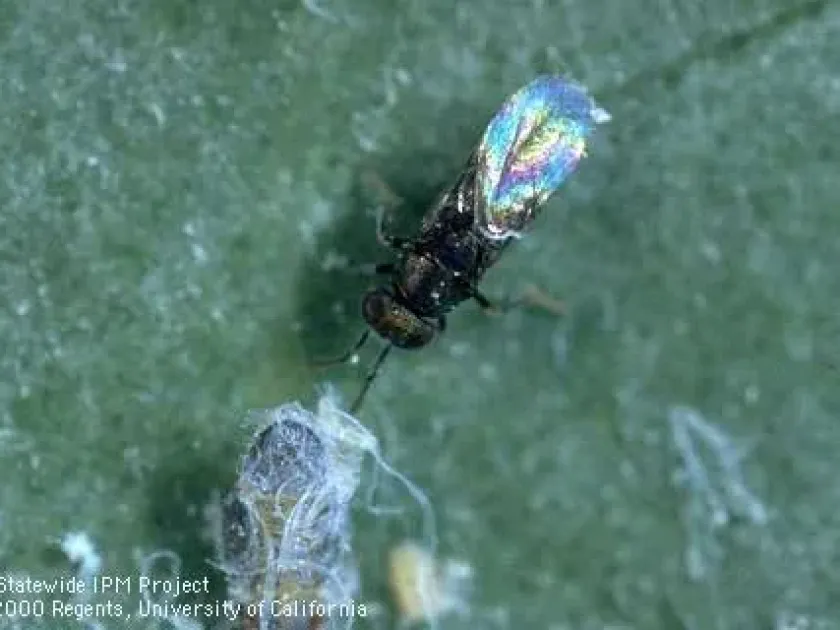
Psyllaephagus pilosus is a minute parasitic wasp belonging to the family Encyrtidae. It is widely recognized in forestry and agriculture as a highly effective parasitoid of specific psyllid species.
The adult wasps are very small, typical for members of the superfamily Chalcidoidea. They generally have dark, metallic-colored bodies that help them blend into the foliage of their host trees.
Morphologically, females are equipped with specialized ovipositors designed to insert eggs into the larval stages of the eucalyptus psyllid (Ctenarytaina eucalypti).
The species is primarily identified by its extreme host specificity. It evolved alongside its host, making it a perfectly adapted biological regulator in eucalyptus plantations worldwide.
Entomological studies confirm that its success as a biocontrol agent is due to its high searching efficiency and reproductive rate within host colonies.
What it damages
It is crucial to clarify that Psyllaephagus pilosus is not a plant pest. It is a highly beneficial insect that functions as a natural enemy to damaging eucalyptus pests.
The actual pest is the eucalyptus psyllid, which causes severe damage by sucking plant sap, resulting in stunted shoot growth, leaf deformation, and tree stress.
Psyllaephagus pilosus kills the psyllid larvae, effectively neutralizing the pest before it can cause significant economic loss to nursery or forest production.
By keeping psyllid populations below harmful levels, this wasp acts as a self-sustaining defense mechanism, reducing the necessity for manual labor and chemical inputs.
Its role is indispensable in integrated pest management (IPM) programs aimed at protecting eucalyptus stands from invasive species that cause physiological damage to trees.
When it appears
The presence of Psyllaephagus pilosus is synchronized with the phenology of the eucalyptus psyllid. It remains active as long as the host population is available on new foliage.
During the growing season, multiple generations of the wasp can emerge, allowing it to exert continuous pressure on the pest population throughout the year.
Overwintering usually occurs within the host's mummified remains, protecting the developing wasp from environmental stress during the colder months.
Field monitoring during spring and summer is essential to determine the synchronization between the wasp's life cycle and the peak abundance of the psyllid.
Temperature variability impacts the development speed of the wasp, with warmer conditions typically facilitating faster generation turnovers and better pest suppression.
Signs of infestation
The most definitive sign of Psyllaephagus pilosus activity is the discovery of "mummified" psyllid larvae. These larvae appear stiff, discolored, and clearly distinguishable from healthy ones.
Once the adult wasp completes its development, it exits the host body, leaving a perfectly round emergence hole in the cuticle of the psyllid larva.
Observation of these exit holes across a tree canopy provides strong evidence of successful parasitism and biological control effectiveness.
A reduction in the typical sticky secretions (honeydew) produced by psyllids, followed by a decrease in leaf curling, indicates that the parasitoid is successfully reducing pest numbers.
Field scouts often conduct mortality assessments by collecting psyllid larvae and inspecting them under a microscope for signs of internal parasitoid development.
Control measures
Since Psyllaephagus pilosus is a beneficial biological control agent, management practices should focus on conservation rather than elimination.
Avoid broad-spectrum insecticide applications, as these chemicals are often lethal to parasitic wasps and can cause secondary pest outbreaks by disrupting the natural balance.
In cases where chemical treatment is necessary, select highly targeted, systemic-free, or soft pesticides that have a minimal residual impact on beneficial insect populations.
Maintaining a healthy forest ecosystem with diverse habitats helps sustain the wasp population during periods when host numbers are naturally low.
In situations where pest outbreaks exceed the natural control capacity of local wasp populations, mass-rearing and augmentation releases are used as a standard IPM strategy.
Taxonomy
- Latin name
- Psyllaephagus pilosus
- Order
- Hymenoptera
- Family
- Encyrtidae
- EPPO code
- PSYAPI
Discussion
No discussions yet — be the first.