
Psyllaephagus euphyllurae
Psyllaephagus euphyllurae
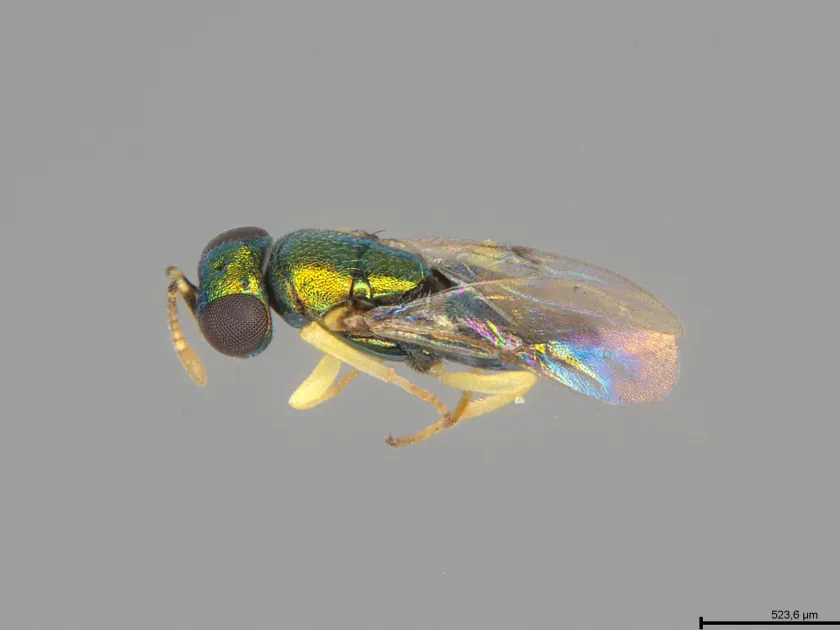
Description
How to identify
Psyllaephagus euphyllurae is a parasitic wasp belonging to the Encyrtidae family. It acts as a specialized entomophage, serving as a crucial natural regulator for specific agricultural pest populations.
Visually, the adult is a tiny, dark-colored wasp. Its morphology is highly adapted for searching and navigating the dense foliage of olive trees to locate its host.
This species is widely distributed across olive-growing regions. Due to its cryptic nature, detecting its presence requires specific monitoring techniques, such as pheromone or sticky traps.
Its life cycle is closely synchronized with the development of its primary host. Under optimal climatic conditions, the species can produce multiple generations within a single season.
A distinctive feature of Psyllaephagus euphyllurae is its high searching capacity. The larvae develop internally within the host, eventually leading to its death and limiting the spread of the infestation.
What it damages
It is important to note that this organism is a beneficial entomophage, not a plant pest. It parasitizes the olive psyllid (Euphyllura olivina), which is a common pest in olive groves.
The damage caused by the olive psyllid includes the deformation of shoots and leaves, which weakens the tree and leads to significant yield losses if not managed properly.
Psyllaephagus euphyllurae naturally limits the reproduction of the olive psyllid, reducing the necessity for intensive chemical insecticide applications on plantations.
Without the presence of this parasitoid, the pest population can quickly reach critical levels, resulting in massive flower and fruitlet drop.
Therefore, the presence of Psyllaephagus euphyllurae is an indicator of ecological balance, contributing to tree health and overall yield quality.
When it appears
The activity of adult Psyllaephagus euphyllurae is strongly correlated with temperature patterns during the spring. Peak abundance occurs during the phase of active shoot growth.
Spring warming stimulates the wasp to emerge from diapause, which coincides with the hatching of the first generation of olive psyllid larvae, the preferred host for egg-laying.
During the summer, activity may slightly decline due to extreme heat, but the species remains present in the agroecosystem until the late autumn months.
The development time depends on the accumulation of active temperatures. In Mediterranean climates, these biological cycles can occur continuously throughout the growing season.
The insect typically overwinters within the mummified remains of its host. This survival strategy ensures the population can recover and resume its regulatory function the following spring.
Signs of infestation
The primary sign of this entomophage's activity is the discovery of mummified olive psyllid bodies. These appear as swollen, darkened, or discolored shells of dead host larvae.
Upon closer inspection of the infested colonies, one may observe tiny exit holes on the remains of the pests, indicating that the adult parasitoid has successfully completed its development.
A noticeable decrease in the characteristic white waxy secretions produced by the psyllids is another reliable indicator that the pest population is being controlled by the parasitoid.
Monitoring using yellow sticky traps is an effective method for identifying the presence and activity levels of this beneficial wasp within the canopy.
The overall healthy appearance of the tree shoots, despite the known presence of the pest, suggests that natural regulation is successfully keeping the damage within acceptable limits.
Control measures
To support Psyllaephagus euphyllurae populations, it is recommended to minimize the use of broad-spectrum insecticides that can negatively affect beneficial insects.
Agrotechnical practices should focus on maintaining biodiversity within the orchard, including planting cover crops that provide essential resources for adult wasps.
If chemical intervention becomes necessary for other pests, preference should be given to selective products that have low toxicity to parasitoids and are applied during times of low insect activity.
Integrated Pest Management (IPM) strategies prioritize the use of these natural enemies, ensuring that olive psyllid levels remain below the economic injury threshold.
- Avoid broad-spectrum pesticide use during peak wasp activity.
- Enhance orchard biodiversity with flowering plants for adult nutrition.
- Conduct regular monitoring to assess the efficacy of the biological control.
- Prioritize biological products as part of an integrated management program.
Taxonomy
- Latin name
- Psyllaephagus euphyllurae
- Order
- Hymenoptera
- Family
- Encyrtidae
- EPPO code
- PSYAEU
Discussion
No discussions yet — be the first.