
Psyllaephagus
Psyllaephagus
Description
How to identify
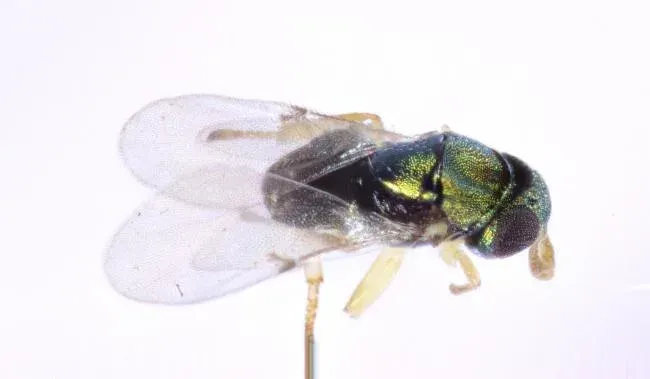
Psyllaephagus is a genus of parasitic wasps belonging to the family Encyrtidae. These insects are small in size and are recognized as important biological control agents.
The adult wasps possess a specialized sensory system that allows them to locate their hosts, which are primarily nymphs of psyllids (jumping plant lice).
Morphologically, these wasps are adapted to navigate within plant canopies and detect the subtle chemical cues emitted by psyllid colonies.
Their life cycle involves a complex parasitic process. The female wasp deposits eggs inside the host nymph, ensuring the offspring has immediate access to resources upon hatching.
The entire internal development of the parasite concludes with the host's death, shortly after which the adult wasp emerges through a characteristic exit hole.
What it damages
Psyllaephagus is strictly classified as a beneficial insect rather than a plant pest. It provides ecosystem services by regulating populations of harmful jumping plant lice.
By parasitizing psyllid nymphs, these wasps prevent the damage caused by high concentrations of plant lice, such as leaf wilting, stunted growth, and the secretion of honeydew which attracts sooty mold.
The host range of Psyllaephagus is highly specific, which minimizes the risk of impact on non-target beneficial insect populations in the field.
Effective management through Psyllaephagus contributes to healthier tree development and higher fruit or leaf quality, especially in forest and orchard environments.
In many regions, this genus is introduced or conserved to handle invasive psyllid species that lack natural enemies in new ecosystems.
When it appears
The activity of Psyllaephagus is closely synchronized with the phenology of its hosts. Emergence generally follows the seasonal rise in psyllid nymph populations.
Spring marks the beginning of the seasonal activity, as rising temperatures trigger both the pest emergence and the maturation of the overwintering wasp generation.
Mid-summer is typically the peak period for wasp activity, where multiple generations can overlap, significantly suppressing psyllid numbers during the height of the growing season.
As autumn approaches and temperatures drop, the wasp enters a period of overwintering, typically as a late-stage larva or pupa within the mummified host body.
Environmental stability, particularly humidity and shade, is essential for the survival and high reproductive rate of these wasps throughout the year.
Signs of infestation
The most reliable sign of Psyllaephagus activity is the presence of "mummies" — psyllid nymphs that have died and turned a dark, brittle color due to the internal development of the parasite.
Examination of these mummies under low magnification often reveals a small, perfectly circular exit hole, indicating where the adult wasp has emerged.
A reduction in the number of active, wax-producing psyllid nymphs in areas previously infested is a clear indication of successful biological suppression.
Lack of new honeydew or sooty mold deposits in areas with high wasp density further confirms the efficacy of the parasitoids.
Growers should look for these mummified bodies on the undersides of leaves and along young stems where nymphs aggregate.
Control measures
To promote the efficacy of Psyllaephagus, agricultural management must emphasize the reduction of broad-spectrum insecticide use, which is lethal to the wasp.
Integrated Pest Management (IPM) practices should prioritize the use of soft pesticides or botanical oils that have minimal residual impact on parasitic wasps.
Planting flowering borders within or around orchards can provide essential nectar sources for adult wasps, increasing their longevity and reproductive capacity.
Monitoring programs should involve scouting for parasitized nymphs to determine if the biological control is sufficient, thereby avoiding unnecessary chemical treatments.
- Avoid broad-spectrum pesticide applications;
- Maintain floral refugia for nectar;
- Use selective chemicals only when thresholds are exceeded.
Taxonomy
- Latin name
- Psyllaephagus
- Order
- Hymenoptera
- Family
- Encyrtidae
- EPPO code
- PSYASP
Discussion
No discussions yet — be the first.