
Neodusmetia
Neodusmetia
Description
How to identify
Neodusmetia (Neodusmetia sangwani) is a minute insect belonging to the order Hemiptera and the family Pseudococcidae, commonly known as mealybugs.
Adult females are characterized by their very small, wingless bodies, which restricts their natural movement across agricultural landscapes.
Their bodies are generally oval-shaped, displaying colors that range from pale yellow to pinkish, and are typically covered in a protective waxy secretion.
Males of the species are rarely observed and contribute minimally to the population dynamics, as the primary spread occurs through crawler dispersal.
This species is highly specialized, and while it has been historically studied as a biological control agent, it can act as a pest in specific grassland environments.
What it damages
The primary hosts of Neodusmetia are various grass species, including forage grasses such as buffel grass and other related cereal crops.
The insect feeds by inserting its mouthparts into the stem tissue, particularly within leaf sheaths, to extract plant sap.
Heavy infestations result in stunted plant growth, chlorosis (yellowing of the leaves), and a significant reduction in biomass production.
Persistent feeding damage can lead to the premature death of tillers, which compromises the overall quality and nutritional value of grazing pastures.
In cases of severe outbreaks, the cumulative damage can lead to large-scale degradation of forage stands, affecting livestock productivity.
When it appears
Neodusmetia development is strictly dictated by climatic conditions, with higher activity levels observed during warm and humid weather periods.
The insect is capable of continuous reproduction throughout the growing season, allowing for multiple generations to occur in a single year.
The crawler stage represents the most mobile period of the life cycle, typically coinciding with steady increases in ambient temperature.
During colder months, the population growth slows significantly, yet the insect remains protected in sheltered areas of the host plant.
Monitoring efforts should ideally commence at the onset of the growing season to prevent the exponential buildup of the pest population.
Signs of infestation
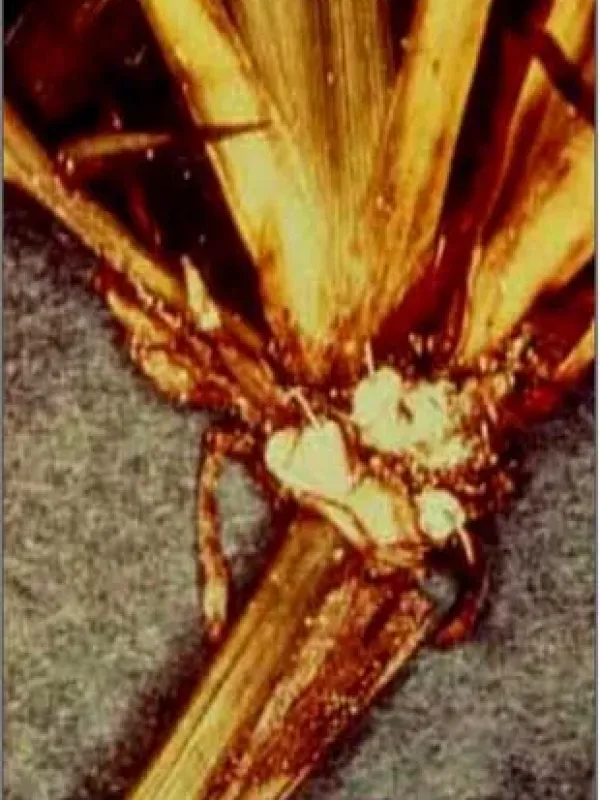
The most reliable sign of a Neodusmetia infestation is the presence of white, cottony, or waxy masses found at the base of the leaf sheaths.
Plants may display unexplained yellowing and weakening, often mistaken for nutrient deficiencies or drought stress in early stages.
Careful inspection of the stem and leaf axils using a magnifying glass will reveal the presence of adult mealybugs and their egg sacs.
Due to the insect's cryptic behavior, it is essential to peel back the leaf sheaths to accurately determine the level of colonization.
The activity of ants attending to the mealybugs, as they collect honeydew, often serves as a secondary indicator of an underlying pest issue.
Control measures
Effective management of Neodusmetia largely relies on biological control agents, specifically parasitic wasps that naturally regulate population numbers.
Chemical control should be considered only when economic thresholds are exceeded, utilizing systemic insecticides for better penetration.
Cultural management practices include removing host weeds from field edges and managing grazing pressure to limit suitable habitats for the pest.
Ensuring healthy soil and plant vigor can help grasses better withstand the stress caused by the feeding activity of these insects.
- Routine field scouting for waxy secretions.
- Introduction of natural parasitoids.
- Application of selective systemic insecticides.
Taxonomy
- Latin name
- Neodusmetia
- Order
- Hymenoptera
- Family
- Encyrtidae
- EPPO code
- NEDUSP
Discussion
No discussions yet — be the first.