
Gyranusoidea
Gyranusoidea
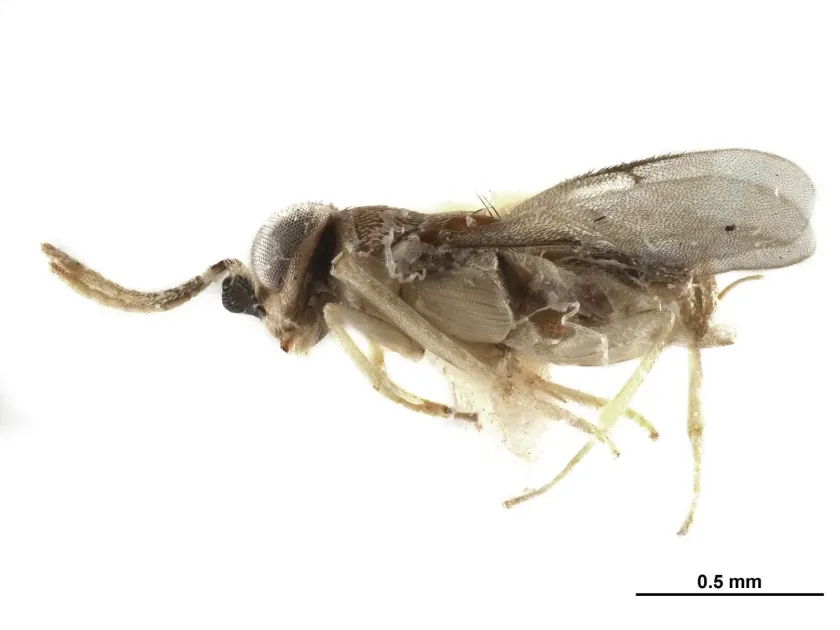
Description
How to identify
The genus Gyranusoidea comprises tiny wasps belonging to the Encyrtidae family. These insects are specialized parasitoids, primarily known for their role in regulating populations of mealybugs (Pseudococcidae) in various agricultural ecosystems.
Adults are very small, often less than 2 mm in length, with a structure characteristic of chalcidoid wasps. They possess well-developed wings and antennae, which are essential for navigating the host plant's foliage during the search for hosts.
Their coloration is typically brownish or yellowish, blending in with the environment, which helps them remain undetected by predators while scouting for mealybug colonies to parasitize.
The life cycle involves internal parasitism; the female inserts an egg into the host, where the larva develops while feeding on the internal tissues of the mealybug, eventually leading to its demise.
Identification of specific species usually requires morphological study of adult structures, such as antenna segments and genital components, under high-magnification microscopy.
What it damages
Gyranusoidea is an beneficial organism rather than a direct pest. Its activity is inherently linked to the presence of mealybugs, which are major agricultural pests on a variety of crops including citrus, grapes, and ornamentals.
The damage caused by the mealybugs themselves includes sap extraction, which leads to plant stress, nutrient depletion, and sometimes the stunting of young shoots or fruit drop.
Furthermore, mealybugs secrete honeydew, which serves as a substrate for sooty mold growth. By limiting mealybug numbers, Gyranusoidea indirectly reduces the risk of secondary fungal infections that inhibit plant photosynthesis.
The parasitoid acts as a natural guardian, preventing the exponential growth of mealybug populations that would otherwise require intensive chemical intervention.
Monitoring the presence of this parasitoid is essential for evaluating the phytosanitary health of a crop, as it represents a natural barrier against severe infestations.
When it appears
The seasonal activity of Gyranusoidea is governed by temperature and the availability of hosts. Their development is most rapid during warm and humid periods, mirroring the peak activity of their mealybug hosts.
In regions with distinct seasons, the emergence of parasitoid adults often synchronizes with the presence of susceptible stages of mealybugs, ensuring high encounter rates between the parasite and host.
Optimal temperatures for their development generally range between 25°C and 30°C. Extreme temperatures can decrease their foraging efficiency and slow down their reproductive rates.
They typically undergo multiple generations within a single growing season, allowing them to exert continuous pressure on pest populations throughout the year.
Agronomists must carefully schedule any necessary field operations to avoid disrupting these cycles, as the survival of the parasitoid population is vital for ongoing natural control.
Signs of infestation
A key indicator of Gyranusoidea activity is the presence of modified mealybug individuals within a colony. Parasitized mealybugs may appear bloated, discolored, or lose their characteristic white waxy coating.
A definitive sign of successful parasitism is the appearance of emergence holes on the bodies of the mealybugs, through which the adult wasp has exited after completing its development.
Field observation showing "mummified" or hollowed-out mealybug shells attached to leaves and stems strongly suggests that these parasitoids are actively regulating the infestation.
A downward trend in mealybug density, accompanied by the observation of these characteristic shells, indicates that the biological control agent is successfully managing the pest.
Sticky traps placed in the canopy can be used to catch adults, allowing for accurate identification and population assessment of the parasitoid in the field.
Control measures
Effective management strategies revolve around integrated pest management (IPM) practices, which prioritize the preservation of existing natural enemy populations.
The use of broad-spectrum insecticides should be strictly minimized or avoided, as these chemicals often have high toxicity toward Gyranusoidea and can disrupt the natural balance.
Conservation of field margins with flowering plants provides necessary nectar sources for adult wasps, increasing their lifespan and reproductive success in the field.
In cases where natural populations are insufficient, augmentation programs involve the mass-rearing and release of the parasitoid into affected areas to quickly suppress outbreaks.
Regular field scouting is critical to assess the ratio of parasitoids to pests, allowing farmers to make informed decisions and avoid unnecessary chemical applications.
Taxonomy
- Latin name
- Gyranusoidea
- Order
- Hymenoptera
- Family
- Encyrtidae
- EPPO code
- GYRNSP
Discussion
No discussions yet — be the first.