
Cryptanusia taiwanus
Cryptanusia taiwanus
Description
How to identify
Cryptanusia taiwanus belongs to the order Hymenoptera, family Encyrtidae. This small parasitic wasp is often studied in the context of biological control, though its population dynamics require close monitoring by agronomists to prevent potential ecosystem disruption.
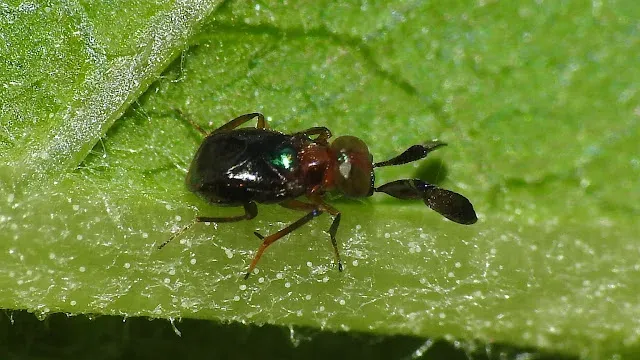
The adult insect has a compact body typical of encyrtids, with developed wings featuring distinct venation and a specific coloration, often displaying a metallic sheen. Identification in the field is difficult and usually requires laboratory microscopic examination.
The systematics of this species are closely tied to parasitoid complexes found in tropical and subtropical ecosystems. Research confirms that Cryptanusia taiwanus actively interacts with a wide range of host insects, making it a critical subject for insect ecology studies.
Morphologically, the species is adapted to locating hosts in dense vegetation. Specialized sensory organs allow the adults to detect specific chemical signals emitted by host insects or damaged plant tissues.
The biology includes a complex life cycle with several larval stages occurring inside the host's body. The duration of the full life cycle may vary significantly depending on local temperature and humidity levels.
What it damages
The primary risk posed by Cryptanusia taiwanus is its role in influencing other insect populations, which can potentially disrupt the biological balance in agroecosystems. This pest is frequently associated with damage to fruit and ornamental crops infested by scale insects.
During mass reproduction, the species can indirectly affect plant productivity by acting as a hyperparasitoid or disrupting natural regulation mechanisms. This creates risks for intensive orchard management where maintaining a precise balance of beneficial insects is vital.
The greatest impact is observed in high-humidity regions where Cryptanusia taiwanus finds ideal conditions for reproduction. Infested plant parts may show signs of weakening and become susceptible to secondary fungal infections.
Damage manifests as a reduction in crop quality due to physiological stress. The constant presence of this species in an orchard necessitates the implementation of integrated pest management (IPM) strategies to minimize negative impacts.
Economic damage is estimated based on monitoring the population density of hosts. Early detection and management are essential to prevent significant losses in marketable yield.
When it appears
The activity of Cryptanusia taiwanus is directly dependent on seasonal temperature variations. Peak adult activity usually occurs during the summer months when conditions for flight and mating are optimal.
In autumn, the pest transitions into resting phases or continues development inside a host undergoing diapause. This ability allows the species to successfully survive even during moderately cold winters.
The spring emergence of the population coincides with the start of the growing season for most agricultural crops. During this time, the insects begin actively searching for hosts to oviposit, representing a critical stage in the life cycle.
Reproductive intensity during summer months can result in several generations, explaining the rapid population growth observed in favorable years. Agronomists should conduct monitoring during peak insect activity periods.
Understanding phenological development phases is necessary for synchronizing protection efforts. Accounting for seasonal fluctuations significantly enhances the effectiveness of control measures and reduces chemical dependency.
Signs of infestation
The first sign of Cryptanusia taiwanus presence is the appearance of emergence holes on the bodies of host insects. These tiny, almost invisible holes on scale coverings or host bodies indicate the completion of the parasite's development cycle.
Plants may lose turgor, and leaves may turn yellow due to the indirect influence of the pest complex. Characteristic damage is often mistaken for the consequences of mite or aphid feeding.
Visual inspection of the underside of leaves allows for the detection of adults during their flight period. The use of yellow sticky traps is the most accurate method for identifying the presence of this species in a field or orchard.
Microscopic examination of infested samples confirms the presence of larvae inside the host. Laboratory diagnosis remains the only reliable way to confirm the species identity.
Changes in the behavior of local entomophages can also serve as an indirect sign of the expansion of new species. Agronomists should pay attention to any anomalies within the orchard's insect complex structure.
Control measures
The primary control method involves adhering to agrotechnical rules, including sanitary pruning and the destruction of infested shoots, which reduces the food source for the hosts of the wasp.
Chemical protection methods should be applied with extreme caution, prioritizing selective insecticides. Broad-spectrum pesticides can eliminate beneficial entomofauna and trigger outbreaks of other secondary pests.
Biological control strategies include the use of entomopathogenic fungi and bacteria, which selectively impact the population. This helps maintain ecological equilibrium within the agroecosystem.
Implementing Integrated Pest Management (IPM) systems helps keep the pest population at an economically acceptable level through regular monitoring and timely decision-making.
Recommended protection measures include:
- Monitoring using pheromone and sticky traps.
- Cleaning tree trunks to remove loose bark where pests may hide.
- Limiting pesticide use during peak insect flight periods.
- Supporting natural enemies of pests within the agroecosystem.
- Isolating infested areas to prevent the migration of insects.
Taxonomy
- Latin name
- Cryptanusia taiwanus
- Order
- Hymenoptera
- Family
- Encyrtidae
- EPPO code
- KRYTTW
Discussion
No discussions yet — be the first.