
Comperiella
Comperiella
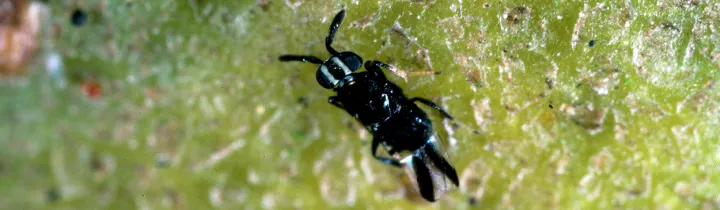
Description
How to identify
Comperiella is a genus of minute parasitic wasps within the family Encyrtidae (order Hymenoptera). These insects are recognized as important natural enemies of various scale insects, particularly those affecting citrus and ornamental trees.
Adult Comperiella are very small, often barely visible to the naked eye. They possess the typical morphological features of Encyrtid wasps, including specialized wing venation and a compact body structure adapted for searching for hosts.
These wasps are highly specialized, often targeting specific species of diaspidid scales. Their evolutionary adaptation allows them to locate and parasitize scale insects even under the protective waxy covering of the host.
The life cycle involves an egg-laying stage where the female wasp injects an egg into the body of the host. The wasp larva then develops internally, consuming the host from the inside.
Comperiella is widely studied in entomology for its effectiveness as a classical biological control agent against invasive scale insect populations in different parts of the world.
What it damages
Comperiella itself does not cause damage to plants. In fact, its presence is highly beneficial as it acts as a regulator for scale insect populations, which are the primary pests that damage agricultural crops.
The scale insects controlled by Comperiella, such as the California red scale, inflict damage by sucking sap from leaves, twigs, and fruits. This leads to yellowing, leaf drop, reduced fruit quality, and overall tree decline.
By parasitizing these scales, Comperiella prevents the damage that would otherwise occur if the scale population were left unchecked. It is a vital component of sustainable pest management.
The damage caused by scale insects can be severe in the absence of natural enemies, necessitating extensive chemical intervention. Comperiella provides a natural, eco-friendly solution to this problem.
The overall impact of this genus on agricultural systems is positive, contributing to lower pest density and healthier plant growth in orchard environments.
When it appears
The activity period of Comperiella coincides with the development of scale insect hosts, typically from spring through autumn, depending on the climatic conditions of the region.
The wasp typically completes multiple generations per year, allowing it to synchronize its life cycle with the peaks of the scale insect populations throughout the growing season.
In warmer climates, activity is nearly continuous, while in temperate zones, the wasp enters diapause, usually as a larva inside the dead host (mummy) to survive the winter.
The timing of adult emergence is critical for the efficacy of the parasitoid, as they must find and infect young scale nymphs or vulnerable stages of the host.
Favorable temperatures and humidity levels significantly enhance the reproductive potential and search efficiency of Comperiella, leading to better pest suppression.
Signs of infestation
The most diagnostic sign of Comperiella activity is the presence of small, circular emergence holes in the scale insect covers (shields). These holes are created by the adult wasp as it exits the host.
Affected scale covers may also appear distorted, discolored, or slightly different in shape compared to healthy, active scales. These are often referred to as "mummified" scales.
A high percentage of scales with exit holes on the bark of trees is a strong indicator of successful parasitism and biological control taking place in the orchard.
Under magnification, one can observe the remains of the wasp larvae or pupae inside the scale insect shell, confirming the presence of this beneficial organism.
Monitoring for these emergence holes allows growers to assess the impact of natural enemies and decide whether chemical intervention is truly necessary.
Control measures
The primary control strategy is the conservation and enhancement of native Comperiella populations. This is best achieved by implementing Integrated Pest Management (IPM) practices.
Avoiding the use of broad-spectrum insecticides, especially during peak flight periods of the wasp, is essential to maintaining its population in the orchard.
Planting flowering borders and nectar-providing species can support adult wasps, providing them with necessary energy sources for searching and reproduction.
When chemical control of other pests is required, choosing selective pesticides that are non-toxic or have low toxicity to Hymenopteran parasitoids is a key management priority.
- Minimize pesticide applications during peak activity periods.
- Establish nectar-rich floral strips to attract and support parasitoids.
- Prioritize selective insecticides over broad-spectrum ones.
- Regular monitoring of host parasitism levels before applying treatments.
Taxonomy
- Latin name
- Comperiella
- Order
- Hymenoptera
- Family
- Encyrtidae
- EPPO code
- COMRSP
Discussion
No discussions yet — be the first.