
Anagyrus vladimiri
Anagyrus vladimiri
Description
How to identify
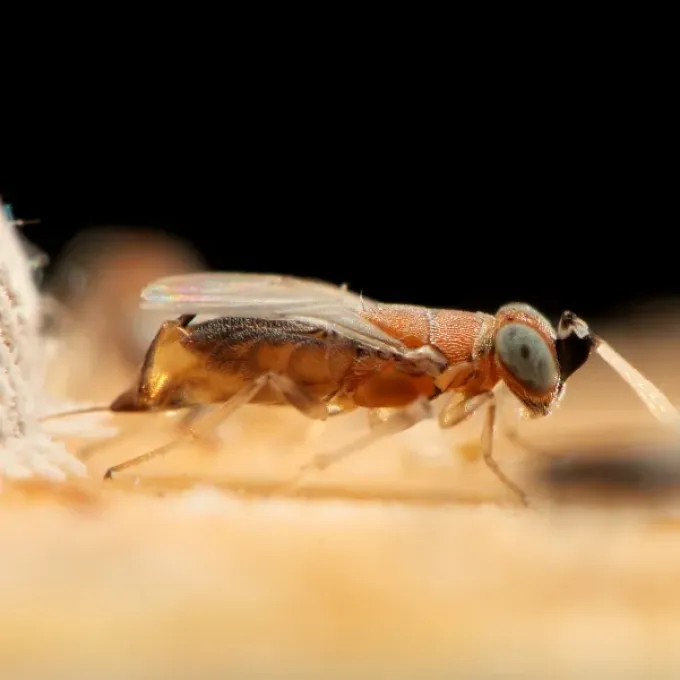
Anagyrus vladimiri is a parasitic wasp belonging to the family Encyrtidae. It is recognized as a highly specialized parasitoid that serves as a cornerstone in modern Integrated Pest Management (IPM) programs worldwide.
Adult wasps are very small, measuring approximately 1.5 to 2 mm in length. They are characterized by their active searching behavior, which enables them to effectively locate hosts even when pest densities are low.
The reproduction cycle starts when a female wasp finds a mealybug and injects a single egg into its body. The parasitoid larva then feeds on the internal tissues of the host, which is the primary cause of the host's mortality.
As the larva grows, the mealybug eventually becomes a hollow, hardened shell known as a mummy. This mummy provides a protected environment for the wasp pupa to complete its development.
Once the cycle is complete, a new adult wasp emerges from the mummy, ready to mate and seek out new hosts. Under favorable greenhouse conditions, this process occurs rapidly, allowing for quick population buildup.
What it damages
The insect Anagyrus vladimiri does not cause damage to plants. On the contrary, it is an essential biological agent used to mitigate damage caused by the mealybug (Pseudococcidae), specifically the citrus mealybug.
Mealybugs are serious pests that attack a wide variety of vegetables and ornamental plants. By sucking sap from plant tissues, they cause stunted growth, leaf yellowing, and deformation of stems and fruits.
Furthermore, their excretion of honeydew promotes the growth of sooty mold, which blocks photosynthesis and drastically reduces the quality of horticultural products. The presence of these pests often leads to severe crop losses.
By targeting mealybugs, Anagyrus vladimiri acts as a natural pressure mechanism that maintains the pest population below economic damage thresholds in greenhouse environments.
Because the parasitoid actively searches for its host within plant foliage, it can access areas where chemical sprays often fail, such as leaf axils and the undersides of leaves.
Control measures
To successfully utilize Anagyrus vladimiri, greenhouse managers must ensure the climate is suitable. Optimum development occurs at temperatures ranging between 22°C and 28°C and moderate to high humidity.
The introduction of these wasps should be timed with the early stages of a mealybug infestation. Regular release schedules are often implemented to ensure continuous presence and long-term control of the pest.
Adopting this biological method helps reduce or eliminate the need for synthetic chemical insecticides, which is crucial for growers focusing on sustainable and residue-free crop production.
Care must be taken to avoid using broad-spectrum pesticides, as these will kill the beneficial wasp population. If chemical intervention is necessary, growers should select selective pesticides with low residual activity.
- Monitor greenhouse crops frequently for signs of mealybug presence.
- Release wasps periodically as part of a structured biocontrol program.
- Avoid broad-spectrum pesticide applications to preserve the parasitoid population.
Taxonomy
- Latin name
- Anagyrus vladimiri
- Order
- Hymenoptera
- Family
- Encyrtidae
- EPPO code
- ANAYVL
Discussion
No discussions yet — be the first.