
Anagyrus greeni
Anagyrus greeni
Description
How to identify
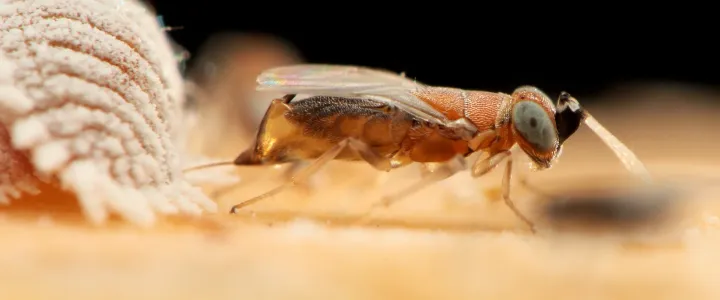
Anagyrus greeni is a parasitic wasp belonging to the Encyrtidae family within the order Hymenoptera. In agricultural entomology, it is recognized not as a plant pest, but as a crucial parasitoid used for controlling populations of mealybugs.
Adult wasps are microscopic, typically measuring between 1 to 2 millimeters. Identifying them in the field requires specialized entomological knowledge and tools such as hand lenses or field microscopes due to their extremely small size.
Morphologically, these wasps exhibit specific wing venation and antennal structures that distinguish them from other encyrtid wasps. They are specifically adapted to locate the chemical signals released by their host insects.
The success of this species as a biocontrol agent stems from its high specificity. It targets various species of mealybugs that are notoriously difficult to control with traditional insecticides.
Understanding the anatomy and behavior of these wasps is essential for professionals working in biological laboratories involved in the mass-rearing of beneficial insects for commercial greenhouse use.
What it damages
Anagyrus greeni does not damage crops. On the contrary, it provides significant economic benefits by acting as a natural enemy of agricultural pests. It is a parasitoid, meaning its life cycle depends on the consumption of a host insect.
The primary hosts for this wasp are mealybugs (Pseudococcidae family), which are significant pests that extract sap from a wide range of fruit, citrus, and ornamental plants, causing growth inhibition and yield loss.
By parasitizing the mealybugs, the wasp prevents the host from reaching maturity and reproducing, effectively collapsing the pest colony. This action mitigates the physical damage that would otherwise be caused by the mealybug population.
The impact of this wasp is indirect. Its presence in an orchard or greenhouse is a sign of a healthy, balanced agro-ecosystem where natural regulation is taking place without excessive human intervention.
Farmers who utilize Anagyrus greeni as part of their Integrated Pest Management (IPM) strategy observe a significant reduction in the economic threshold of damage caused by sucking pests.
When it appears
The seasonal activity of Anagyrus greeni is directly linked to the presence and abundance of its host. In temperate regions, the wasp is most active during the spring and summer when mealybug populations are expanding.
In greenhouse settings, where environmental conditions are controlled, the lifecycle of the wasp can be continuous throughout the year, allowing for persistent pest suppression.
Adult wasps emerge from their host pupae and immediately begin searching for new hosts. This synchronized emergence with the pest population is what makes them such effective biological controllers.
Temperature and humidity play a critical role in their developmental speed. Higher temperatures typically accelerate the lifecycle, leading to more generations per season, provided the host is available.
Monitoring programs usually start in the early spring, as soon as the first signs of mealybug activity appear on the new foliage or stems of the plants.
Signs of infestation
The most reliable sign of Anagyrus greeni activity is the presence of "mummies." These are the dried, hollowed-out exoskeletons of mealybugs that have been parasitized and killed by the wasp larva.
Careful inspection of leaves and twigs will reveal tiny, clean-cut exit holes on the bodies of the dead mealybugs. These holes indicate that the adult wasp has successfully emerged after completing its development inside the host.
A reduction in the presence of honeydew (the sticky substance excreted by mealybugs) is another indicator of successful biological control, suggesting that the pest population is under heavy pressure from the parasitoids.
If you observe adult wasps hovering around plants known to harbor mealybugs, it is a clear signal that the population is actively hunting and laying eggs in the hosts.
Professional agronomists often use yellow sticky traps and visual counts of parasitized hosts to estimate the efficacy of the biocontrol intervention in real-time.
Control measures
The "control" of Anagyrus greeni involves its protection and conservation. To encourage a healthy population of these wasps, it is essential to avoid the use of broad-spectrum chemical insecticides that are lethal to beneficial hymenopterans.
When chemical management is absolutely necessary for other pests, growers should select selective pesticides that have minimal residual impact on parasitoid wasps and shorter half-lives.
Planting nectar-rich flora in the field borders helps maintain adult wasps by providing them with carbohydrate sources when mealybug hosts are temporarily scarce or during periods of low activity.
In high-value crops, farmers often purchase mass-reared Anagyrus wasps from specialized facilities to introduce them into greenhouse ecosystems as a proactive measure against mealybug outbreaks.
- Implement Integrated Pest Management (IPM) protocols.
- Prioritize biological control over synthetic chemicals.
- Maintain non-crop vegetation as habitat for beneficials.
- Regularly monitor pest colonies for parasitization levels.
Taxonomy
- Latin name
- Anagyrus greeni
- Order
- Hymenoptera
- Family
- Encyrtidae
- EPPO code
- ANAYGR
Discussion
No discussions yet — be the first.