
Anagyrus fusciventris
Anagyrus fusciventris
Description
How to identify
Anagyrus fusciventris is a parasitic wasp belonging to the family Encyrtidae (order Hymenoptera). It is a highly specialized entomophage used extensively in sustainable agriculture and horticulture as a biological control agent.
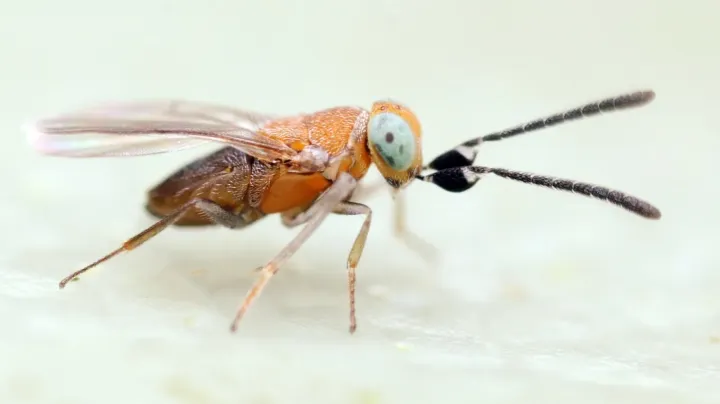
The adult wasp is minute, characterized by a dark metallic appearance and specialized antennae that serve as primary sensory organs. Females possess a keen ability to detect host pheromones and the presence of mealybugs on infested plants.
The life cycle of this wasp is strictly endoparasitic. The female deposits eggs inside the host's body. The developing larvae feed on the host's internal tissues, eventually leading to the death of the mealybug, which serves as a protective pupation chamber.
This species is highly valued for its efficacy in diverse environments. Its search capacity allows it to locate even sparse populations of pests, ensuring that the control mechanism remains active throughout the cropping season.
By integrating Anagyrus fusciventris into pest management programs, growers can achieve sustainable control of various mealybug species, reducing the need for chemical intervention.
What it damages
It is crucial to clarify that Anagyrus fusciventris is beneficial and does not cause damage to plants. Instead, it targets mealybugs (family Pseudococcidae), which are notorious pests that cause significant economic losses in various crops.
Mealybugs feed on plant sap, leading to stunted growth, leaf yellowing, and the secretion of honeydew. This honeydew promotes the growth of sooty mold, which severely reduces photosynthesis and lowers the quality of fruits and flowers.
The larvae of the wasp effectively sterilize and eventually kill the host mealybug. This activity prevents the pest population from reaching an exponential growth phase, thus protecting the structural integrity and health of the crop.
The parasitism exerted by Anagyrus fusciventris is precise. By targeting specific stages of the mealybug, the wasp maintains a natural equilibrium, preventing outbreaks that could otherwise necessitate expensive and harmful pesticide sprays.
The presence of this parasitoid is a key indicator of a healthy, integrated pest management (IPM) system, contributing to more sustainable agricultural practices worldwide.
Signs of infestation
The most visible sign of Anagyrus fusciventris activity is the presence of "mummified" mealybugs. These hosts turn dark brown or black, becoming rigid and immobile as the wasp larva completes its development inside.
Upon reaching adulthood, the wasp emerges through a small, neat circular hole cut into the cuticle of the mummified mealybug. The discovery of these empty shells is a definitive proof of successful parasitization in the field.
During monitoring, agronomists look for these specific color changes in mealybug colonies. A high ratio of mummified hosts indicates that the biological control agent is well-established and performing its function effectively.
Another indicator is the gradual decline in the activity and density of the mealybug colony. As the number of parasitized individuals increases, the overall pressure of the pest on the crop significantly decreases.
Regular visual inspections, particularly in hidden areas such as leaf axils and stems, allow growers to assess the effectiveness of the release and determine if further intervention is required.
Control measures
Effective management with Anagyrus fusciventris requires careful environmental control. The wasps are sensitive to extreme temperatures and low humidity, which should be avoided within greenhouse environments to ensure their longevity.
The use of broad-spectrum insecticides must be strictly avoided during the release period, as these chemicals are lethal to beneficial wasps. Growers should prioritize soft chemistry and biologicals that are compatible with parasitoids.
Application involves releasing the wasps directly into infested areas. The release strategy is often staggered to match the life cycle of the pest, ensuring that a sufficient population of the parasitoid is always present.
Combining Anagyrus fusciventris with other biological controls, such as predatory beetles, provides a synergistic effect, attacking the pest population from multiple angles and improving overall crop protection.
- Regular monitoring for mummified hosts.
- Avoidance of toxic pesticide applications.
- Targeted release in pest hotspots.
- Maintenance of stable greenhouse humidity and temperature.
Taxonomy
- Latin name
- Anagyrus fusciventris
- Order
- Hymenoptera
- Family
- Encyrtidae
- EPPO code
- ANAYFU
Discussion
No discussions yet — be the first.