
Anagyrus beneficans
Anagyrus beneficans
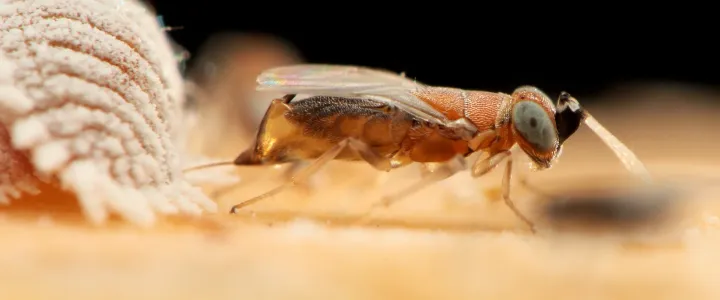
Description
How to identify
Anagyrus beneficans is a specialized parasitic wasp belonging to the family Encyrtidae within the order Hymenoptera. It is a highly effective biological control agent widely used in integrated pest management (IPM) programs.
Adult wasps are tiny, measuring approximately 1–2 mm in length. They are characterized by their dark body coloration and metallic sheen, along with a pair of transparent wings with distinct venation.
These wasps are excellent searchers. Females are highly efficient at detecting chemical signals (kairomones) emitted by their hosts, which allows them to locate even low-density populations of mealybugs in complex foliage.
The morphology and behavior of Anagyrus beneficans are evolutionarily specialized for finding and parasitizing specific species of mealybugs, making them a preferred choice for greenhouse growers.
Unlike pests, these insects do not feed on plant tissue; they rely on nectar for adult energy and host larvae for the development of their offspring.
##damage##It is crucial to note that Anagyrus beneficans is not a plant pest; it is a beneficial organism. It targets various species of mealybugs (Pseudococcidae), which are detrimental pests that suck plant sap and cause severe crop damage.
Mealybugs cause yellowing, stunted growth, and premature leaf drop in a wide variety of ornamental plants, fruit trees, and vegetables by injecting toxins and excreting honeydew.
The parasitoid wasp attacks the mealybug by laying an egg inside the host body. The developing wasp larva consumes the internal tissues of the mealybug, ultimately killing it.
By effectively suppressing mealybug populations, Anagyrus beneficans prevents the accumulation of honeydew, which in turn reduces the risk of secondary infections such as sooty mold.
Implementing this biological control agent helps reduce the reliance on synthetic pesticides, supporting a more sustainable and environmentally friendly agricultural approach.
##season##The activity and development rate of Anagyrus beneficans are highly dependent on temperature. They perform best in warm conditions, typically between 20°C and 30°C.
In greenhouse environments, they can be active throughout the year, provided that the microclimate is maintained within the optimal range for both the wasps and the host pests.
Under favorable temperatures, the life cycle from egg to adult is relatively short, usually completing within 2 to 3 weeks, allowing for rapid population growth.
In open field conditions, their seasonal presence is limited to the warmer months when temperatures support successful flight and foraging activity.
Strategic releases are best timed with the early emergence of mealybug generations, ensuring the parasitoid population is established before the pest infestation becomes severe.
##signs##The most reliable sign of Anagyrus beneficans activity is the appearance of 'mummies'. Parasitized mealybugs stop feeding, become immobile, and darken in color, eventually hardening into a shell.
Close inspection of the host colony will reveal tiny, clean-cut exit holes on the backs of these mummified mealybugs, indicating that a new generation of adult wasps has emerged.
Presence of active, searching adult wasps on the foliage, often flicking their antennae, is a positive indicator that the parasitoids are successfully colonizing the plant area.
A reduction in the sticky honeydew residue on leaves and fruit is a secondary sign that the pest population is being successfully managed by the wasps.
Over time, the gradual decline of the white, waxy mealybug colonies confirms the efficiency of the biological control effort in the greenhouse or field.
##control##The primary 'control' measure here is the preservation and enhancement of the parasitoid population rather than their eradication. Careful management of the environment is key to their success.
- Avoid the use of broad-spectrum pesticides, especially those with long residual effects, for several weeks prior to releasing the wasps.
- Provide floral resources (like nectar-rich plants) in or around the greenhouse to support adult wasp longevity and fecundity.
- Maintain consistent temperature and humidity levels to optimize the wasps' searching and egg-laying activity.
- Monitor the crop regularly for signs of successful parasitism, such as mummified hosts, to determine the effectiveness of the control.
- Follow professional guidelines for the rate and frequency of wasp releases based on the density of the mealybug infestation.
Taxonomy
- Latin name
- Anagyrus beneficans
- Order
- Hymenoptera
- Family
- Encyrtidae
- EPPO code
- ANAYBE
Discussion
No discussions yet — be the first.