
Acerophagus phenacocci
Acerophagus phenacocci
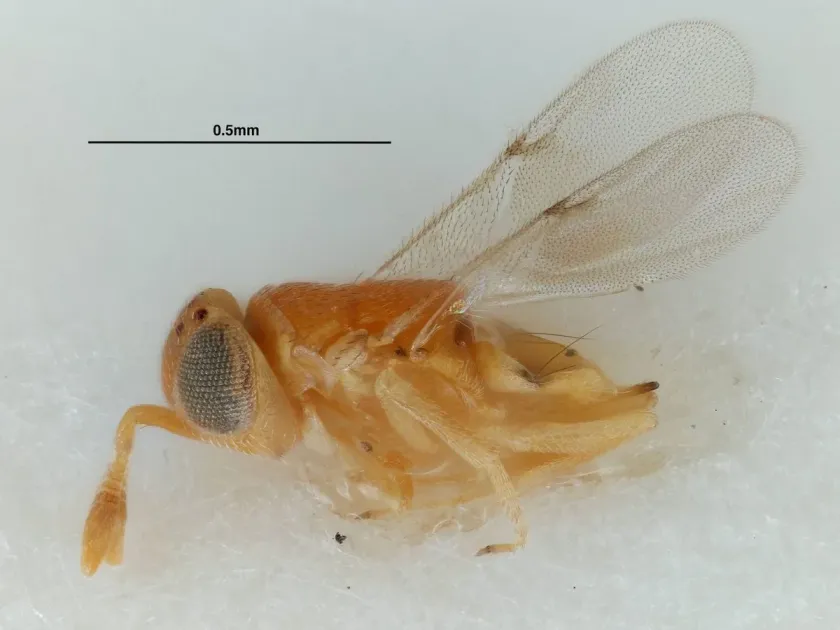
Description
How to identify
Acerophagus phenacocci is a small parasitic wasp belonging to the Encyrtidae family within the order Hymenoptera. It is a highly specialized parasitoid that targets specific mealybug species.
Adult wasps are microscopic and possess features characteristic of the Encyrtidae family, including metallic coloration and specialized sensory structures on their antennae.
The life cycle is closely linked to the host's development. Females lay their eggs directly into the larvae or adult stages of the mealybug host using their ovipositors.
The entire developmental process, from egg to pupa, takes place inside the body of the host. The parasitoid larva consumes the internal tissues of the mealybug during its development.
Once the transformation into an adult is complete, the wasp emerges by chewing a circular exit hole through the cuticle of the host, ready to search for new targets.
What it damages
Acerophagus phenacocci does not cause damage to plants as it is a beneficial organism. Instead, it serves as a natural regulator of mealybug populations, which are significant agricultural pests.
The mealybugs targeted by this wasp, such as species of the genus Phenacoccus, cause damage by sucking plant sap, weakening host plants like citrus and various greenhouse ornamentals.
By parasitizing these pests, the wasp effectively reduces their ability to reproduce and spread, thereby acting as a powerful biological control agent.
The presence of this parasitoid can significantly decrease the need for chemical interventions, promoting a more sustainable and environmentally friendly agricultural approach.
However, the use of broad-spectrum pesticides can inadvertently kill these beneficial wasps, leading to a resurgence of the mealybug populations they were controlling.
When it appears
The activity of this species is largely dictated by environmental temperatures and the presence of suitable hosts throughout the growing season.
In controlled environments such as greenhouses, Acerophagus phenacocci can remain active and reproduce throughout the entire year, provided that host populations are available.
Peak populations usually follow the peak occurrence of the mealybug host, as the wasp population relies on the host's availability to complete its life cycle successfully.
Lower temperatures generally inhibit the metabolic rate of the wasp, leading to slower development and decreased activity levels during colder months.
The parasitoid is most effective during periods of warm weather when both the host and the wasp can complete their life cycles in synchrony.
Signs of infestation
The most reliable sign of Acerophagus phenacocci presence is the discovery of mummified or discolored mealybugs within a colony on the infested host plant.
Careful observation will reveal small, perfectly circular emergence holes in the dead bodies of the mealybugs, indicating where the adult wasp has already emerged.
Infestations under control by this parasitoid often show a visible reduction in the amount of honeydew and waxy secretions typically produced by healthy mealybugs.
Over time, the overall density of the mealybug colony will drop significantly, and the plants will show signs of recovery as the pest pressure decreases.
Examining the colony under magnification may also reveal the internal developmental stages of the wasp, which appear as a yellowing of the host's body before pupation.
Control measures
To support populations of Acerophagus phenacocci, farmers and growers should avoid the use of broad-spectrum insecticides that are known to be toxic to beneficial Hymenoptera.
Integrated Pest Management (IPM) strategies should be prioritized, focusing on cultural and biological practices rather than solely on chemical applications.
If chemical control is unavoidable for other pests, growers should select selective pesticides with minimal residual activity that have a lower impact on parasitoids.
Providing nectar-producing plants near greenhouse or garden areas can provide supplemental food sources for adult wasps, increasing their longevity and efficiency.
- Prioritize biological control agents over synthetic pesticides.
- Use selective pesticides only when necessary.
- Monitor for parasitoid emergence holes before making management decisions.
Taxonomy
- Latin name
- Acerophagus phenacocci
- Order
- Hymenoptera
- Family
- Encyrtidae
- EPPO code
- PSUDPH
Discussion
No discussions yet — be the first.